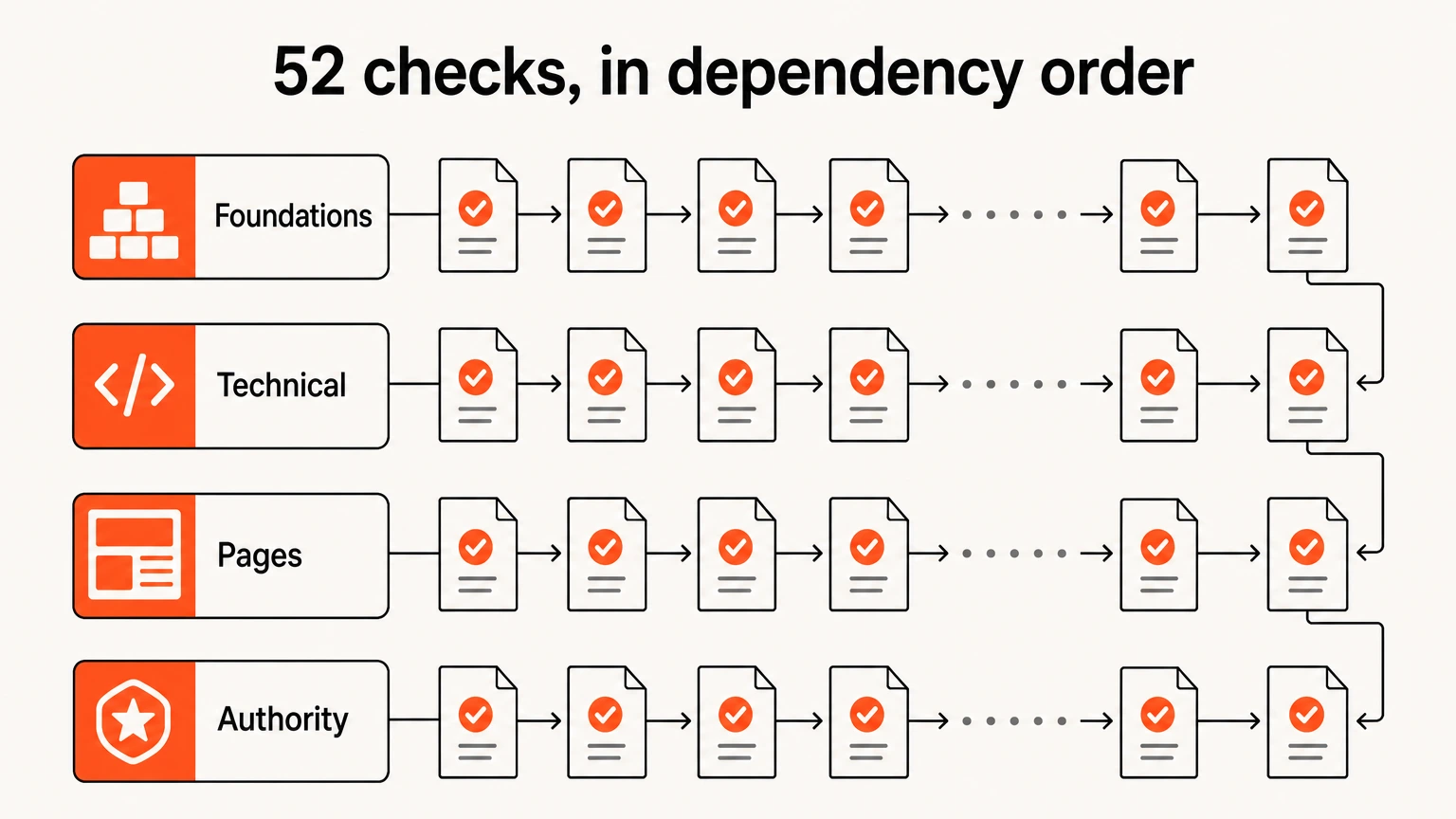
This is the list we work through on every SaaS engagement, in the order we work through it. The ordering carries most of the value: the items are dependent, and running them out of sequence is how audits produce fifty findings and no improvement.
A SaaS SEO checklist should cover six areas in dependency order: measurement foundations, SaaS-specific technical checks, keyword mapping scored on contract value, the commercial page types SaaS sites must own, AI search visibility, and authority. Most published checklists cover generic on-page work and skip all six of the parts specific to software.
52 checks below, all tickable. Nothing is saved, so a refresh resets it. If you only have an afternoon, do the foundations and the technical section; the rest depends on them.
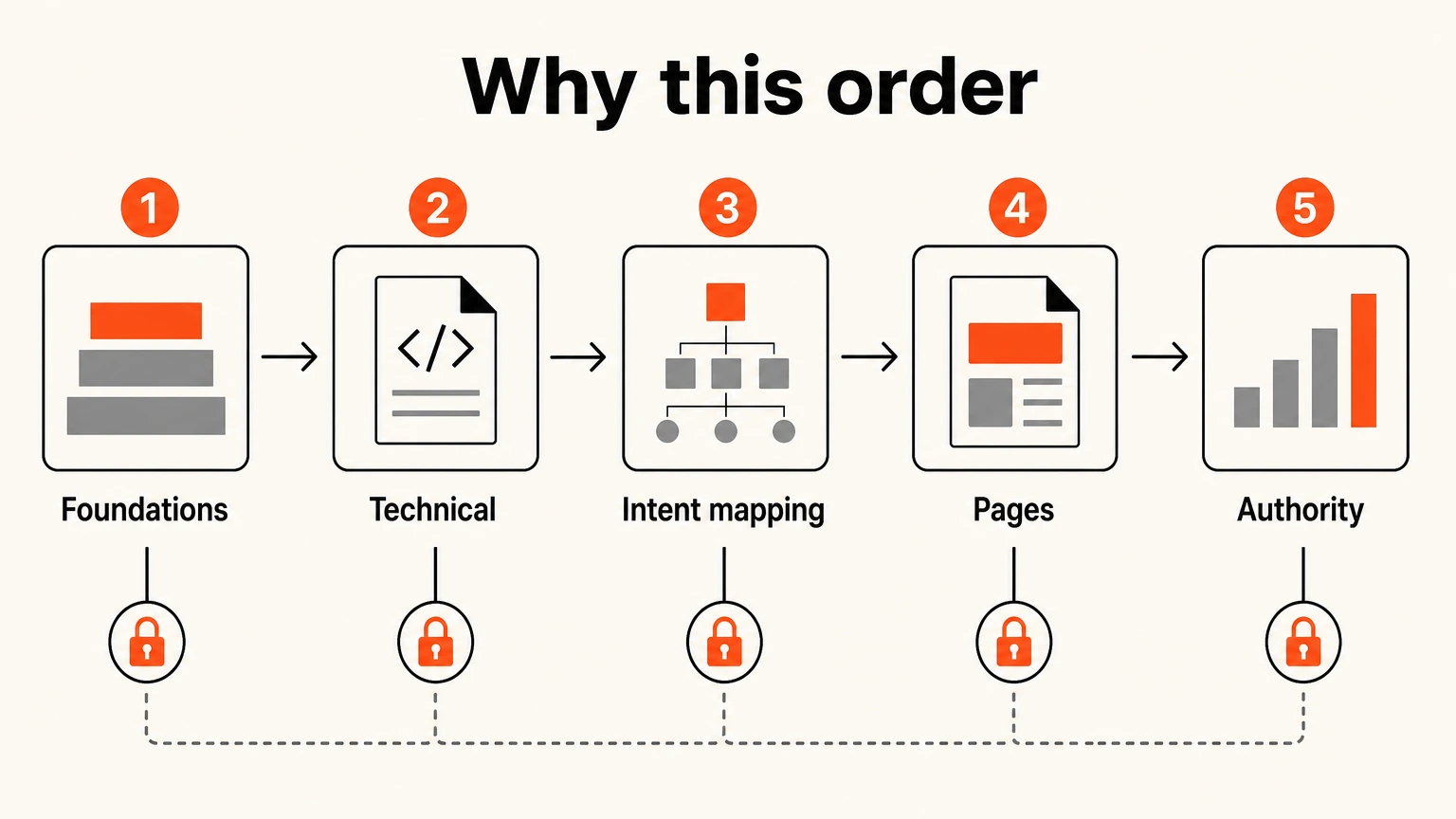
Why this order, and why SaaS is different
Generic SEO checklists are not wrong, they are just calibrated for a business where the conversion is a purchase and the site is server-rendered. Software companies differ in five ways that change the work substantially.
- The conversion is a trial or a demo, not a sale, so the funnel continues long after the page does its job.
- The marketing site is usually a JavaScript framework, because the team that built the product built the site.
- Comparison and alternative searches decide deals, and they are a page type most checklists never mention.
- Contract value varies enormously, so search volume is close to useless as a prioritization signal.
- Documentation competes with marketing pages, which is a problem almost unique to software.
Hence the ordering. Measurement first, because without contract value and conversion rate you cannot prioritize anything. Then technical, because content published onto a site crawlers cannot render is wasted. Then intent, pages, AI visibility and authority, in that sequence.
Foundations
Do these before anything else. Each one changes what the rest of the list should prioritize.
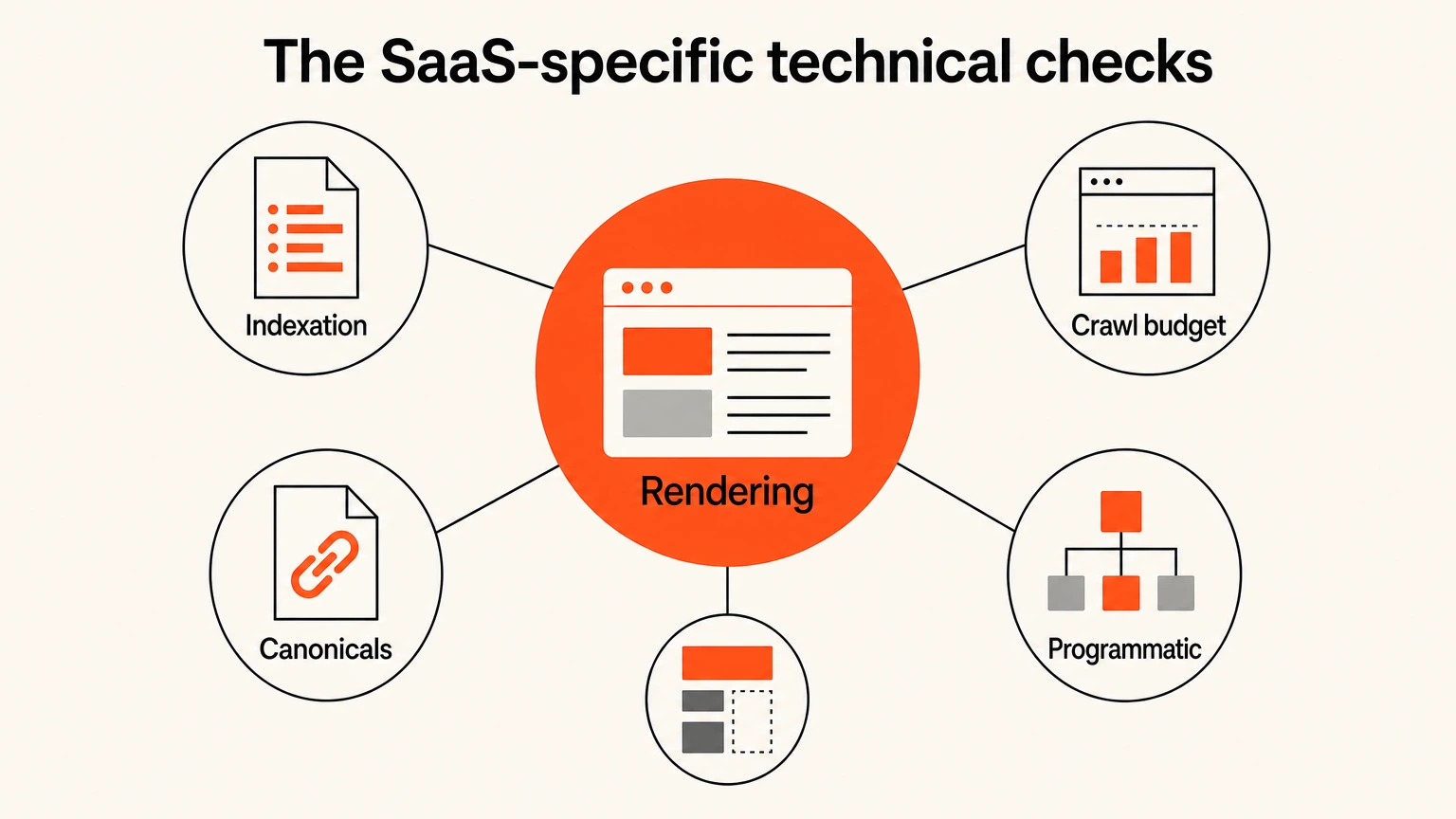
Technical, the SaaS-specific parts
Generic technical checklists miss most of these, and they are where SaaS sites actually break.
Keyword and intent mapping
Where SaaS SEO most often goes wrong, because the obvious approach is the incorrect one.
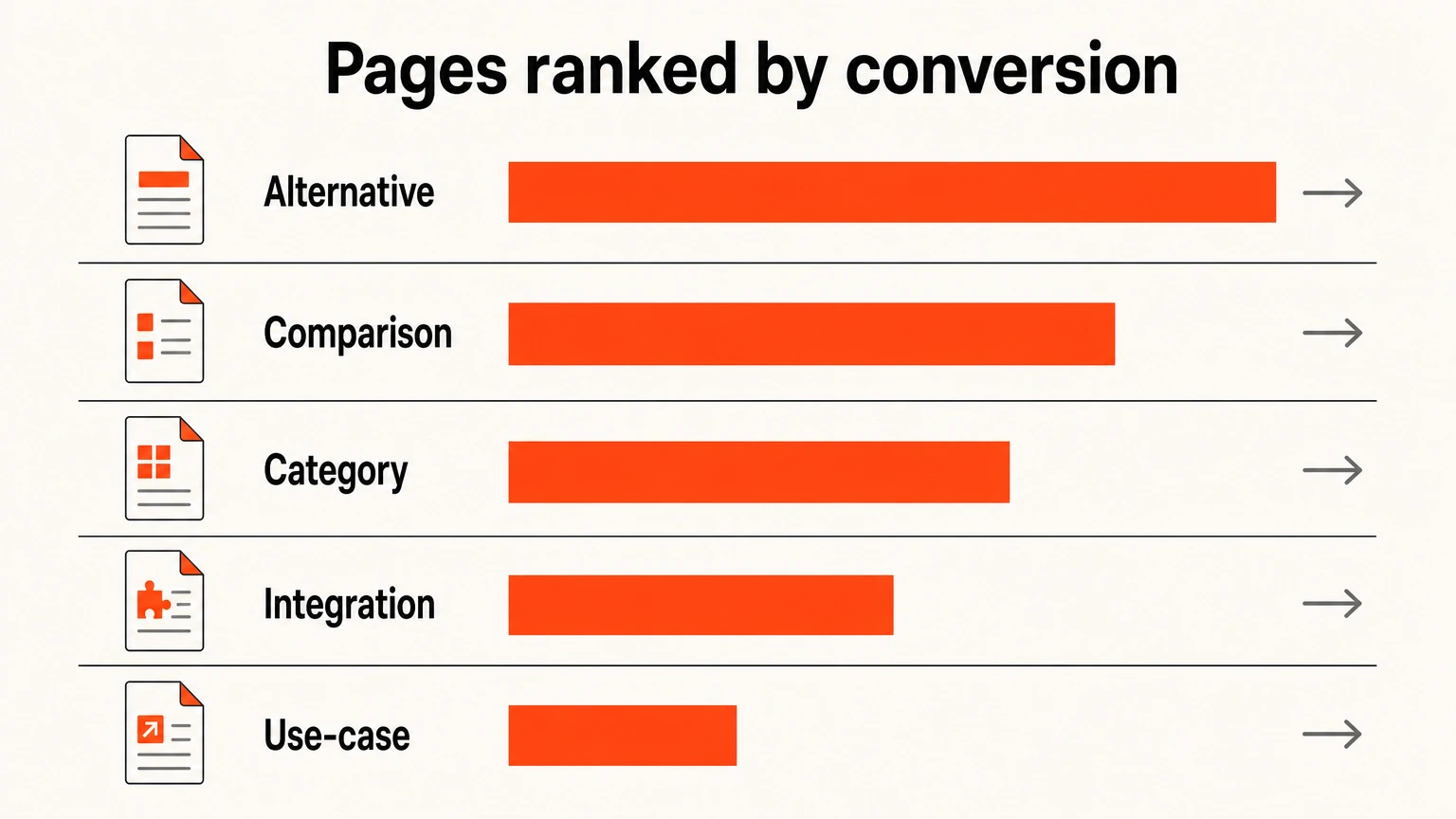
The pages SaaS sites must own
Ordered by how quickly each converts, not by how much traffic it attracts.
AI search visibility
The section most SaaS checklists still omit, and where shortlists now form.
Authority and measurement
The slowest work to pay and the first that should start. The software we run this section on is listed in the link building tools we use.
| Section | Checks | What it unblocks |
|---|---|---|
| Foundations | 7 | Measurement and access, so everything after it can be verified rather than assumed. |
| Technical, the SaaS-specific parts | 11 | Rendering, architecture and indexation. Nothing downstream works on a site engines cannot read. |
| Keyword and intent mapping | 8 | Which pages are worth building at all, mapped to buying stage and deal size. |
| The pages SaaS sites must own | 10 | The bottom-of-funnel set that converts to trials and demos. |
| AI search visibility | 8 | Being named when a buyer asks an assistant which tool to pick. |
| Authority and measurement | 8 | Earned links and the reporting that ties the work to pipeline. |
| Total | 52 | Run in this order, because each section depends on the one above it. |
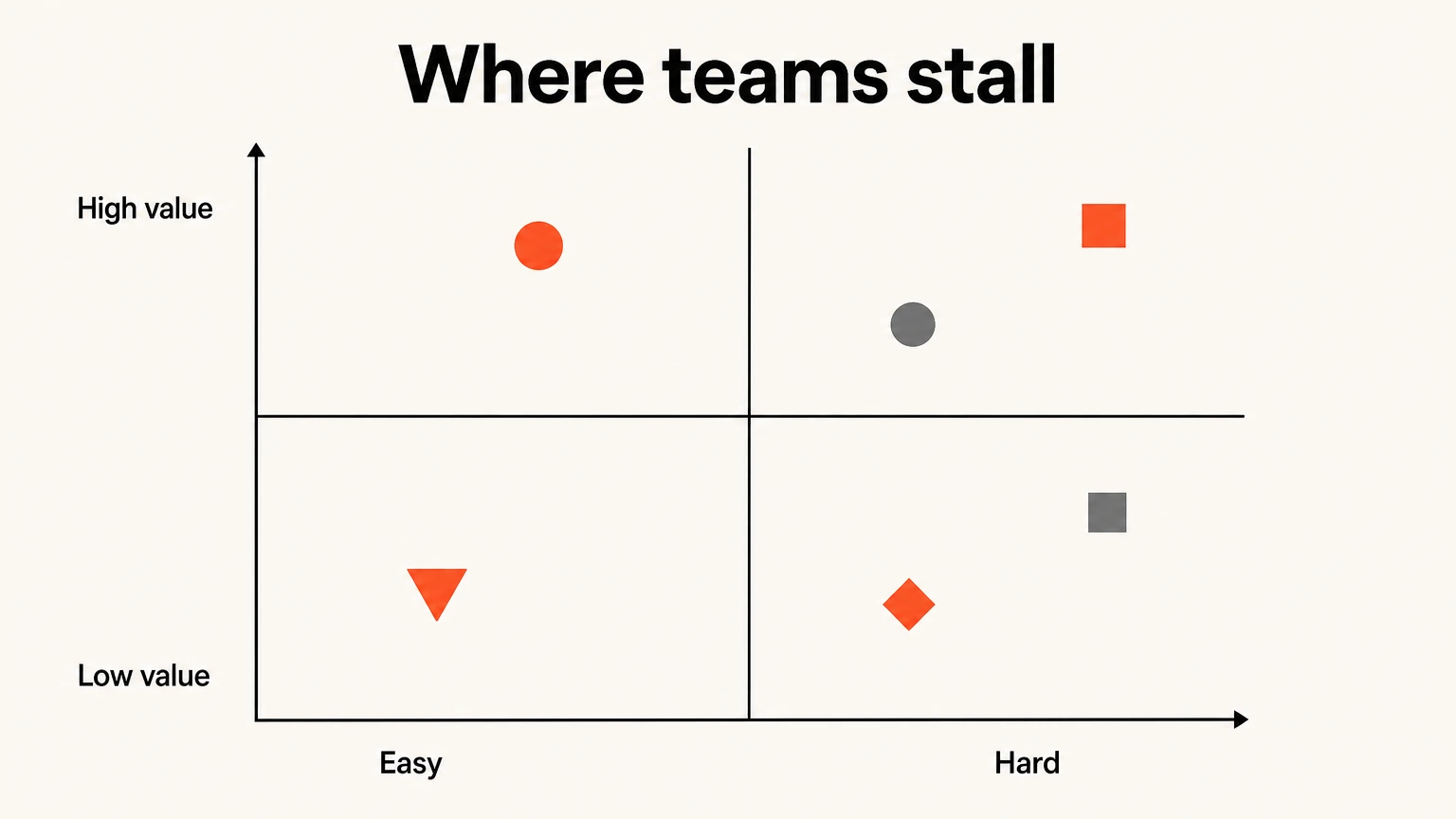
Where SaaS teams stall
Four failure patterns, each of which we have watched cost a quarter.
- Publishing before fixing rendering. Forty articles onto a site that does not serve content in HTML. Nothing ranks, and the diagnosis takes months because nothing looks broken.
- Chasing volume over contract value. Ranking for broad terms that bring readers, then concluding SEO does not work for your category.
- Building top of funnel first. Educational content compounds slowly. Bottom-funnel pages produce the early trials that fund patience for everything else.
- Technical fixes sitting in a backlog. The most common cause of a stalled program, and it is an organizational problem rather than a search one. Fix the approval path before the site.
This checklist is the first two weeks of every engagement
We run all 52 checks plus log file analysis and a full AI citation baseline across seven engines, then hand over a fix list ranked by revenue impact with effort estimates your engineers can plan against. The ranking is the deliverable. Producing fifty findings is easy.
- Ranked by revenue impact, not by severity score, because those are different lists
- Implementation specs your developers can act on without interpreting a finding
- Keyword mapping scored on your contract value, built from your sales call recordings
- We will tell you if you are too early. Roughly half of applications get that answer.
What to do once you have worked through it
- Fix indexation blockers first, whatever else the list says. Everything downstream depends on them.
- Ship two bottom-funnel pages before any educational content. Early trials buy patience for the slow work.
- Get attribution into the CRM in month one, not month six when someone asks whether it is working.
- Start authority work immediately. It is the slowest line item to pay and the one most teams start last.
- Re-run the technical section after every front-end deploy. Non-negotiable if you ship weekly.
For the general version applicable to any site, see the 34-point SEO audit checklist. For the AI section in depth, LLM SEO covers why retrieval favors certain structures. For what this costs to have run for you, the pricing guide has real numbers.
Frequently asked questions
What should a SaaS SEO checklist include?
How is SaaS SEO different from regular SEO?
What should a SaaS company do first in SEO?
Why does search volume not work for prioritizing SaaS keywords?
Which pages should a SaaS company build first?
How often should a SaaS company run this checklist?
Do I need an agency to run a SaaS SEO checklist?

Mohammad Qaiser
Working in SEO since 2010, founder of Authority Magnet since 2018, and campaign lead on every case study the agency publishes. Also built PRWiz, where this work gets tested on our own software before it reaches a client.
Work with us