AI search optimization for SaaS
Buyers now ask an assistant which tool to use and evaluate the three names it returns. GEO is the work of being one of those names, measured as citation share across seven engines, not asserted as a slide.
What is GEO for SaaS?
Generative engine optimization is the work of getting your product named and cited inside AI answers. ChatGPT, Claude, Perplexity, Google AI Overviews, Gemini, Grok and Bing, when a buyer asks which tool to use.
It matters because AI answers have become a shortlisting surface. A buyer asks which tool suits a team of twenty, receives three names, and evaluates those three. If you are not among them, you were never in the running, and no amount of Google ranking recovers that.
How AI engines pick which products to name
Models do not have opinions about software. They retrieve and synthesize. Understanding what they retrieve from is the entire discipline.
- Category roundups. "Best X software" listicles are the single most-quoted source type for buying questions.
- Comparison articles. Both third-party and vendor-published, which is why your own comparison pages matter twice.
- Review platforms. G2, Capterra and TrustRadius carry disproportionate weight because they are structured and consistently updated.
- Community threads. Reddit and Hacker News discussions where practitioners name tools unprompted.
- Your own pages, but only when they are structured cleanly enough to lift a claim from.
Most of your AI visibility is decided on pages you do not own. That makes digital PR and placement work a direct acquisition activity rather than a branding nicety, which is why we compared the firms doing it in the best digital PR agencies.
What GEO work actually involves
Four workstreams, run together and measured as one number.
Off your site
Where most citations are decided- Placement in the category roundups models quote
- Review-platform presence and profile completeness
- Correcting inaccurate third-party descriptions of your product
- Earned mentions in publications with retrieval weight
On your site
Making pages quotable- Direct answers in the first two sentences, before preamble
- Explicit definitions written as "X is Y"
- Tables and specific numbers, which extract far more reliably than prose
- Named authors, dates and schema that raise trust signals
How we measure it
GEO is the most-claimed and least-measured service in the category right now. Ours is measured, and we baseline before changing anything so movement is provable rather than asserted.
- Build the prompt set. Twenty to fifty real buyer questions, sourced from your sales calls rather than invented.
- Baseline across seven engines. ChatGPT, Claude, Perplexity, Google AI Overviews, Gemini, Grok and Bing, recorded before any work starts.
- Record position and sentiment. Named first, named as a budget option, or mentioned as a caveat: these are very different outcomes.
- Log source composition. Which pages the answer drew on tells you exactly where to work next.
- Benchmark against named competitors. Citation share is relative. Knowing who owns the answer is the strategy.
- Re-run on a fixed schedule and report movement per engine, because they diverge sharply.
How each AI engine sources its answers
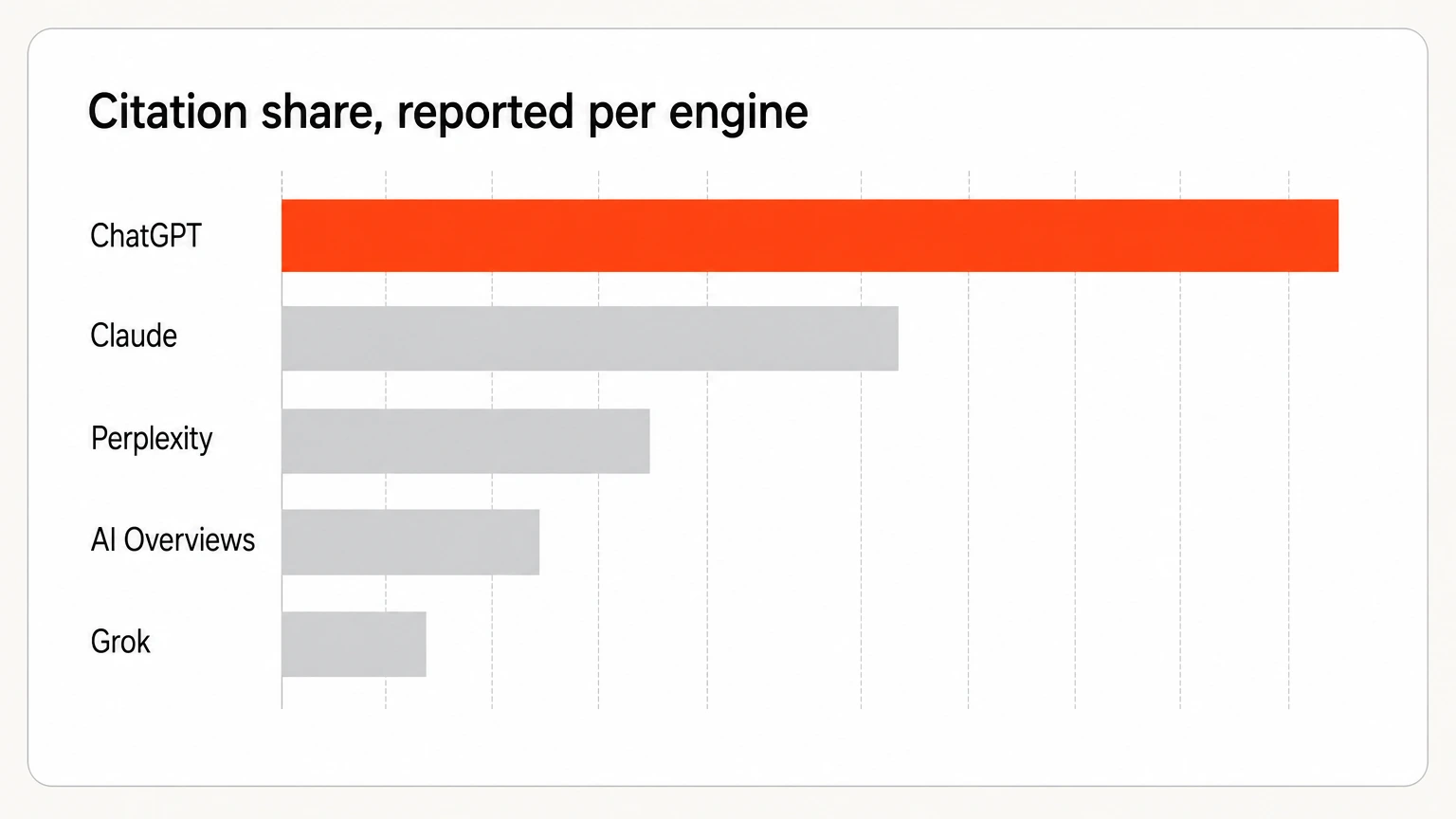
Treating "AI search" as one surface is the most common mistake. Citation patterns diverge sharply, and a strategy that works on one engine can be invisible on another.
| Engine | How it sources | What moves it |
|---|---|---|
| ChatGPT | Live retrieval plus training data, leaning on established, well-linked sources | Category roundups and long-standing authority |
| Claude | Retrieval with a visible preference for structured, factually dense pages | Clear definitions, tables, self-contained claims |
| Perplexity | Heavy live search, cites aggressively and visibly | Ranking well on the underlying query still matters most |
| Google AI Overviews | Drawn largely from pages already ranking | Classic SEO, plus snippet-friendly structure |
| Gemini | Google index plus its own synthesis | Entity clarity and structured data |
| Grok | Weights real-time social discussion unusually highly | Community presence, particularly on X and Reddit |
| Bing Copilot | Bing index, often overlooked entirely | Bing Webmaster Tools hygiene, which almost nobody does |
Perplexity and AI Overviews reward classic SEO, so good rankings carry you. ChatGPT and Claude reward third-party consensus and structure, which needs deliberate work. Grok rewards community presence most teams have never built. This is why we report per engine rather than as one number.
When AI describes your product wrongly
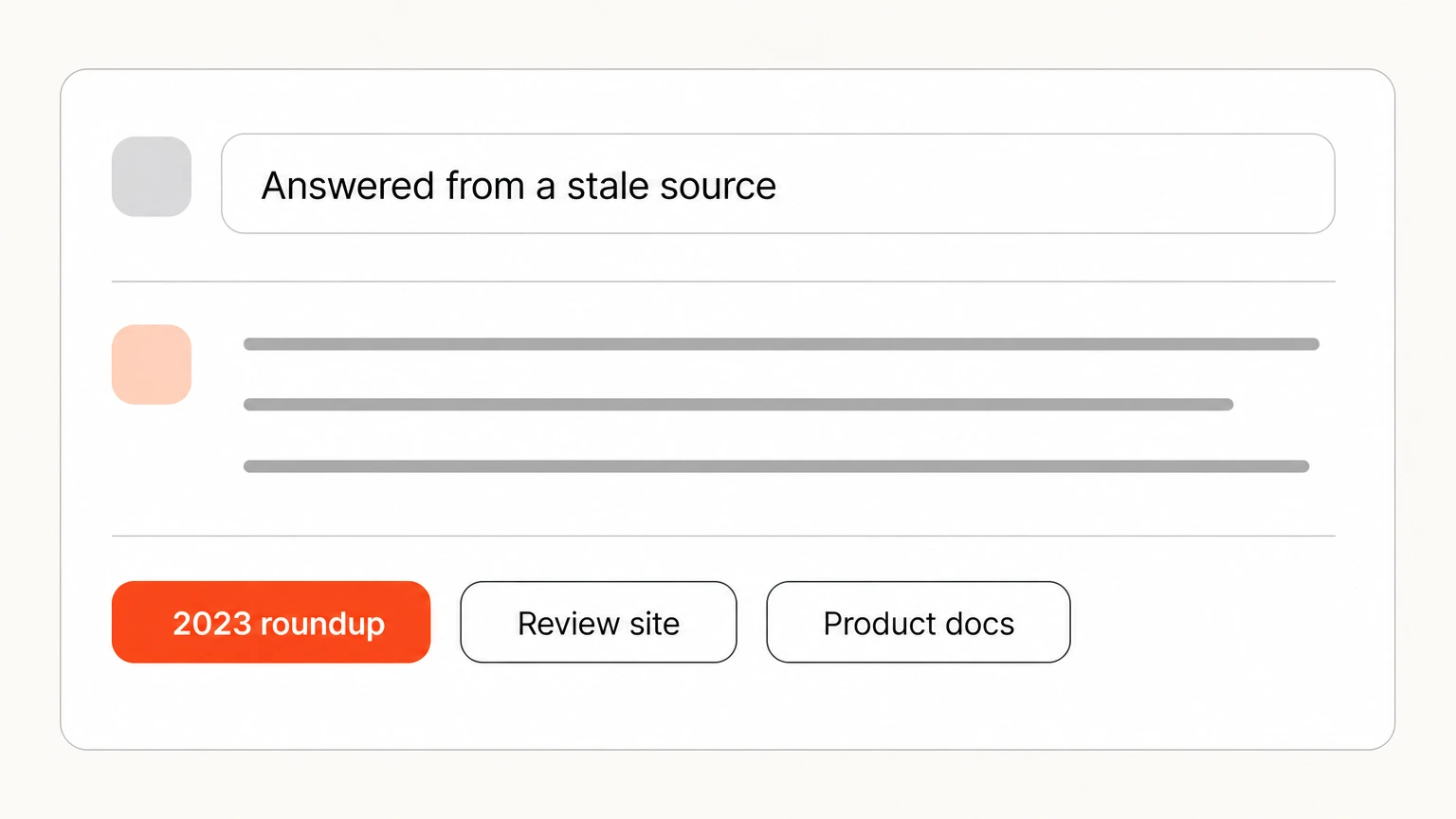
A common and expensive problem: models confidently state your product lacks a feature it has had for two years, or price it wrongly, or describe it as being for a segment you abandoned. This happens because the model learned from stale third-party content, and it does not correct itself.
- Find the source. Ask the engine directly what it is basing the claim on. The citation usually points straight at an outdated roundup or review.
- Get the source corrected. Contact the publisher with the accurate information. Most update willingly, since their content being wrong is their problem too.
- Publish an unambiguous correction on your own site. A clear, dated, factual page stating the current position, structured so it is trivially extractable.
- Seed the correct version in newer third-party content. New roundups and comparisons carry more weight than old ones over time.
- Re-check on schedule. Corrections propagate over weeks, not days, and inconsistently across engines.
An incorrect AI description is worse than absence. A buyer who is told you lack a critical feature never visits your site to discover otherwise. We audit for this on every engagement because it is often the highest-value fix available in week one.
Building the prompt set
The prompt set is the whole measurement system. Get it wrong and you track questions nobody asks.
Sales calls, not brainstorming. The questions your prospects actually ask a rep are the questions they ask an AI first. Inventing prompts produces a tidy dashboard measuring nothing.
What GEO cannot do
This is the least mature service in the category, which makes it the easiest to oversell. Some things are worth being sceptical about, including when we say them.
Not possible
- "We can make ChatGPT recommend you." Nobody has a lever into the model. What exists is influence over the sources it reads.
- "Guaranteed AI citations." Outputs vary between sessions and change without notice.
- "We optimize your llms.txt." A proposed convention with no confirmed adoption by major engines. Harmless, but not a strategy.
- "Results in 30 days." Source material has to be published, crawled and absorbed. That takes longer.
- "GEO replaces SEO." Google still sends most high-intent traffic, and several engines draw straight from its index.
Genuinely achievable
- Measurable citation-share movement across engines over eight to twelve weeks
- Correcting inaccurate descriptions of your product, often the fastest win available
- Presence in the roundups that engines retrieve when assembling shortlists
- Structural improvements that lift both citations and classic rankings simultaneously
- Competitive intelligence, knowing precisely who owns the answer in your category
What is GEO (generative engine optimization)?
What is the difference between GEO, AEO and SEO?
How do AI engines decide which SaaS products to recommend?
Can you actually influence what ChatGPT says about a product?
How do you measure AI search visibility?
Does traditional SEO still matter if AI search is growing?
Find out what AI says about you today
We baseline your citation share across seven engines before proposing anything. If you already dominate the answers, we will tell you that too.
Baseline first · Measured per engine · From $5,000/mo