SaaS SEO services
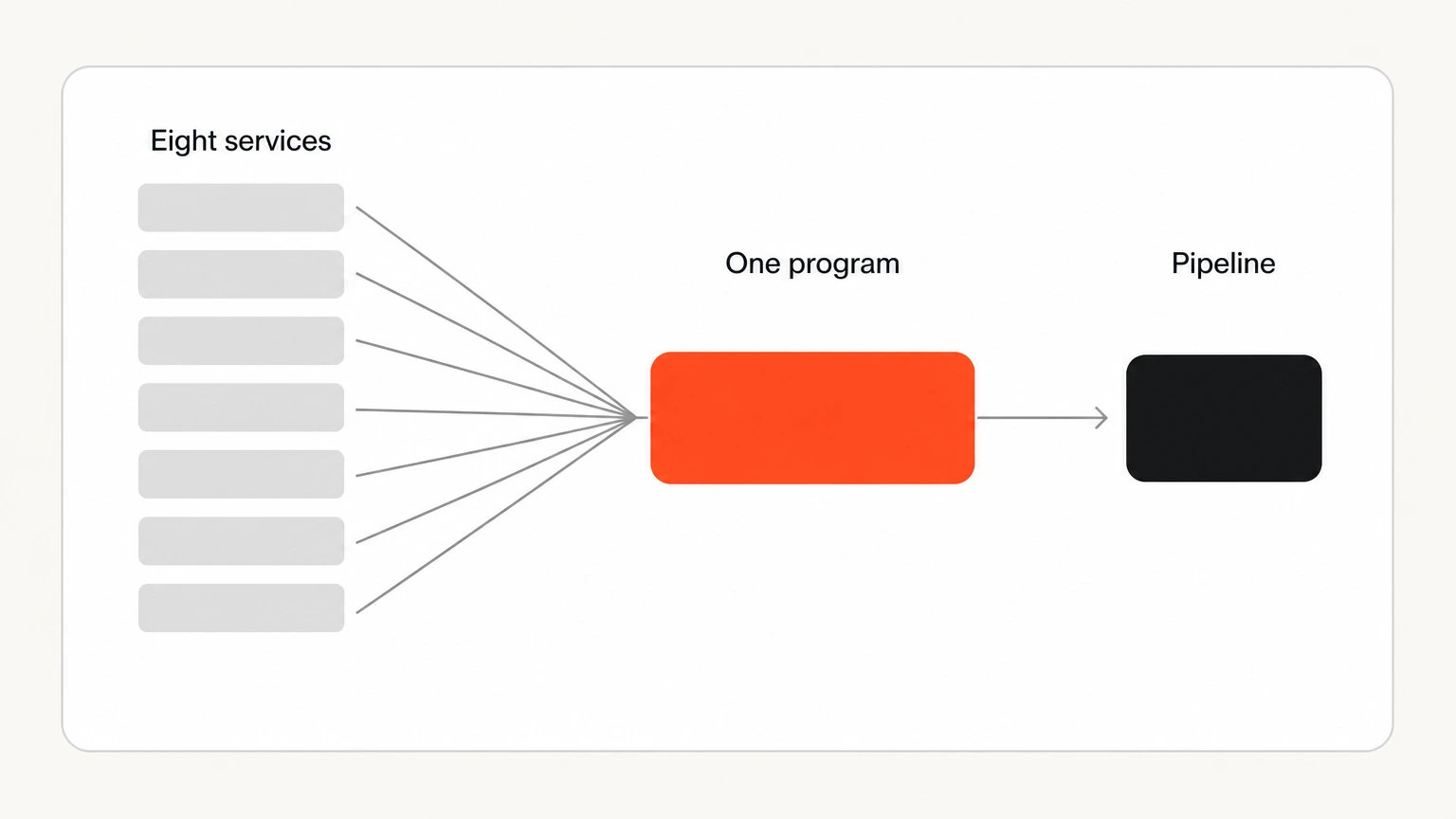
Eight services, run as one program rather than a menu. Technical first, bottom-of-funnel second, authority underneath, because the order decides whether any of it produces revenue.
What SaaS SEO services cover
A full SaaS SEO program runs eight services: technical SEO, intent research, bottom-of-funnel page production, product-led content, digital PR and links, AI search optimization, conversion work, and pipeline attribution. Most engagements combine three or four.
We sell them as one system rather than a menu, because they compound. Links make pages rank. Technical work makes them indexable. Conversion work makes the rankings worth having. Bought separately, each one underperforms.
SaaS SEO services we run
Each links to a full page explaining the work, what it costs to get wrong, and how we approach it.
Technical SEO for SaaS
Start hereJavaScript rendering, app-shell indexation, crawl budget, canonical logic and Core Web Vitals. The layer that decides whether anything else you publish can rank at all.
B2B SaaS SEO
Committee buyingLong cycles, multiple stakeholders and high contract values change which keywords are worth chasing and what a page has to do. Built around ACV rather than volume.
AI Search (GEO/AEO)
The new shortlistGetting named by ChatGPT, Claude, Perplexity, Google AI Overviews, Gemini, Grok and Bing when a buyer asks which tool to use. Measured as citation share, not vibes.
Content Strategy for SaaS
Product-ledComparison, alternative, use-case and integration pages written from sales-call language rather than keyword tools, with the conversion path defined before writing starts.
Digital PR & Link Building
Earned links and brand mentions from sources that move both rankings and AI citations.
⚡SaaS SEO Automations
AI agents running research, rank and citation monitoring, and reporting.
▲Attribution & reporting
Trials, PQLs, CAC payback and citation share wired into your CRM.
◆B2B SaaS marketing agency
The three agency types, and which one you actually need.
◎SaaS SEO consulting
Audit, strategy and roadmap for teams who have hands but need direction.
What each service actually involves
Service names mean very little in this category. Two agencies both selling "technical SEO" can do work that differs tenfold. Here is what sits behind each of ours.
Technical SEO
We compare what a crawler receives against what a browser shows. Then we check indexation coverage, crawl budget from log files, canonical logic on every template, click depth to your money pages, and Core Web Vitals per page type rather than one site-wide score. You get a fix list ranked by revenue impact, written so your engineers can act on it.
Intent research and keyword mapping
Sales calls first, keyword tools second. We pull the exact phrases your buyers use, the rivals they name unprompted, and the objections that keep coming up. Then we map each term to a buying stage and score it on your contract value rather than search volume. That usually flips the priority order teams arrive with.
Bottom-of-funnel page production
Comparison, alternative, category and integration pages. The conversion path goes in the brief before anyone writes. On comparisons we admit where a rival is genuinely better, because buyers discount one-sided pages and AI models now flag them.
Product-led content
Use-case pages written in the language of the job, not your feature names. Plus template libraries and free tools that solve one slice of the problem. These earn links on their own and show the product while they rank, so the visitor converts without a separate pitch.
Digital PR and earned links
We target the category roundups that pass authority and feed AI citations at the same time. Then original-data campaigns pitched to journalists, unlinked mention reclaim, and partner directory links. You see every placement with its live URL, anchor, real traffic, and whether that page ranks for anything.
AI search optimization
We build a set of twenty to fifty real buyer questions and run them across seven engines before we change anything. Then we re-run them on a schedule and log where you appear, how you are described, and which sources the answer used. Roughly seventy percent of the work happens on other people's pages, thirty percent on yours.
Conversion work
Not a separate CRO retainer. Every page we ship has a defined next step. We review conversion rate by page type each month, because one blended number hides the fact that comparison pages might convert at six percent while blog traffic converts under one.
Attribution and reporting
First-touch and last-touch fields in your CRM, page type tagged on every lead, a PQL threshold agreed with sales, and logged-in traffic stripped out so your own customers do not skew the numbers. Without this, none of the rest can prove its worth.
Which services you probably need
Matched to the symptom you have, not the full menu.
| Your situation | Start with | Add next |
|---|---|---|
| Publishing steadily, nothing ranks | Technical SEO | Digital PR once indexation is verified |
| Traffic rising, signups flat | Bottom-funnel pages + conversion work | Intent research to fix the keyword mix |
| Ranking well, absent from AI answers | AI search optimization | Digital PR into the sources models retrieve |
| Strong pages, no authority to rank them | Digital PR and earned links | Product-led linkable assets |
| Everything works, nothing scales | Programmatic pages | Automations for monitoring at volume |
| Cannot prove SEO's value internally | Attribution and reporting | Everything else, once you can measure it |
| Marketer in place, no roadmap | Consulting engagement | Selective execution support later |
What order to run SaaS SEO services in
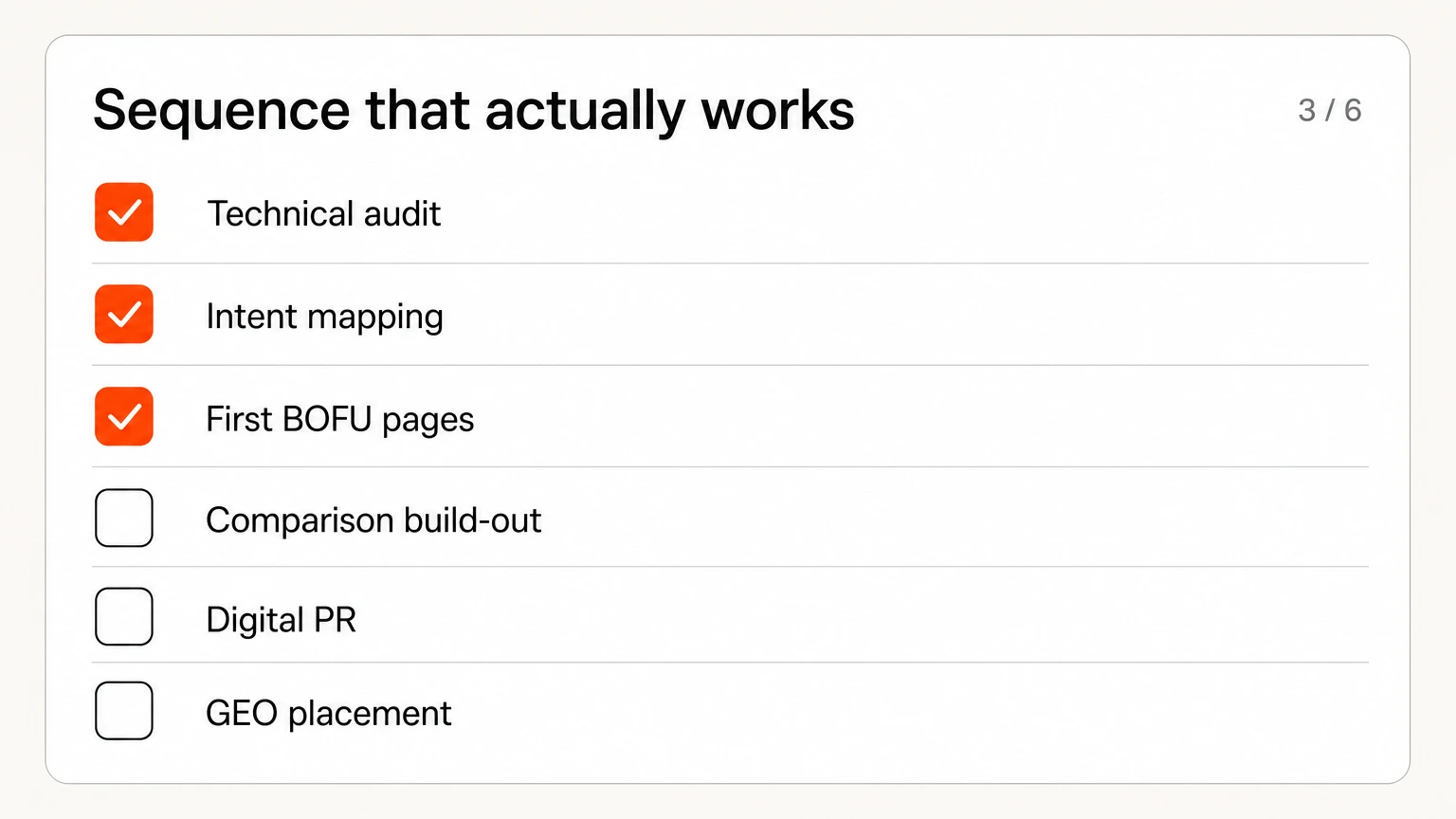
Running these in the wrong sequence is the most common way a well-funded SaaS SEO program produces nothing.
Months 1–2
Foundation and first revenue- Technical audit and indexation fixes
- Intent mapping from sales calls, not tools
- First bottom-of-funnel pages live
- AI citation baseline recorded
Months 3–6
Compounding- Full comparison and alternative build-out
- Programmatic integration and use-case pages
- Digital PR and earned links
- GEO placement in the sources AI quotes
Five ways teams buy the wrong services
Every one of these is common, and every one wastes a quarter.
Buying the wrong thing
- Content before technical. The most expensive mistake there is. Pages on a site Google cannot render will not rank, and you will not know for months.
- Links before pages worth linking to. Outreach with nothing useful to point at is just cold email with a worse response rate.
- GEO as a bolt-on. Adding "AI search" to a content retainer with no measurement is a rename, not a service.
- Programmatic pages too early. Four hundred thin pages on a weak domain creates a quality problem instead of a growth channel.
- Everything at once. Spreading a $5,000 budget across eight services buys a thin slice of each and moves none of them.
Buying in the right order
- Verify indexation first. Cheap and fast, and it tells you whether anything else can work.
- Ship two bottom-funnel pages next. Early trials fund patience for the slower work.
- Baseline AI citations before changing anything. Otherwise you cannot prove movement later.
- Start authority work early even though it pays late. Links take months, so month one is the right time.
- Wire up attribution before you need it. Two weeks of setup that decides every future budget conversation.
When each service starts paying
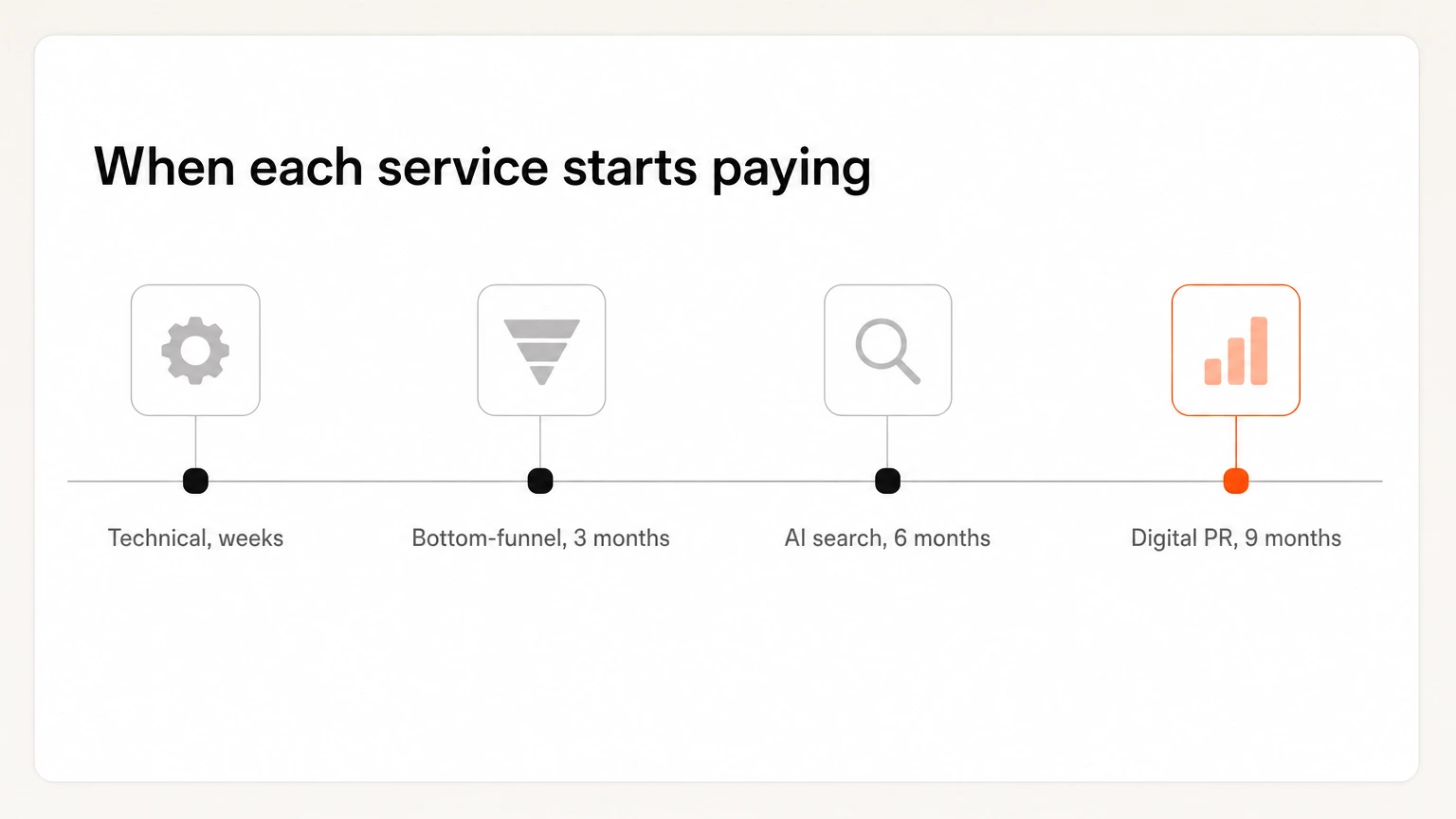
Different services have very different payback curves. Knowing which is which is the difference between a program that survives to month six and one that gets cut at month four.
| Service | First signal | Real payback |
|---|---|---|
| Technical SEO | Days, indexation data moves immediately | Weeks. Often the fastest win available. |
| Bottom-funnel pages | 4–8 weeks to rank | 2–3 months to steady trial volume |
| Conversion work | Immediate on existing traffic | Instant. The cheapest lever if you already have visitors. |
| Attribution setup | 2 weeks | Pays every time you defend the budget |
| AI search / GEO | 4–8 weeks for citation movement | 3–6 months for meaningful share |
| Digital PR and links | 6–12 weeks for placements | 4–9 months. Slowest to pay, needed earliest. |
| Product-led content | 3–6 months | 12 months+, then compounds indefinitely |
| Programmatic pages | Weeks once technical is sound | 3–6 months, and only after the base is clean |
Digital PR is slowest to pay and needs to start earliest. That tension is why so many programs fail: teams delay link work until month four because it has no visible return, then wonder why their pages still do not rank at month nine.
What services does a SaaS SEO agency provide?
Which SaaS SEO service should I start with?
Do you offer SaaS SEO services separately or only as a bundle?
How quickly do SaaS SEO services produce results?
Do you write the content or do we?
Can you work with our existing marketing team?
Which of these do you actually need?
Tell us the site and the bottleneck. We will tell you which two or three services would move it, and which ones would be a waste of your money.
From $5,000/mo · No lock-in · Reply within 24h