SaaS SEO automations
AI agents run the repetitive layer, research, monitoring across seven AI engines, crawl alerting, reporting. Senior operators keep the decisions with consequences. Here is exactly where we draw that line, and why it changes the pricing.
What are SaaS SEO automations?
AI agents and scripted workflows that run the repetitive layer of a search program. Research, rank and citation monitoring, crawl alerting, internal linking and reporting, so senior time goes to strategy and judgment.
This is not a separate product we sell you. It is why our retainers cover more scope than the hours would otherwise buy.
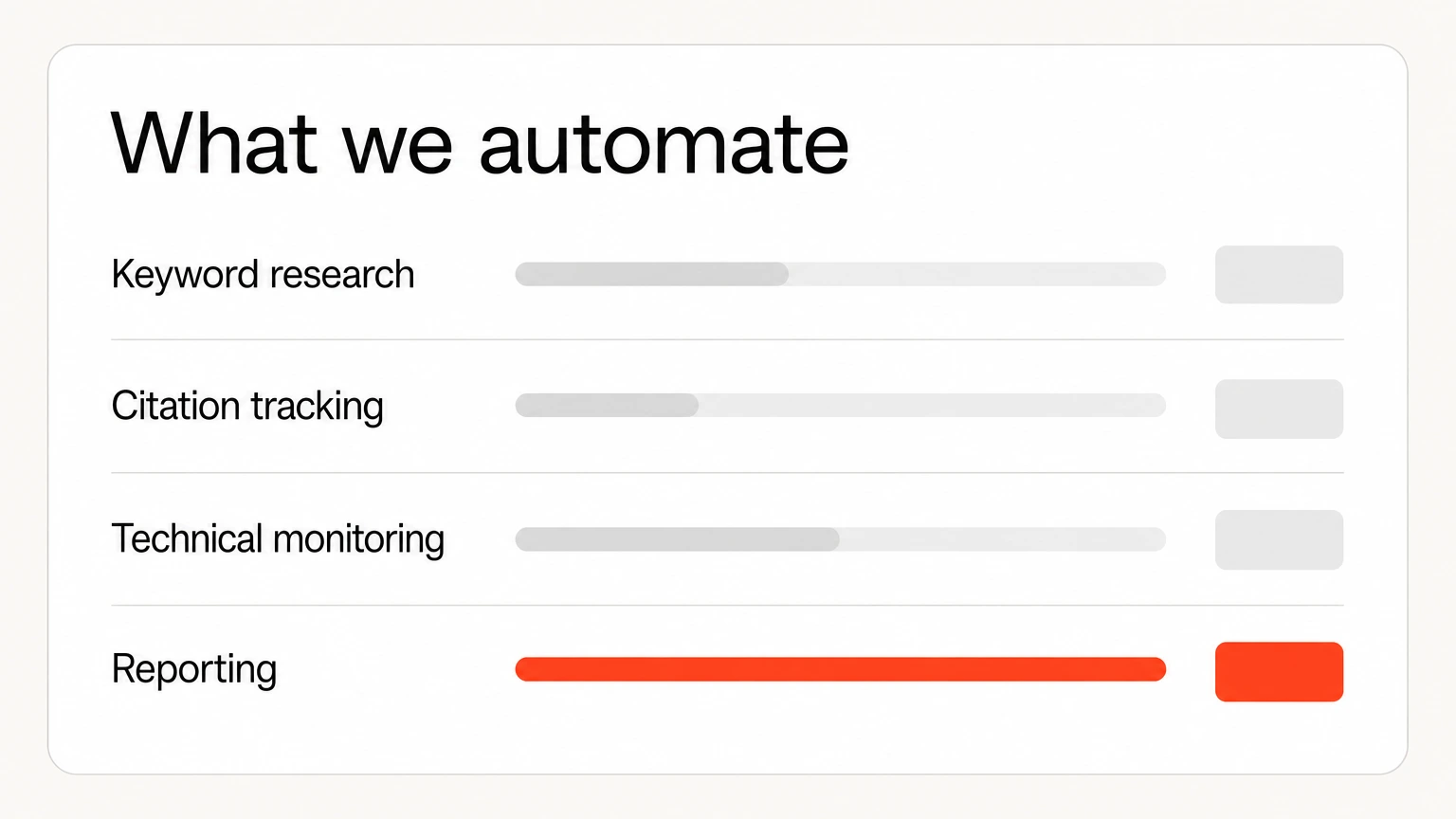
What we automate, and what we never will
The split is not about capability. It is about which decisions carry consequences a model cannot weigh.
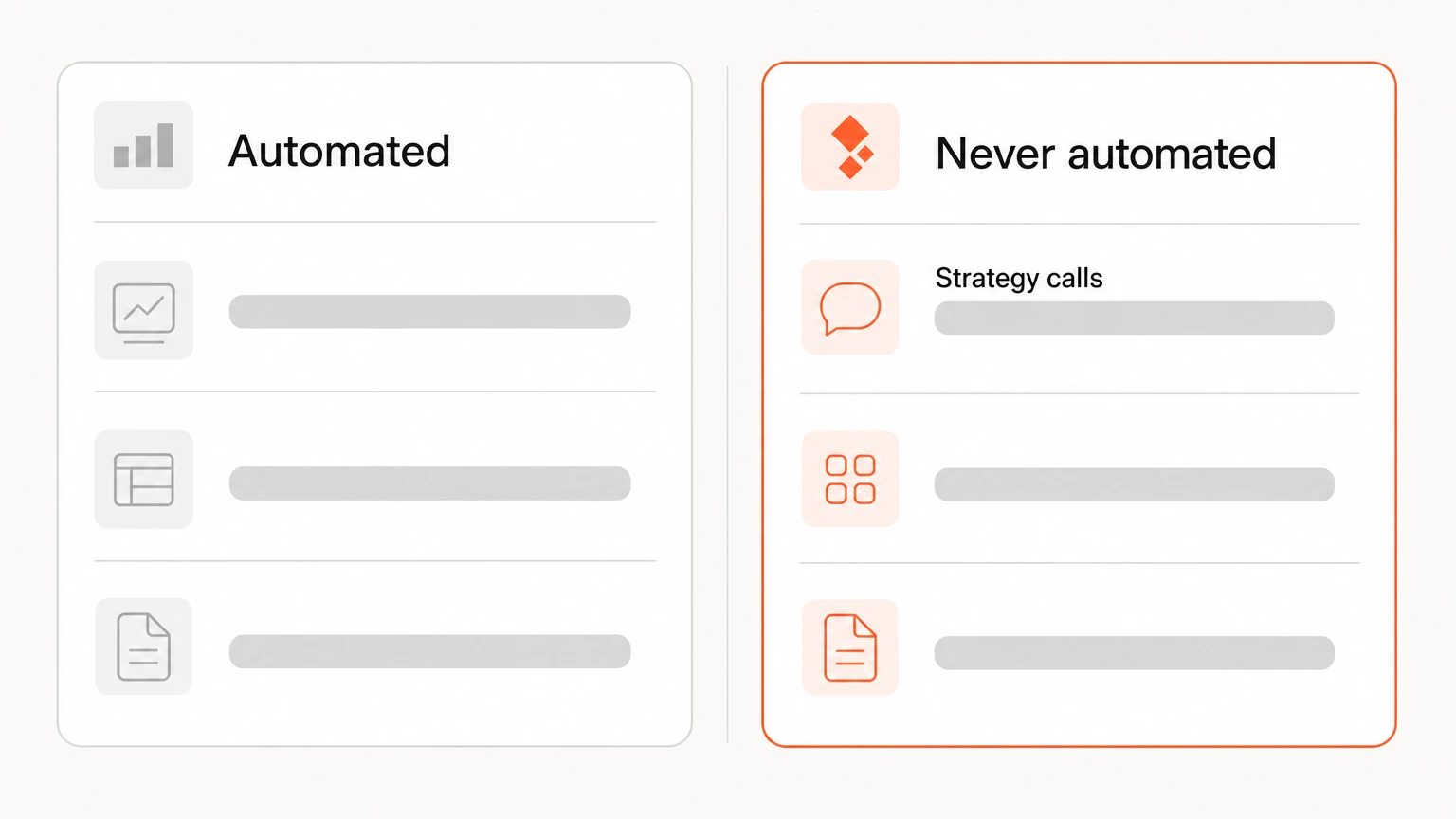
Automated
- Keyword and competitor research. Clustering thousands of queries by intent, continuously rather than quarterly.
- Rank monitoring. Daily position tracking on commercial terms with movement alerts.
- AI citation monitoring. A fixed prompt set across seven engines on schedule, results logged for trend analysis.
- Crawl and indexation alerting. Detecting when pages drop out of the index before it shows up in traffic.
- Internal link detection. Surfacing every place a new page should be linked from.
- Reporting assembly. Pulling from Search Console, analytics and CRM into one continuously updated view.
- Content decay monitoring. Flagging pages losing position before the traffic loss compounds.
Never automated
- Which opportunity to pursue. Forty options, one roadmap. That trade-off needs your ACV and priorities, not a score.
- Whether a technical fix is worth it. Engineering time is expensive; some issues are not worth the sprint.
- Product positioning and nuance. Where generic pages come from, and instantly visible when it goes wrong.
- Final voice and specific claims. Rewritten by a person with product access and sales transcripts.
- Comparison page honesty. Deciding which competitor strength to concede is a commercial judgment.
- What to tell you when it is not working. That conversation is the job.
| Task | Automated? | Why |
|---|---|---|
| Keyword and competitor research | Automated | Clustering thousands of queries by intent is repetitive and rule-based, so it runs continuously rather than quarterly. |
| Rank monitoring | Automated | Daily position tracking on commercial terms with movement alerts. |
| AI citation monitoring | Automated | A fixed prompt set across seven engines on schedule, logged for trend analysis. |
| Crawl and indexation alerting | Automated | Catches pages dropping out of the index before it shows up in traffic. |
| Internal link detection | Automated | Surfaces every place a new page should be linked from. |
| Reporting assembly | Automated | Pulls Search Console, analytics and CRM into one continuously updated view. |
| Content decay monitoring | Automated | Flags pages losing position before the traffic loss compounds. |
| Which opportunity to pursue | Never | Forty options and one roadmap is a trade-off that needs your ACV and priorities, not a score. |
| Whether a technical fix is worth it | Never | Engineering time is expensive and some issues are not worth the sprint. |
| Product positioning and nuance | Never | This is where generic pages come from, and it is instantly visible when it goes wrong. |
| Final voice and specific claims | Never | Rewritten by a person with product access and sales transcripts. |
| Comparison page honesty | Never | Deciding which competitor strength to concede is a commercial judgment. |
| What to tell you when it is not working | Never | That conversation is the job. |
What SEO automation changes in practice
Concrete before-and-after from work we run every week.
Because it explains the pricing. A $10,000 retainer that includes technical work, content, links and AI-search measurement only adds up if the research and monitoring layer costs hours rather than days. That is the trade we are passing on.
Building this yourself
Nothing here is proprietary. If you have engineering time and want to run it in-house, this is the order we would build in and roughly what each step takes.
- Search Console to a warehouse. The API retains more history than the interface shows, and you will want that comparison in a year. A day's work, and the highest-value thing on this list.
- Scheduled rank tracking on commercial terms only. Not every keyword. The twenty to fifty that carry revenue, checked daily with alerts on movement.
- An indexation watcher. Compare published URLs against indexed ones weekly and alert on the delta. Catches technical regressions weeks before traffic moves.
- The AI prompt runner. Your buyer questions against each engine's API on a schedule, results stored with timestamps. Two to three days to build, and almost nobody has one.
- Content decay detection. Flag pages losing position quarter over quarter, before the traffic loss compounds.
- Internal link suggestions. When a new page publishes, surface every existing page that should link to it.
Not the building, the maintaining. Engine APIs change, selectors break, schedules silently fail. An automation nobody has verified in three months is usually reporting stale data confidently, which is worse than having no automation at all.
Where automation stops helping
Concrete examples, because "AI can't replace judgment" is easy to say and vague enough to be useless.
What are SaaS SEO automations?
Can AI replace an SEO agency?
What SEO tasks should be automated?
How do you monitor AI citations at scale?
Do automations replace your team or add to the cost?
Will AI-generated SEO work get penalized?
More scope for the same fee
Automation is why a $10,000 retainer covers technical, content, links and AI-search measurement. Tell us what you need built.
Included, never billed separately · From $5,000/mo