Content strategy for SaaS
Twenty strong commercial pages beat two hundred thin blog posts. Which pages to build first, what goes in the brief before anyone writes, and how to use AI without producing pages a competitor could publish by swapping the product name.
What is SaaS content strategy?
SaaS content strategy decides which pages you build, in what order, for which buyer intent, with what conversion path defined before writing starts. For software it weights heavily toward commercial pages, with educational content underneath to earn the authority those pages need.
The common failure is inverting that: six months of awareness blogging before a single comparison page exists, then a conclusion that SEO does not work.
What to build, in priority order
Ranked by how quickly each converts, not by how much traffic it attracts.
| Page type | Buyer state | Priority & note |
|---|---|---|
| Alternative pages | Actively leaving a competitor | First. Highest intent in SaaS. One page per meaningful rival. |
| Comparison pages | Shortlisting, budget approved | First. Convert 2–3× blog traffic. Honesty is the conversion lever. |
| Qualified category pages | Defining requirements | Second. "For agencies", "for enterprise", the qualifier filters for fit. |
| Integration pages | Checking stack compatibility | Second. Programmatic, uncontested, high converting. |
| Use-case pages | Matching product to their job | Second. Written in their language for the job, not your feature names. |
| Free tools & templates | Solving one slice now | Third. Earns links passively, demonstrates competence. |
| Problem-aware guides | Does not know tools exist | Third. Converts poorly first visit, earns the authority everything else needs. |
| Thought leadership | Not buying | Last. Real value for brand and links. Never the starting point. |
The brief decides the outcome
Most weak SaaS content was weak before anyone wrote a word. These go into every brief we produce.
Where AI belongs in the process
We use AI heavily and say so, because pretending otherwise in 2026 is theatre. What matters is which parts of the job it is trusted with.
- Research and clustering, yes. Grouping hundreds of queries by intent is exactly the kind of work models do well.
- Outlining from a strong brief, yes, with the brief written by a human who talked to your sales team.
- First drafts of structured pages, yes for integration and comparison pages with consistent shape.
- Product nuance and positioning, no. This is where generic pages come from, and it is instantly visible.
- Final voice and specific claims, no. Rewritten by a person with product access and sales-call transcripts.
Read the finished page and ask whether a competitor could publish it by swapping the product name. If they could, it will not rank and it will not convert, regardless of who or what wrote it.
How to write a comparison page that converts
The highest-value page type in SaaS, and the one most teams write badly. Seven rules, learned from pages that worked and pages that did not.
Structure
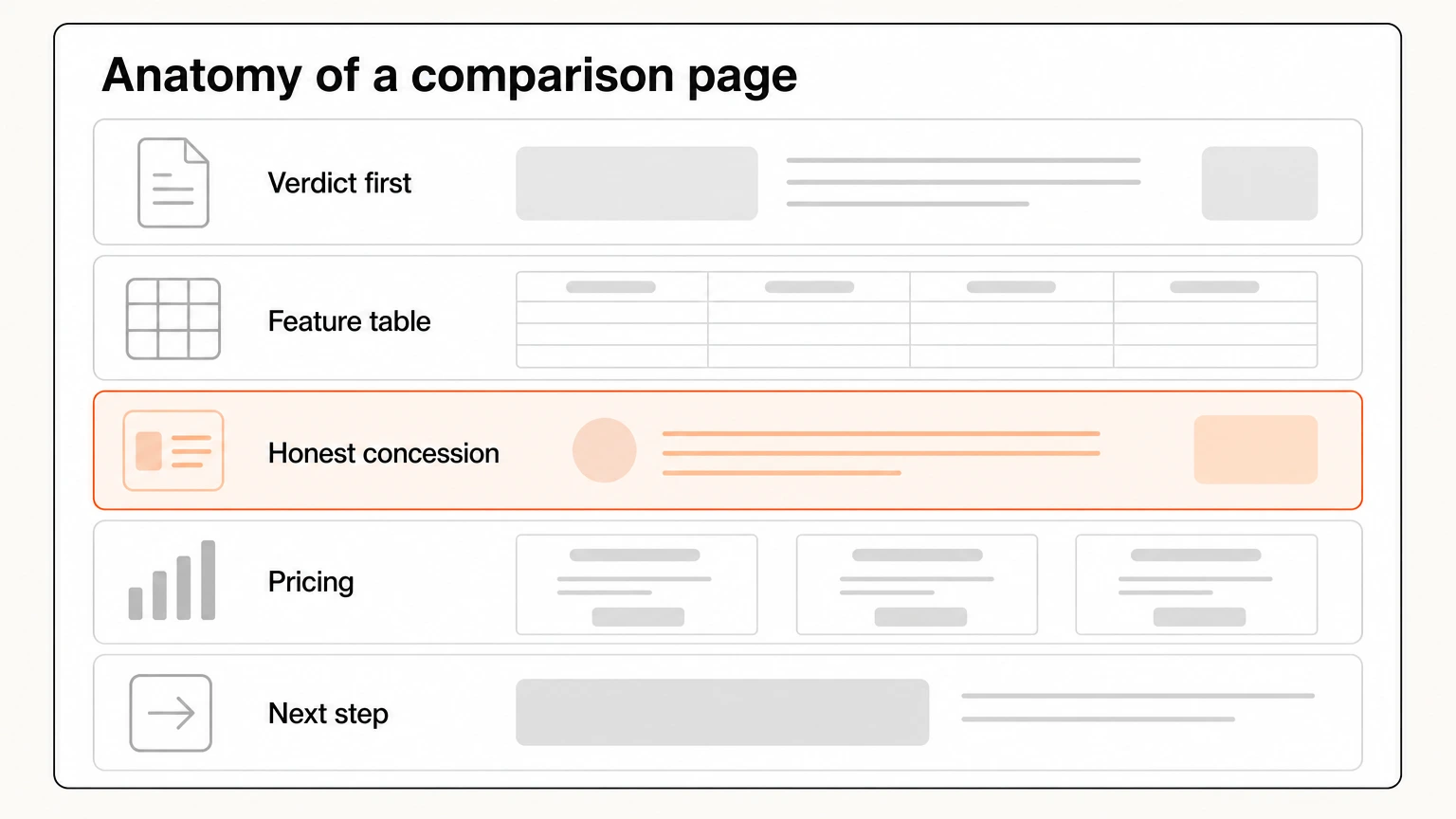
What goes where- A verdict in the first two sentences. Who each tool suits, before any detail
- A comparison table above the fold, because most visitors will not scroll
- Sections by buyer criterion, not by feature list
- Pricing stated plainly, including where they are cheaper
- A migration section, since switching cost is the real objection
Credibility
What earns the conversion- Concede at least one genuine competitor advantage, specifically
- Name the buyer for whom the competitor is the better choice
- Use their current public pricing, dated, not a figure from 2023
- Avoid strawman comparisons against a plan nobody buys
- Include a screenshot of your own product doing the thing you claim
Models increasingly flag one-sided vendor comparisons and decline to cite them. An honest comparison page is now both a conversion asset and a citation asset, which changes the return on writing it properly.
Maintaining content, not just publishing it
A SaaS content library decays faster than most because competitor pricing changes, your own features ship weekly, and integration lists go stale. Pages that ranked well eighteen months ago quietly stop converting long before they stop ranking.
- Audit comparison pages quarterly. Competitor pricing and positioning change often enough that a stale page becomes actively misleading.
- Refresh on feature launch, not on a calendar. Shipping something that changes a comparison claim should trigger a content ticket automatically.
- Track decay by position, not traffic. Traffic loss lags position loss by weeks; catching the drift early is much cheaper.
- Prune what never worked. Pages with no impressions after ninety days consume crawl budget and dilute topical focus.
- Consolidate cannibalizing pages. Two pages targeting one query means neither ranks properly. Merge and redirect.
On most established SaaS sites, updating twenty existing pages produces more revenue in a quarter than publishing twenty new ones. It is unglamorous work and it is almost always the higher-return option.
Topic clusters: how the pages connect
Individual pages rarely rank in a competitive category. Clusters do. The structure below is what makes a set of pages defensible rather than a collection of isolated posts.
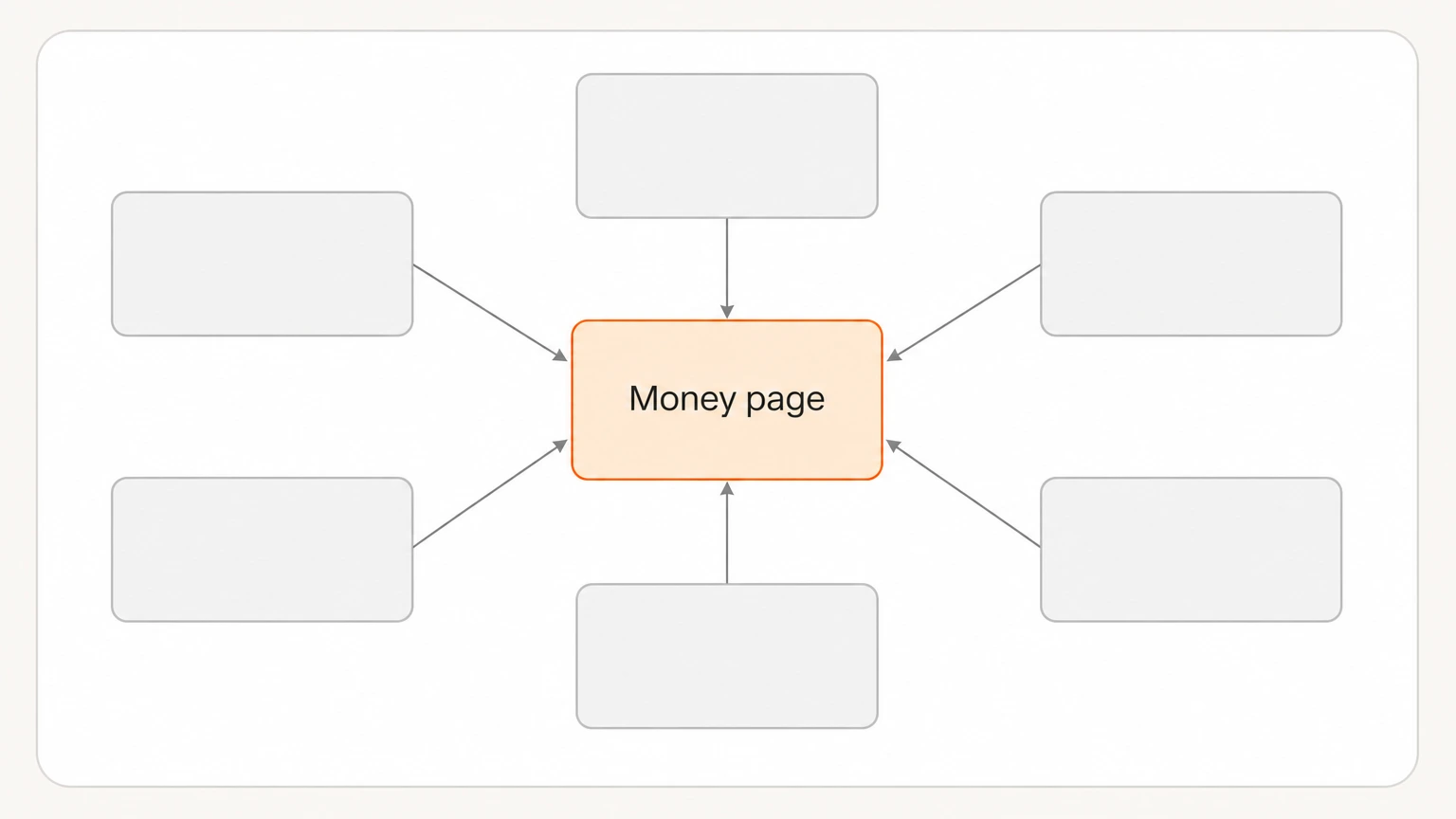
The money page sits at the center
Pick the page that would produce the most revenue if it ranked first, usually your primary category page or your strongest comparison. Everything else exists to support it. That page gets the internal links, the strongest earned links, and the most careful conversion work.
Supporting pages point inward
Six to twelve pages around each money page, covering related questions and adjacent intent. Each links to the money page with descriptive anchor text. Each targets a distinct query so they support rather than compete.
Then check for cannibalization
Filter Search Console by query and look for terms where two of your URLs appear. Two pages splitting the signal for one term means neither ranks properly. Merge them, redirect the weaker one, and consolidate the links.
Build the money page first even though it will not rank yet. Then the supporting pages, which rank sooner because they are less competitive. The internal links from those pages are part of what eventually lifts the money page.
What a usable brief contains
The difference between a brief a writer can execute and one that produces generic filler.
A weak brief
What most teams send- A target keyword and a word count
- "Write about X, 1,500 words, include the keyword"
- Three competitor URLs to "use as reference"
- A tone note saying "professional but friendly"
A usable brief
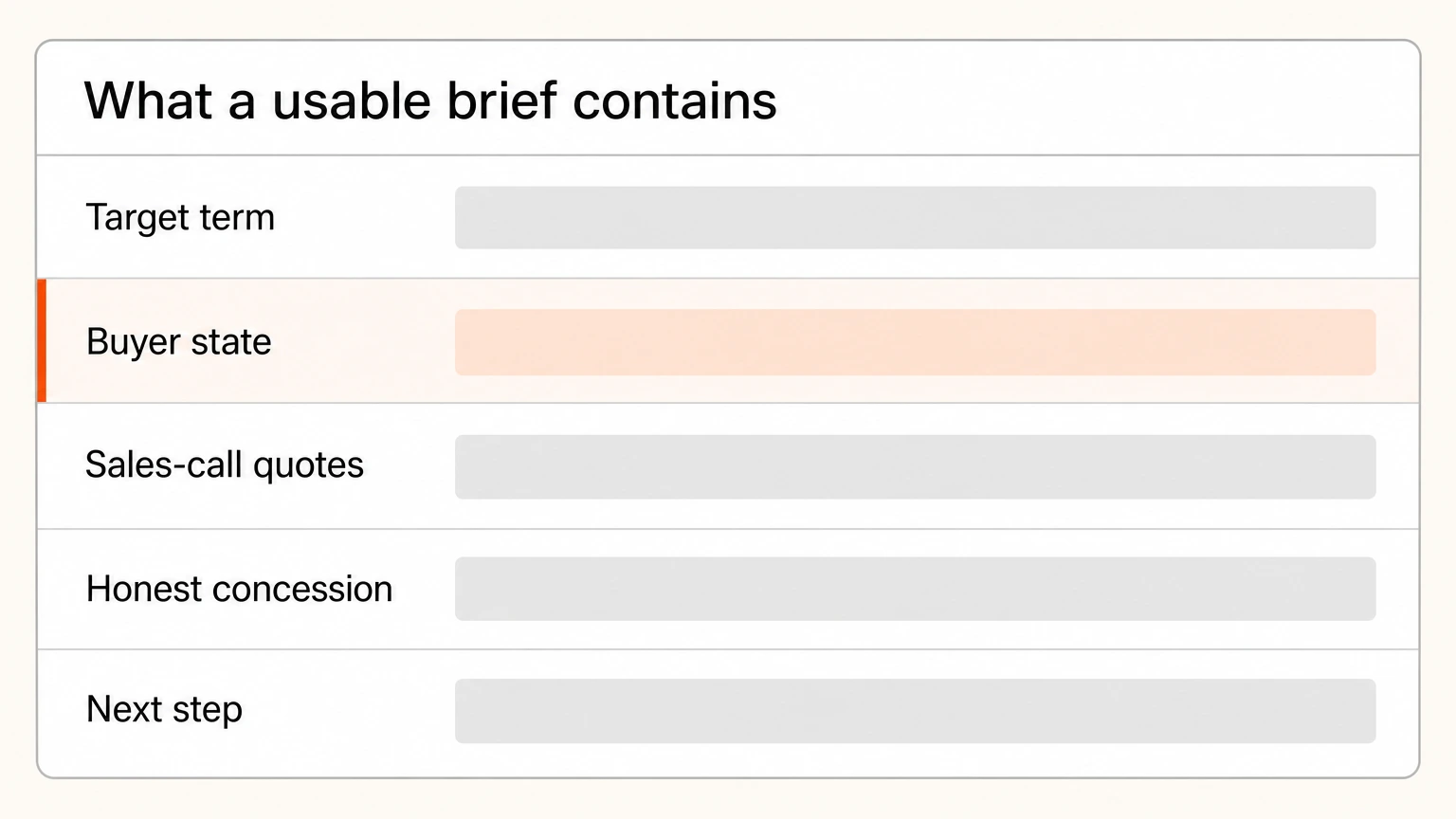
What we send- The exact searcher: role, stage, and the objection already in their head
- Verbatim phrases pulled from sales calls
- The conversion path and why they would take it here
- Which product proof point makes each claim concrete
- One self-contained sentence built for AI extraction
- Internal links in and out, named specifically
- What the page must beat, and on what dimension
What is SaaS content strategy?
What content converts best for SaaS?
How much content does a SaaS company need?
Should SaaS companies use AI to write content?
What is product-led content?
How do you write comparison pages without looking biased?
Content that converts, not just publishes
Tell us your category and competitors. We will map which twenty pages would move your pipeline, in priority order.
From $5,000/mo · Briefs built from your sales calls