How to choose a SaaS SEO agency
We run one of these agencies, so read this accordingly. It is the framework we would use if we were buying. The seven criteria that predict results, the six questions that expose weak candidates, and the situations where hiring us specifically would be a mistake.
Most of this guide will not send you to us
We run a SaaS SEO agency, so treat this page accordingly. What follows is the evaluation framework we would use if we were the ones buying. Including the questions that would expose us, and the situations where hiring us would be a mistake.
The reason to write it this way is simple: the most-read page on this topic is a Reddit thread, because buyers have learned that vendor content on "how to choose a vendor" usually describes the vendor. If this page is useful when you hire someone else, it did its job.
Start with your bottleneck, not the shortlist
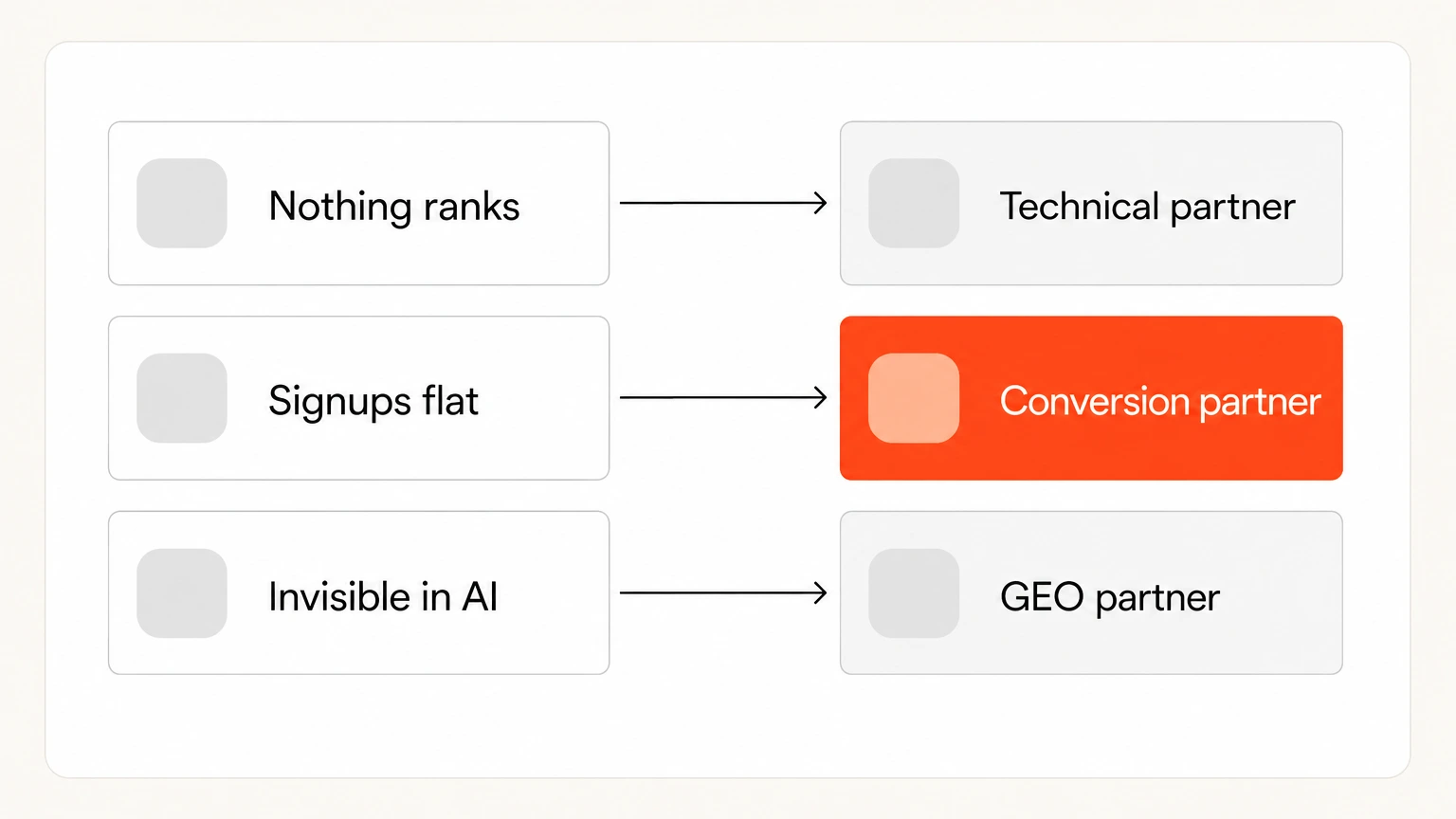
"We need SEO" is not a brief. Five very different constraints all present as flat organic growth, and each needs a different kind of partner.
| Your symptom | Likely bottleneck | What you actually need |
|---|---|---|
| Publishing steadily, nothing ranks | Technical or authority | A technical audit first. Content on a broken base is wasted spend. |
| Traffic is up, signups are flat | Intent and conversion | Bottom-of-funnel page strategy and CRO, not more volume. |
| Ranking well, invisible in AI answers | Citation footprint | A GEO and digital PR partner who measures citation share. |
| Pages exist but are not indexed | Rendering and crawl | Technical SEO with engineering capability, possibly a one-off project. |
| Everything works, nothing scales | Production capacity | Programmatic SEO and content operations. |
| You have a marketer with no plan | Direction, not hands | Consulting, not a full retainer. Cheaper and faster. |
If you brief five agencies on "we need SEO", you will get five near-identical proposals for a content retainer, because that is the safest thing to sell. Brief them on a specific bottleneck and the weak candidates become obvious immediately.
Seven criteria for evaluating a SaaS SEO agency
Score each candidate one to five. Anything scoring below three on the first three criteria is a pass, regardless of price.
SaaS specialization
Have they solved rendering, trial funnels and comparison pages before? Ask for two SaaS clients and what changed.
Intent over volume
Does their keyword thinking start with your buyer and ACV, or with a search-volume export sorted descending?
Technical depth
Can they discuss your specific stack (rendering, canonicals, programmatic templates) without deferring to "our tech team"?
Conversion thinking
Is the CTA path defined in the brief before writing starts, or added after the page is live?
Authority capability
Where do links come from, and can they name publications? "We have a network" without specifics usually means paid placements.
AI-search measurement
Do they track citation share across engines, or is GEO a slide in the deck with nothing behind it?
Pipeline reporting
Does the monthly report show trials, demos and CAC, or sessions and average position?
Bonus: they say no
An agency that has never turned down a client is optimizing for revenue. The ability to decline is a quality signal.
Six questions, and what the answers reveal
Ask these verbatim. The gap between a strong and weak answer is unmistakable once you know what you are listening for.
"Show me a bottom-of-funnel page you shipped and what it converted."
Question one- Strong: a live URL, the term it targets, the conversion rate, and what they would change now
- Weak: traffic screenshots, or a blog post described as bottom-of-funnel
"What will you fix technically in month one?"
Question two- Strong: specifics about your rendering, indexation or architecture. Meaning they looked before the call
- Weak: "we'll start with a full audit", with no observation about your actual site
"How do you track whether ChatGPT names us?"
Question three- Strong: a described method. Prompt sets, engines covered, competitor benchmarking, reporting cadence
- Weak: "we optimize for AI" with no measurement, or conflating AI Overviews with all AI search
"Who runs the account day to day?"
Question four- Strong: a named person, present on the call, who will still be there in month six
- Weak: "you'll be assigned a dedicated account manager after onboarding"
"What will your reporting show my board?"
Question five- Strong: trials, demos, pipeline influenced, CAC payback, citation share
- Weak: a dashboard tour heavy on sessions, impressions and keyword counts
"When would you tell us not to hire you?"
Question six- Strong: a clear, specific description of the client they are wrong for
- Weak: "we can help any SaaS company", or a non-answer dressed as enthusiasm
Red flags and green flags
Walk away
- Guaranteed rankings. Nobody controls Google. A guarantee means either meaningless keywords or a coming excuse.
- Traffic as the headline. Sessions without trials is a vanity report you are paying for.
- No questions about ICP, ACV or sales cycle. They cannot map search to revenue without these, so they will not try.
- Hidden pricing. If the number only appears after two calls, the number depends on what you reveal about budget.
- Case studies without figures. "Significant growth" is not a result.
- Twelve-month lock-in on day one. Confidence does not need a contract to hold you.
- No opinion on your stack. Most SaaS indexation problems live in the front-end framework.
- AI search as pure buzzword. Adding GEO to a generic retainer is a rename, not a service.
Good signs
- They critique your current site unprompted. Specific observations before you have paid anything.
- They ask about churn and expansion revenue. Signals they think past the signup to whether it was worth acquiring.
- They want access to sales calls. The best keyword research comes from recordings, not tools.
- They push back on your assumptions. A partner who agrees with everything is a vendor.
- They publish their own pricing. Rare enough to be a genuine signal.
- They rank for their own commercial terms. Not decisive, but a shoemaker with bare feet deserves a question.
- References describe friction honestly. Every engagement has problems. How they were handled is the real reference.
Agency, consultant, freelancer or in-house?
The right answer changes with your stage. Most companies get this wrong by hiring the model that suited them eighteen months ago.
| Model | Monthly cost | Best when. And the limitation |
|---|---|---|
| Agency retainer | $5,000–$25,000+ | You need breadth and speed without hiring. Limitation: never as deep in your product as an employee. |
| Consultant | $2,000–$8,000 | You have a capable marketer who needs the roadmap. Limitation: you still do the work. |
| Freelancer | $1,500–$6,000 | One defined slice, an audit, a page type, a migration. Limitation: single point of failure, rarely owns outcomes. |
| In-house hire | $10,000–$15,000 loaded | Above roughly $10M ARR. Limitation: one person cannot cover strategy, technical, content and links. |
| Hybrid | $12,000–$25,000 | The strongest setup between $2M and $10M ARR: an in-house owner plus an agency executing. |
How to run the evaluation
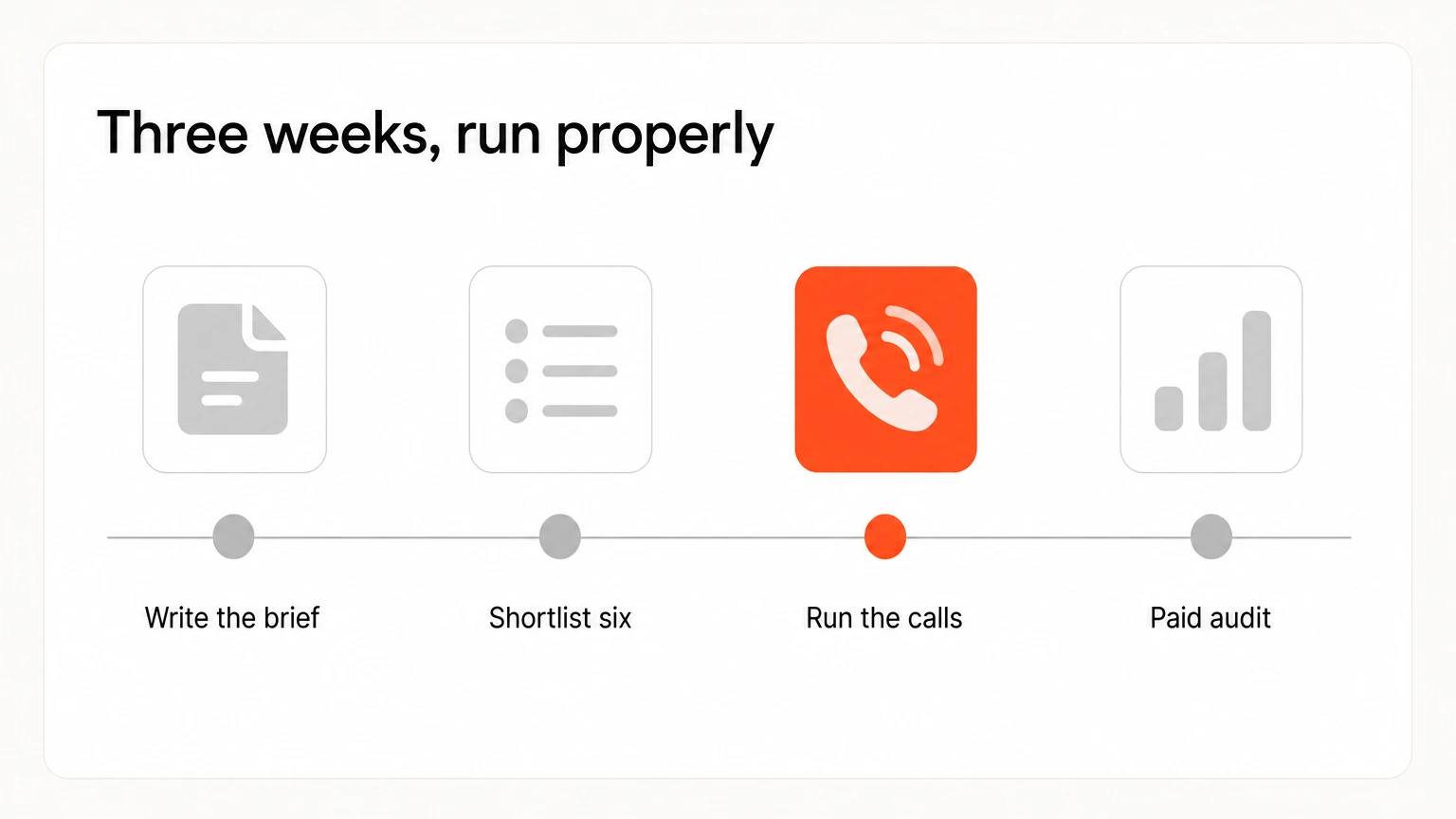
A structured process takes about three weeks and dramatically improves the outcome. Most teams instead take two calls and go with whoever seemed most confident.
- Write down your bottleneck and your target. One sentence each. "Trials from organic are flat at 30 a month; we want 100 by Q2." Everything else follows from this.
- Shortlist four to six specialists. Use case studies containing real figures as the filter. Ignore rankings on "best agency" listicles, which are largely paid placements.
- Send the same brief to all of them. Identical inputs make the differences in thinking visible. Variation in proposals is the signal you are buying.
- Run the six questions on every call. Score as you go, immediately after each call rather than at the end of the week.
- Ask for a paid discovery or audit from the top two. A few thousand dollars to see how someone actually thinks is the cheapest insurance available.
- Check references for friction. Ask what went wrong, not whether they were happy. Then ask how it was handled.
- Agree itemized scope and a review point. Pages per month, links per month, who implements technical changes, and a defined date to reassess.
Offering to pay two finalists for a scoped audit is the highest-signal step in the whole process. You see their thinking on your actual site, they take it seriously because it is paid work, and the cost is trivial against a year of retainer.
The scorecard
Score each candidate one to five per row. The weighting matters as much as the score.
| Criterion | Weight | What a 5 looks like |
|---|---|---|
| SaaS specialization | ×3 | Named SaaS clients, figures, and a view on your specific funnel |
| Intent over volume | ×3 | Keyword thinking starts from ACV and buying stage |
| Technical depth | ×3 | Specific observations about your stack, unprompted |
| Conversion thinking | ×2 | CTA and next step defined in the brief, before writing |
| Authority capability | ×2 | Named publications and a described earned-link method |
| AI-search measurement | ×2 | Prompt sets, engines, competitor benchmarking, cadence |
| Pipeline reporting | ×3 | Trials, demos, CAC payback by page type |
| Willingness to decline | ×1 | A clear description of the client they are wrong for |
When we are the wrong choice
Running the framework above on ourselves, since a guide that never turns the lens around is just a brochure.
We score well if…
- You sell B2B SaaS or high-ticket B2B with a considered buying cycle
- Your bottleneck is bottom-funnel visibility or AI citations
- You want a senior operator accountable rather than an account manager
- You can give the work three to six months to compound
- $5,000/month or more is a sane share of your acquisition budget
We score badly if…
- You need leads this month. Run paid, then layer organic underneath it
- You want the cheapest cost per published word
- You are pre-launch with no product for search intent to point at
- You need a large on-site team embedded in your standups
- Nobody internally can approve technical changes to the site
Product depth. An in-house marketer who uses your product daily will always understand it better than we will in month two. We compensate with sales-call mining and a heavy onboarding, but if deep product intuition is the main thing you need, hire for it and use us for the technical and authority work around it.
Hiring questions
What SaaS teams ask when they start evaluating partners.
Run the six questions on usHow do I choose a SaaS SEO agency?
What questions should I ask a SaaS SEO agency?
What are red flags when hiring a SaaS SEO agency?
Should I hire a SaaS SEO agency or a consultant?
How long should I commit to a SaaS SEO agency?
How do I know if a SaaS SEO agency is actually good?
What does a good SaaS SEO agency actually deliver in month one?
Is a SaaS-specialist agency better than a generalist?
How much should I pay a SaaS SEO agency?
Can I do SaaS SEO in-house instead?
Put us through your process
Send the same brief you send everyone else. We will tell you where we score badly, and if another agency fits your bottleneck better we will say so.
From $5,000/mo · No lock-in · We will tell you when we are wrong for you