Most LLM SEO advice tells you to write clearly and add schema. That is true and it is not enough, because it skips the part that decides everything: how a language model actually finds and selects the passage it quotes. Once you understand retrieval, the tactics stop being a checklist and start being obvious.
LLM SEO is the practice of optimizing content, entity signals and third-party presence so large language models can retrieve, understand, trust and cite your brand inside generated answers. It is also called GEO, LLMO or AEO depending on who is selling it. The underlying work is close to identical.
This guide covers the retrieval mechanics first, because they explain why the standard recommendations work. Then the tactics, then a test you can run this afternoon to see where you currently stand.
The naming problem, resolved quickly
LLM SEO, generative engine optimization, answer engine optimization, LLMO and AI SEO are largely the same discipline under five labels. The distinctions people draw are real but narrow, and none of them changes what you should do on Monday.
- AEO leans toward being the extracted answer, including in snippets and voice, which predates generative AI.
- GEO and LLM SEO lean toward being named inside a synthesized response from a language model.
- AI SEO is usually the umbrella term, and occasionally means using AI to do SEO, which is a different thing entirely.
If a vendor charges you separately for AEO and GEO, ask what work differs between the two. In our experience the honest answer is very little. We cover the strategic side in the answer engine optimization guide; this piece goes deeper on mechanics.
How retrieval actually works
There are two distinct paths by which a model can mention your brand, and confusing them is the source of most bad advice in this category.
Path one: training data
The model absorbed information about you during training. You cannot influence this directly, it is frozen at a cutoff date, and it is why models sometimes state confidently outdated facts about products. Nothing you publish today changes what a model already learned, though it does shape the next training run.
Path two: retrieval at query time
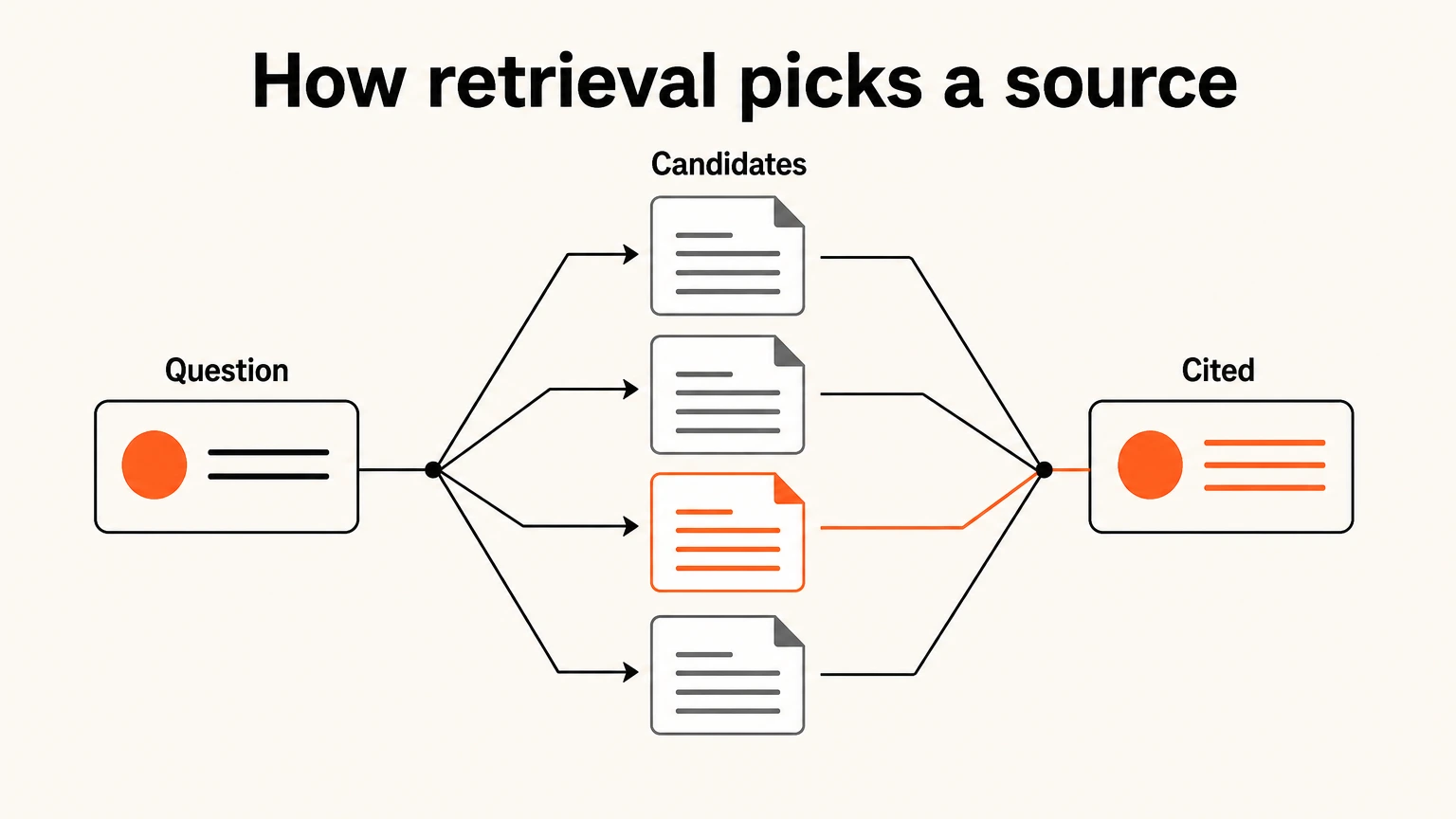
This is the path that matters and the one you can influence. When an engine handles a question it cannot answer confidently from memory, it searches, pulls back documents, splits them into passages, and selects the passages most relevant to the question. Those passages become the answer, and the sources become the citations.
That splitting step is called chunking, and it is the single most underappreciated concept in this discipline.
Why chunking changes how you write
A retrieval system does not evaluate your article as a whole. It breaks the document into segments, converts each into a numerical representation, and matches those against the question. The unit competing for the citation is a paragraph or a section, not the page.
Three practical consequences follow, and they are the reason the standard advice works.
- Every passage must stand alone. A paragraph beginning "This means that..." is close to useless in isolation, because the retrieved chunk arrives without the sentence it refers back to. Restate the subject.
- Headings are retrieval anchors. A descriptive heading travels with its chunk and tells the system what the passage is about. "Pricing" is weak; "How much a SaaS SEO agency costs" is strong.
- One idea per section. A section covering four loosely related points produces a chunk that matches nothing well. Split it.
This is why bulleted facts, tables and short self-contained answers keep appearing in every guide. Not because models prefer bullets aesthetically, but because those formats produce clean, independently meaningful chunks.
The four signals that decide citations
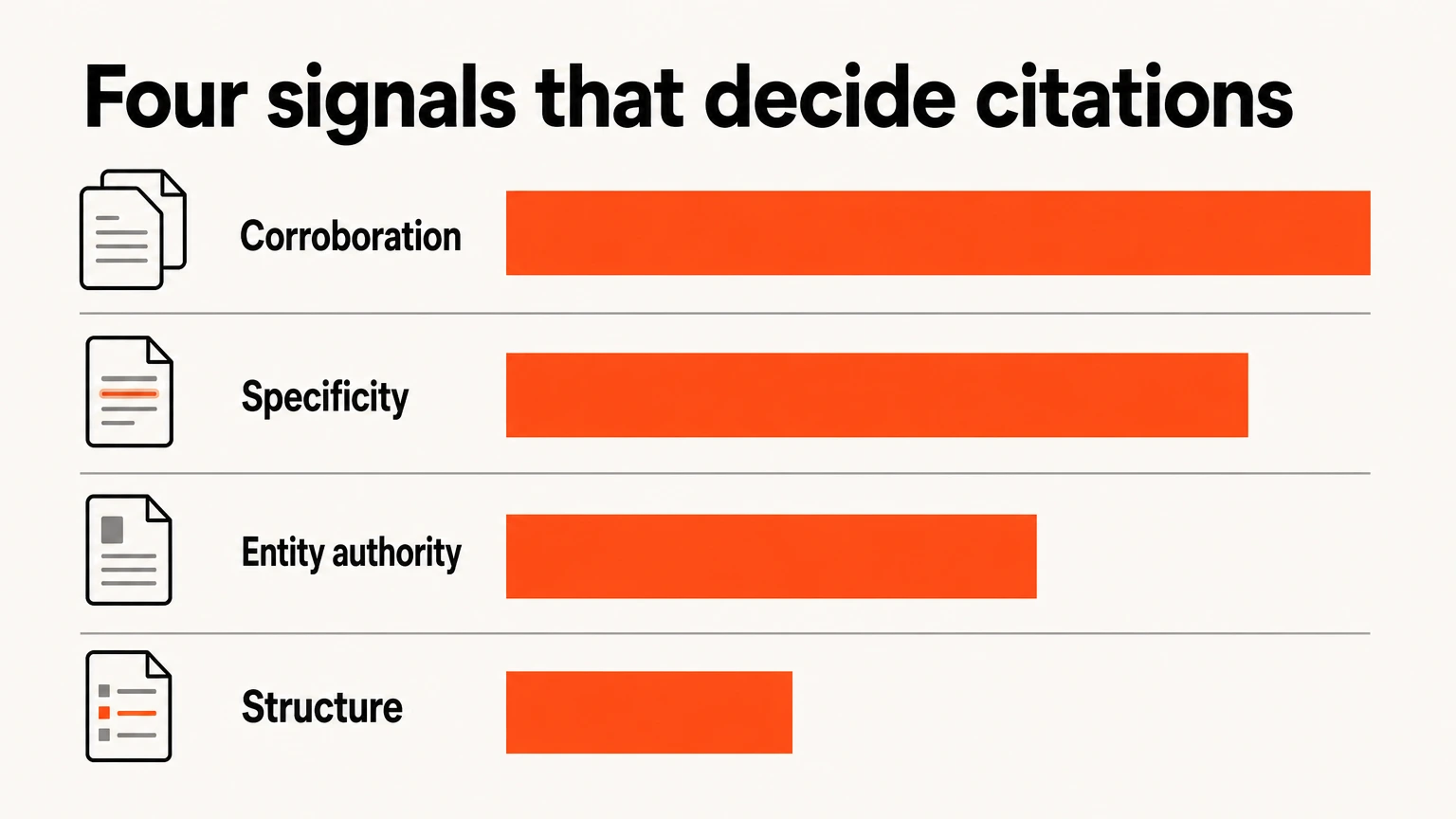
Retrieval gets you considered. These four decide whether you get quoted.
| Signal | What it means | How to improve it |
|---|---|---|
| Structure | Whether passages can be cleanly extracted and understood alone | Descriptive headings, one idea per section, self-contained sentences, tables |
| Specificity | Whether your claims contain concrete, quotable facts | Real numbers, named methods, dated figures instead of vague adjectives |
| Entity authority | Whether the model recognizes your brand as a known, corroborated entity | Consistent naming, Organization schema, earned mentions across many sources |
| Freshness | Whether the content appears current | Visible last-updated dates, genuine periodic revision, current figures |
Specificity is doing more work than people realize
A model choosing between two passages that answer the same question will favor the one carrying concrete detail, because concrete detail is what makes an answer useful. "Pricing varies by scope" gets ignored. "Retainers run $3,000 to $25,000 per month depending on content velocity and link volume" gets quoted.
The uncomfortable implication for marketers is that vagueness, which is often a deliberate commercial choice, is now a visibility cost. Hiding your pricing behind a discovery call does not just frustrate buyers. It removes the most quotable fact on the page.
Entity authority is not the same as domain authority
Domain authority is a third-party estimate of link strength. Entity authority is whether a model has enough corroborated information to treat your brand as a distinct, known thing. They correlate but they are not the same, and the second is what matters here.
- Name yourself consistently. If you are Acme, Acme Inc and Acme Software across different properties, you are diluting a single entity into three weak ones. Declare variants in your Organization schema.
- Get corroborated in multiple places. A model trusts a fact that appears across independent sources far more than one asserted only on your own site.
- Build a footprint beyond your domain. Review platforms, category roundups, community threads and industry publications all contribute.
- Publish an unambiguous about page. What you do, who you serve, where you operate, when you started. Dull, and disproportionately useful for entity resolution.
A test you can run this afternoon
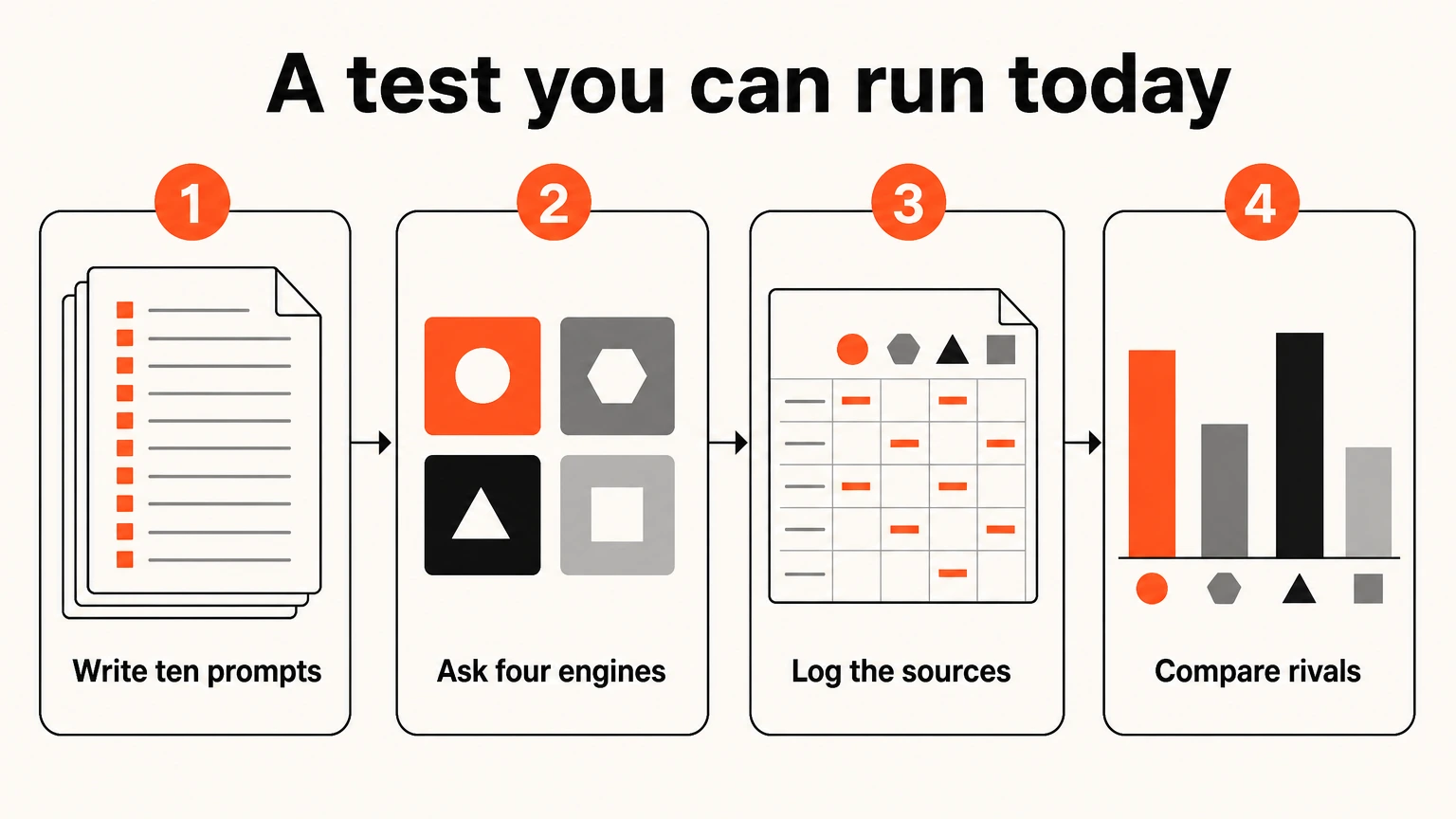
Before changing anything, find out where you actually stand. This takes about forty minutes and costs nothing, and it is the step almost everyone skips.
- Existence. Ask each engine what your company is and what it does. You are checking whether the model knows you at all, and whether the description is accurate.
- Legitimacy. Ask whether your company is reputable, and who founded it. This surfaces trust signals and any inaccurate history.
- Category. Ask for the best tools or providers in your category, without naming yourself. This is the commercial question that matters most.
- Comparison. Ask how you compare to your two closest competitors. Check whether the comparison is fair and current.
- Objection. Ask what the drawbacks of your product are. Models will repeat criticisms from third-party sources, and you need to know which ones.
Run all five across ChatGPT, Claude, Perplexity, Gemini and Google AI Overviews, and record the answers verbatim along with any cited sources. Outputs vary between sessions, so treat one run as a snapshot rather than a measurement, and repeat it on a schedule.
Most teams discover two things. They are absent from the category question, which they expected. And they are described inaccurately somewhere, which they did not. The second is usually the cheaper fix and the higher-value one, because a wrong description loses deals silently.
Fixing an inaccurate description
If an engine states something wrong about your product, the instinct is to update your own website. That rarely works on its own, because the error came from somewhere else.
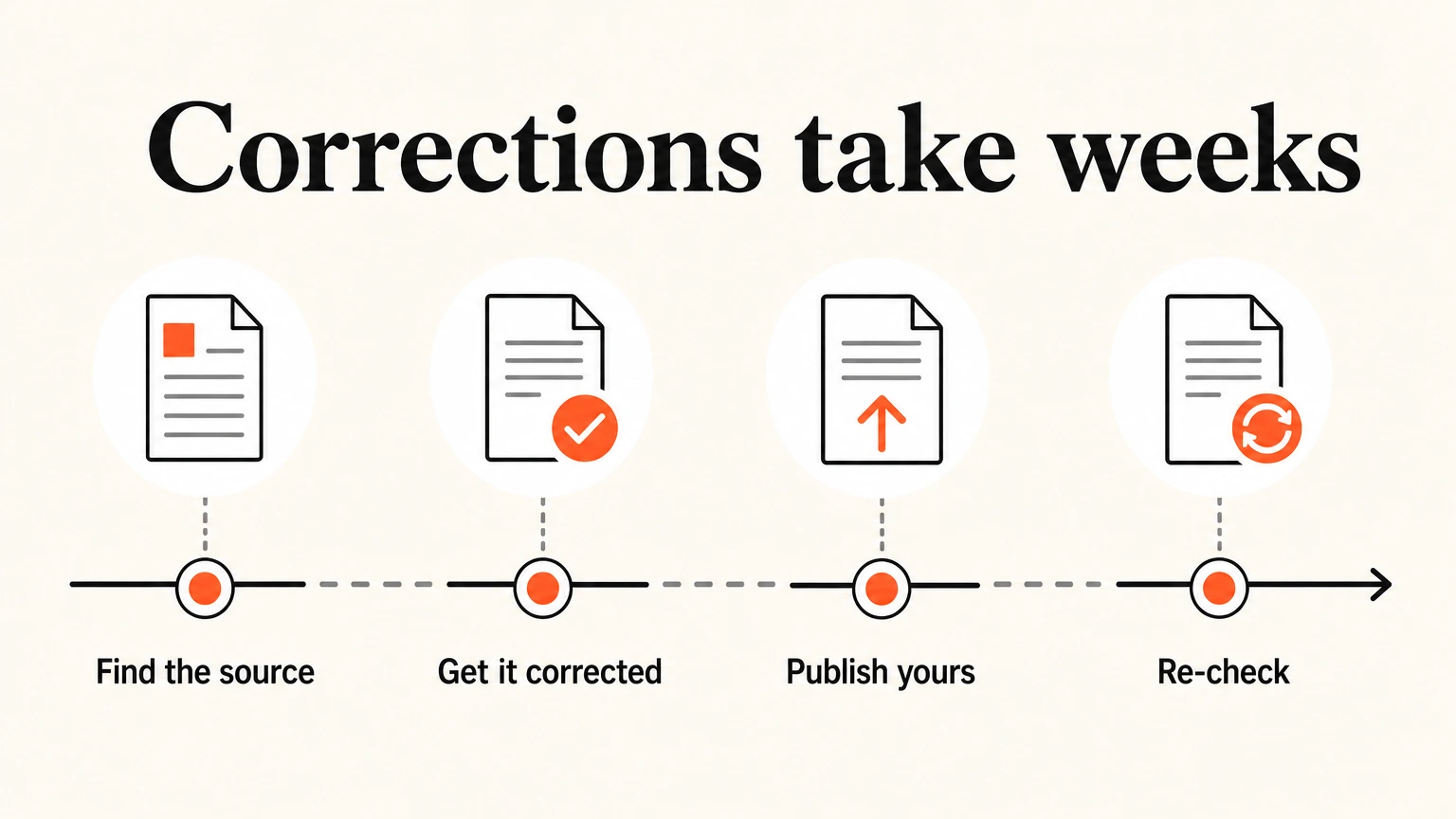
- Find the source. Ask the engine what it is basing the claim on. The citation usually points at an outdated roundup or an old review.
- Get that source corrected. Contact the publisher with current information. Most update willingly, since their content being wrong is their problem too.
- Publish an unambiguous correction on your own site. Dated, factual, structured so it is trivially extractable.
- Seed the correct version into newer third-party content. Recent sources carry more weight over time than old ones.
- Re-check on a schedule. Corrections propagate over weeks and inconsistently across engines.
Mistakes that quietly kill citations
- Content that only exists after JavaScript runs. AI crawlers handle JavaScript considerably worse than Googlebot. If your copy is not in the raw HTML response, assume they see nothing. The technical checklist covers how to verify this.
- Burying the answer under preamble. Four paragraphs of context before the definition means the definition sits in a chunk with poor relevance to the question.
- Pronoun-heavy writing. "It does this by..." is meaningless in a retrieved chunk. Restate the subject even when it feels repetitive.
- Undated content. Freshness signals matter, and a page with no visible date is harder to trust.
- Blocking AI crawlers by accident. Worth checking your robots.txt deliberately rather than assuming.
- Treating it as a content-only problem. Most commercial citations come from third-party sources. Your pages are perhaps thirty percent of the picture.
We treat LLM visibility as measurement first, tactics second
The prompt test above is what we run in week one of every engagement, formalized into a set of twenty to fifty questions drawn from your sales calls and baselined across seven engines before anything changes. Then we work the third-party sources, which is where most citations are actually decided, using our own publisher platform rather than a broker's list.
- Baseline before we change anything, so movement is provable rather than asserted
- Accuracy audits included, because being described wrongly costs more than being absent
- Source-pool work, not just page tweaks. Roundups, review platforms and communities
- We publish our pricing, which is both a policy and, as this article argues, a citation strategy
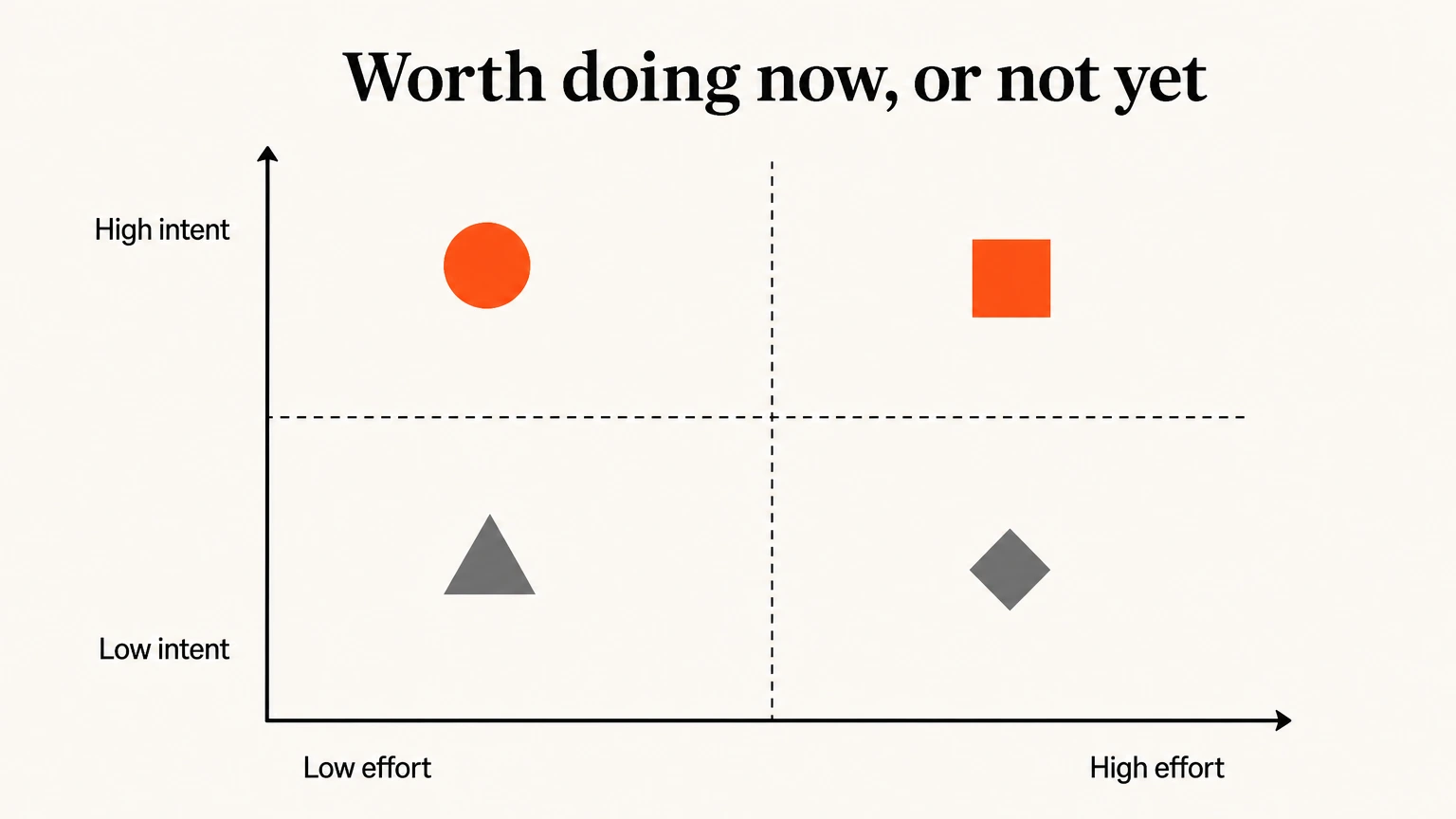
Is any of this worth doing yet?
A fair question, and the honest answer depends on your category. AI-referred traffic is still small in absolute volume for most businesses. It also converts unusually well, because someone arriving from a recommendation has already been pre-qualified by the recommendation itself.
The stronger argument is not traffic. It is that shortlists now form inside answers, and absence at that moment is invisible in your analytics. You never see the buyer who asked which tool to use, got three names, and never included yours.
What we would not do is build a separate LLM SEO workstream with its own budget and its own team. Nearly everything here also improves classic rankings, and the technical prerequisites are identical. Treat it as an extension of a well-run search program rather than a replacement for one, and be sceptical of anyone selling it as a wholly new discipline. Including us, if we ever start.
Frequently asked questions
What is LLM SEO?
What is the difference between LLM SEO and traditional SEO?
What is the difference between LLM SEO and GEO?
How do large language models decide what to cite?
What is chunking and why does it matter for SEO?
How do I check if ChatGPT knows about my brand?
Does LLM SEO replace traditional SEO?
Why does an AI say something wrong about my product?
Is LLM SEO worth investing in yet?

Mohammad Qaiser
Working in SEO since 2010, founder of Authority Magnet since 2018, and campaign lead on every case study the agency publishes. Also built PRWiz, where this work gets tested on our own software before it reaches a client.
Work with us