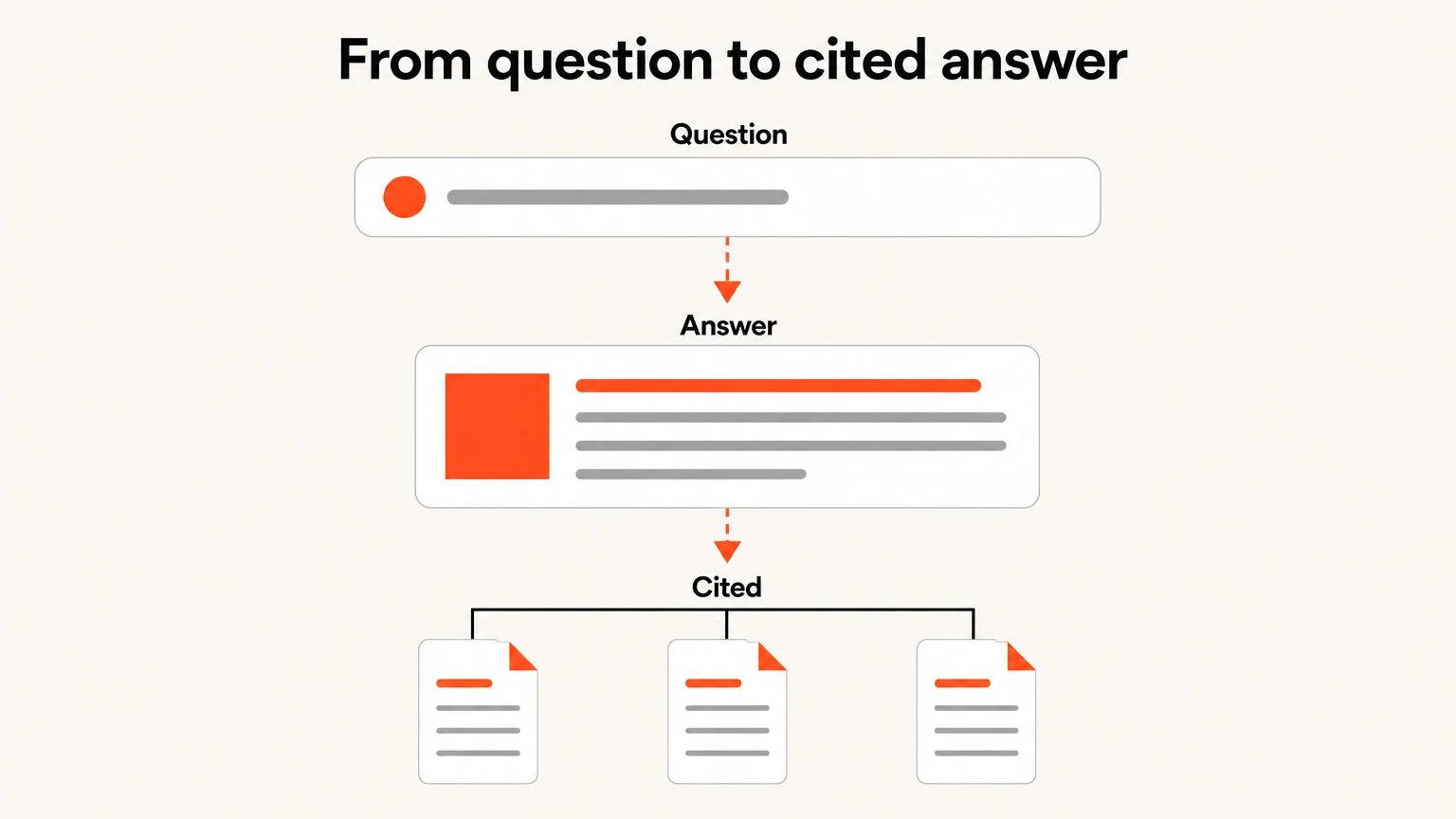
Answer engine optimization is the discipline that decides whether an AI assistant names your brand or a competitor's when someone asks it what to buy. It is not a rebrand of SEO, and it is not a new set of tricks. It is a different unit of success: a citation inside a synthesized answer rather than a position in a list of links.
Answer engine optimization (AEO) is the practice of structuring content, technical signals and third-party mentions so AI systems such as ChatGPT, Perplexity, Claude and Google AI Overviews can extract, trust and cite your brand as a direct answer. Traditional SEO competes for clicks. AEO competes for the citation inside the answer.
That box is not decoration. Answer engines reliably lift a concise definition placed high on the page, and the current consensus is that forty to sixty words is the extractable range. Writing one is the single cheapest AEO improvement available to most pages, and almost nobody does it.
What answer engine optimization actually is
An answer engine is any system that returns a synthesized response rather than a list of links. ChatGPT, Perplexity, Claude, Gemini, Grok, Copilot and Google AI Overviews all qualify. So, arguably, do voice assistants, which have been doing a cruder version of this for a decade.
AEO is the work of making your content the source those systems draw from. It splits into three parts, and only one of them happens on your own website.
- Extractability. Can a model lift a clean, self-contained claim from your page without needing the surrounding paragraphs to make sense of it?
- Trust. Does the model have reason to treat your page as authoritative, based on who wrote it, what links to it, and whether other sources corroborate it?
- Presence in the source pool. Are you mentioned in the roundups, comparisons, review platforms and community threads that models retrieve from when they assemble an answer?
The third is the one most guides skip, and it is the one that matters most for commercial queries. When someone asks an AI which project management tool suits a twenty-person team, the model is not reading vendor websites and deciding. It is synthesizing what independent sources already say. If you are absent from those sources, no amount of on-page structuring will put you in the answer.
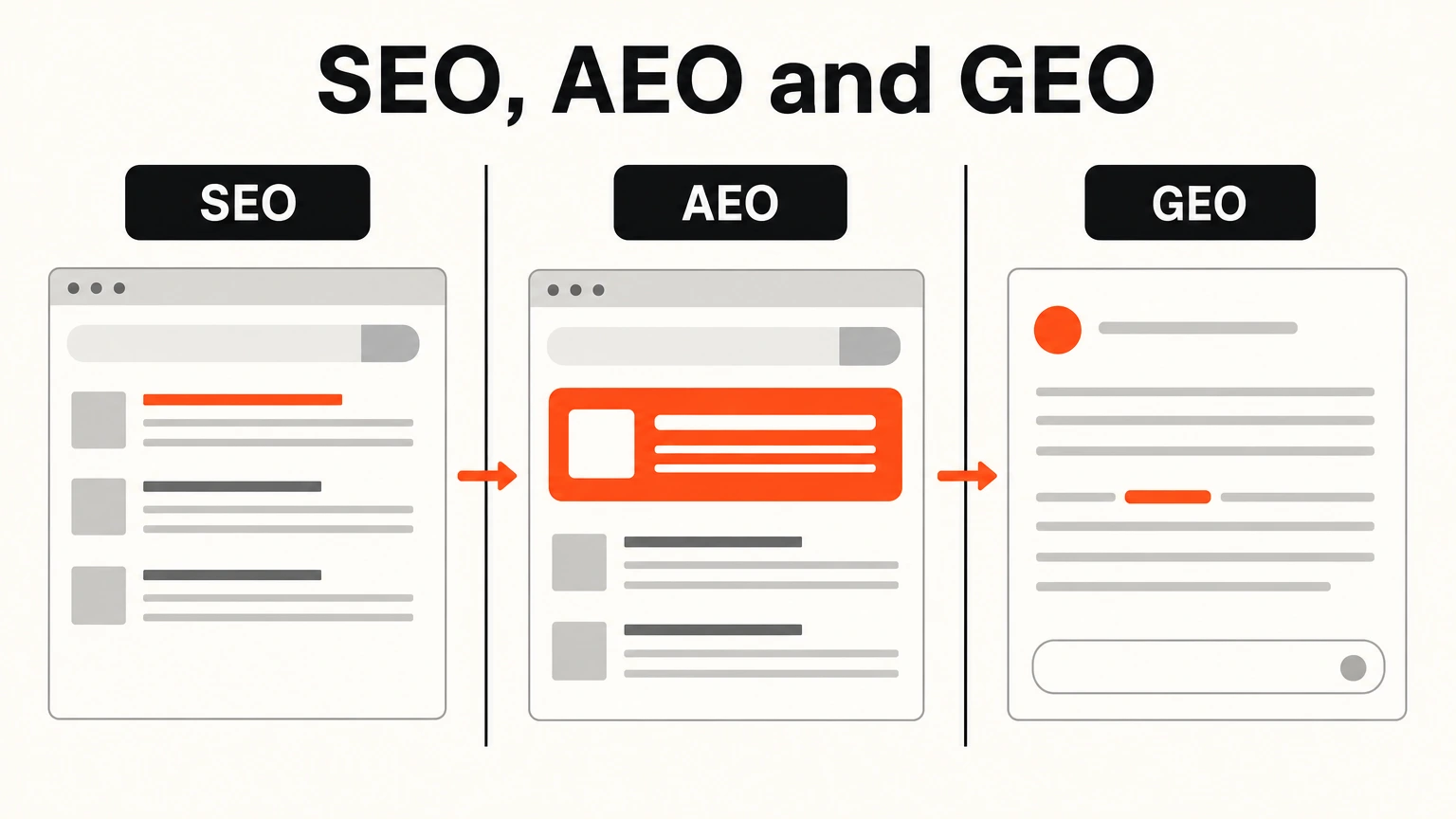
AEO vs SEO vs GEO: the difference that matters
These three acronyms are used interchangeably in a great deal of marketing copy, which is unhelpful because the distinctions are real, if narrower than the people selling them suggest.
| SEO | AEO | GEO | |
|---|---|---|---|
| Goal | Rank in a list of links | Be the extracted answer | Be named inside a generated response |
| Unit of success | Position and click | Featured answer or citation | Brand mention with attribution |
| Where it happens | Search results page | Snippets, voice, AI Overviews | ChatGPT, Claude, Perplexity, Gemini |
| Primary lever | Relevance and links | Structure and clarity | Third-party source presence |
| Typical outcome | Traffic | Zero-click visibility | Shortlist inclusion |
The honest version: the overlap between all three is larger than the difference. Clear structure helps every engine. Authoritative mentions help every engine. Technical accessibility helps every engine. An agency selling AEO as a wholly separate service with a separate fee is usually selling you a rename.
Where the genuine divergence sits is measurement and source strategy. SEO is measured in positions and sessions. AEO and GEO are measured in citation rate across a set of buyer questions, and improved primarily by getting into the sources engines retrieve. That is a different workflow, and it is the part worth paying for.
Why it matters now, and where the hype overshoots
The case for taking this seriously is straightforward. A growing share of buying research begins with a question to an assistant rather than a search box. The answer returns three or four names. Those names get evaluated. Everything else is invisible at the exact moment a shortlist forms.
Two consequences follow. First, absence is now expensive in a way it was not when the alternative was ranking eleventh. Second, and less discussed, being described inaccurately is worse than absence. A model that confidently states your product lacks a feature it has had for two years will lose you deals silently, because the buyer never visits your site to find out otherwise.
The overshoot is the claim that SEO is dead. It is not, and the data does not support it. AI Overviews are assembled largely from pages that already rank. Perplexity leans heavily on live search. Gemini draws from Google's index. For most companies, ranking well remains the most reliable route into an AI answer, and treating AEO as a replacement rather than an extension is how teams end up with neither.
If an AEO recommendation would not also improve your page for a human reader or for Google, be suspicious of it. Nearly everything that genuinely works here is good practice that has become more valuable rather than a new technique that has been discovered.
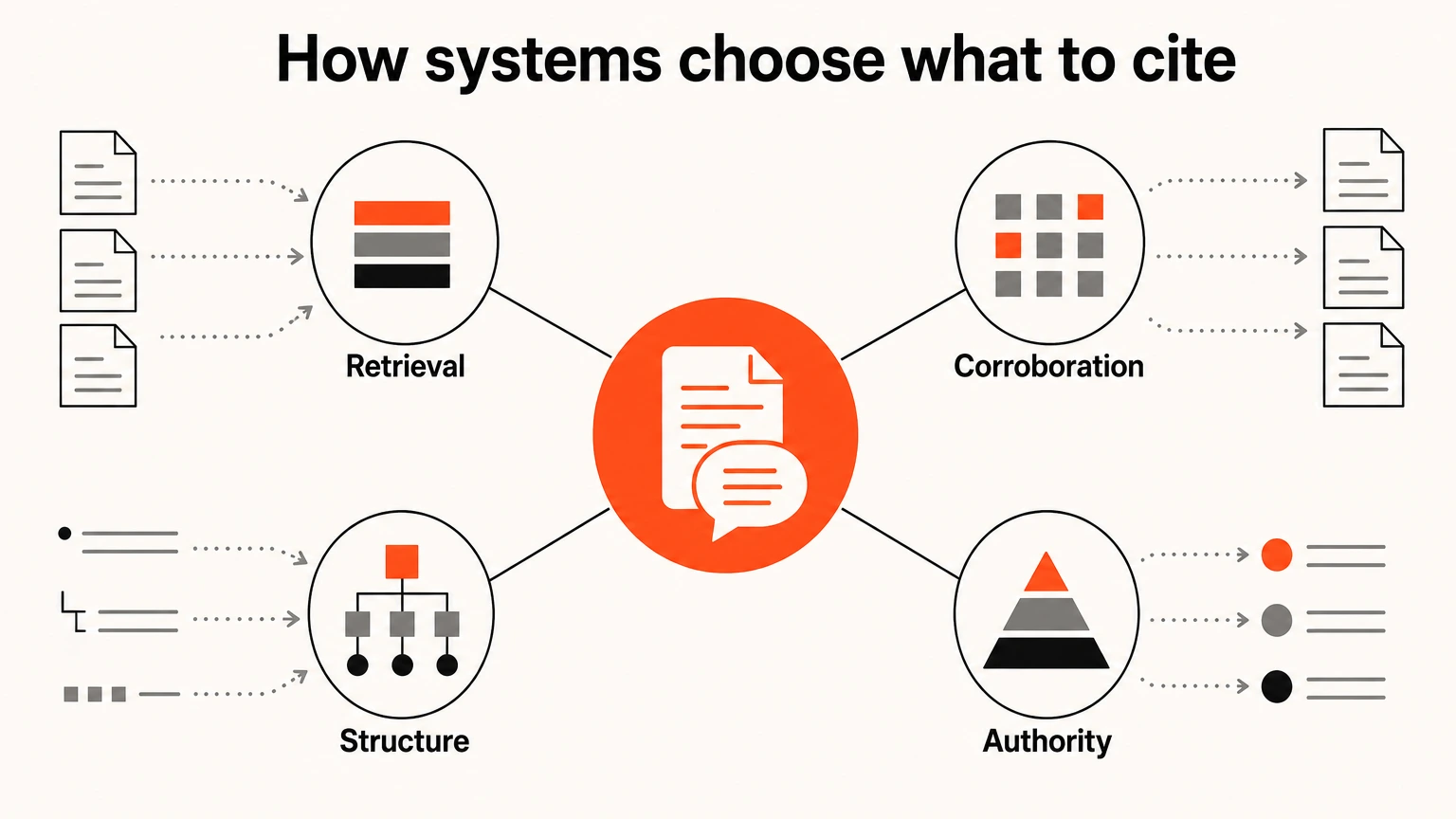
How AI systems choose what to cite
Models do not have opinions about products. They retrieve and synthesize. Understanding what they retrieve from is most of the discipline.
The source types that dominate commercial answers
- Category roundups. "Best X software" articles are the most-quoted source type for buying questions, by a considerable margin.
- Comparison content. Both third-party and vendor-published, which is why your own comparison pages earn twice.
- Review platforms. G2, Capterra, TrustRadius and their equivalents carry disproportionate weight because they are structured, consistent and regularly updated.
- Community threads. Reddit and Hacker News discussions where practitioners name tools unprompted. Notably, Reddit ranks in the top three for a large share of commercial software queries.
- Your own pages, but only when structured cleanly enough to lift a claim from without ambiguity.
What makes a specific passage quotable
Having watched which passages get lifted and which get ignored, the pattern is consistent and unglamorous.
- Self-contained sentences. A claim that requires the previous paragraph to make sense will not be extracted.
- Explicit definitions. "X is Y" written plainly, rather than a definition implied across three sentences of narrative.
- Specific numbers. "$5,000 per month" is extractable. "Affordable pricing" is not.
- Tables. Models parse structured comparisons far more reliably than the equivalent prose.
- Question-shaped headings. Matching the phrasing of the question being asked helps retrieval considerably.
- Attribution signals. A named author, a date, and citations of your own raise the trust weighting.
How to do answer engine optimization
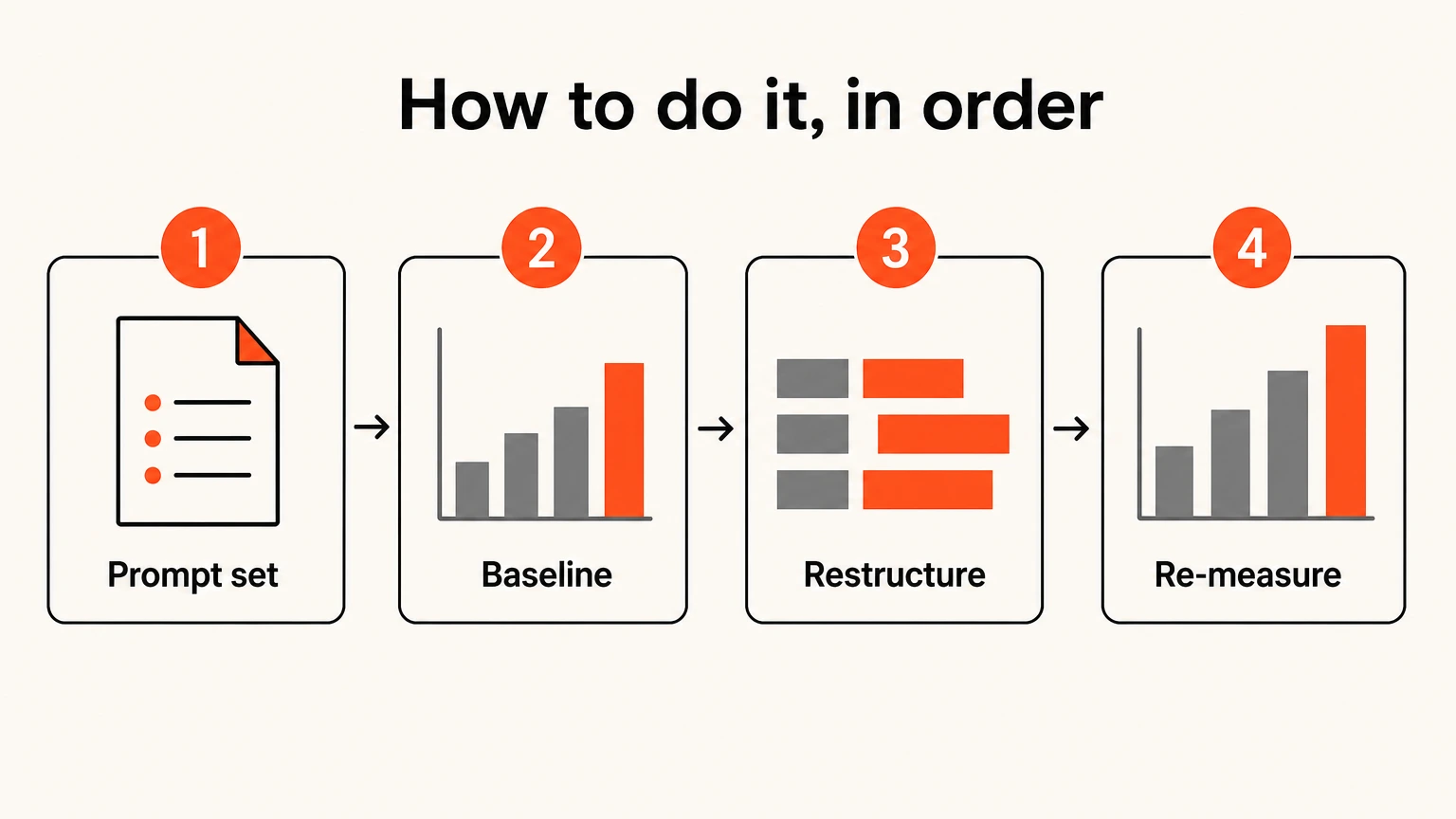
In the order we run it, because sequence matters more than completeness here.
- Build a prompt set from real buyer questions. Twenty to fifty questions your sales team actually hears. Invented prompts produce a tidy dashboard that measures nothing.
- Baseline before you change anything. Run the set across every engine your buyers use and record whether you appear, where in the answer, and which sources the response cited. Without this you cannot prove movement later.
- Audit how you are described. Ask the engines directly what your product does, what it costs, and who it is for. Inaccuracies here are usually the highest-value fix available in week one.
- Fix extractability on your key pages. A forty to sixty word direct answer near the top, explicit definitions, tables, specific figures, question-shaped headings, and FAQ schema where the questions genuinely appear on the page.
- Make sure crawlers can read the page at all. AI crawlers handle JavaScript considerably worse than Googlebot. If your copy is not in the raw HTML response, assume they see nothing.
- Work the source pool. Get into the roundups and comparisons the engines retrieve from, complete your review-platform profiles, and correct outdated third-party descriptions of your product.
- Re-run the prompt set on a schedule and report movement per engine, because they diverge sharply and an aggregate number hides that.
Steps one to three take a couple of weeks and cost almost nothing. Step six is where the sustained work lives, and it looks a great deal like digital PR, because that is essentially what it is.
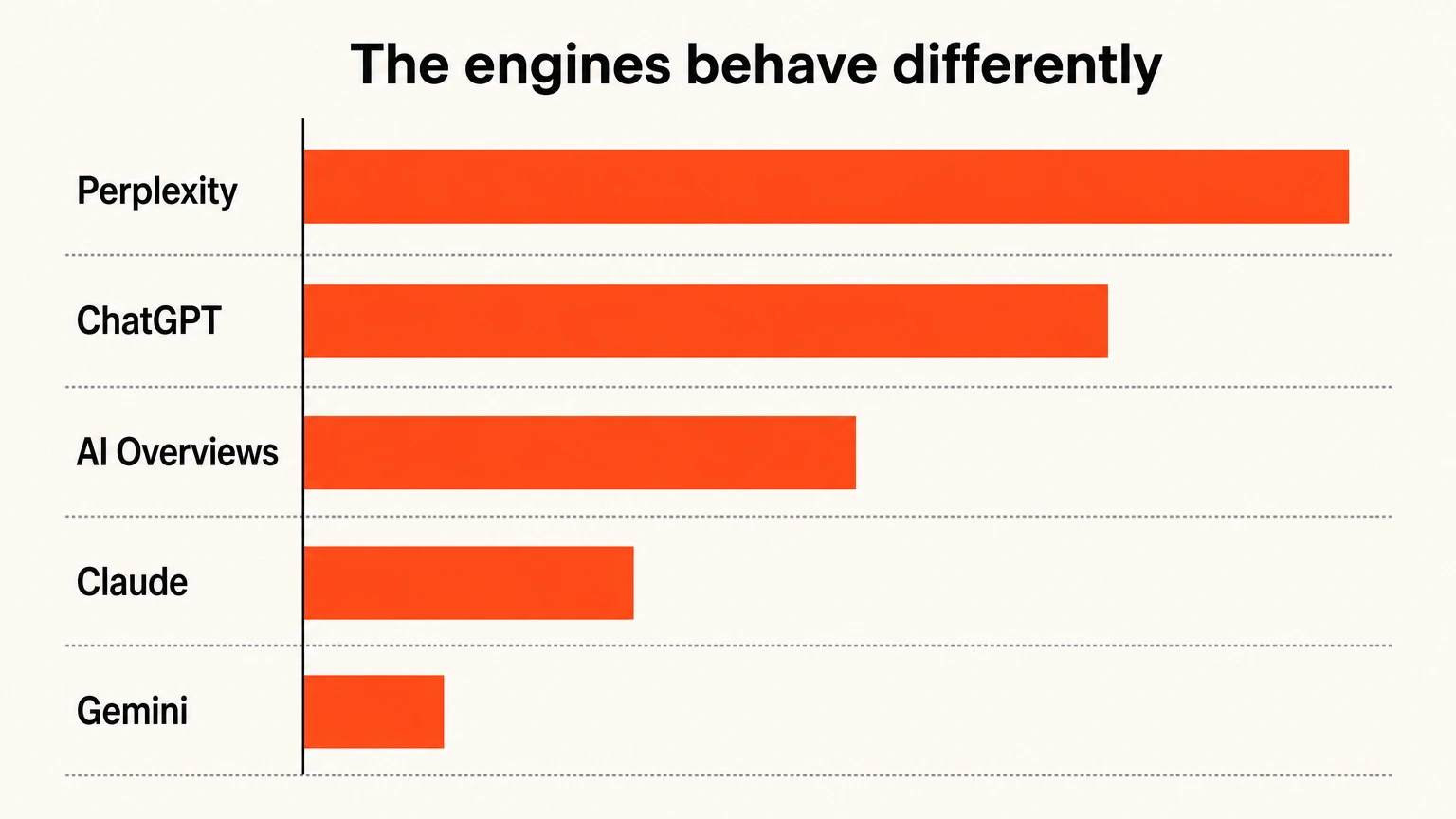
The engines behave differently
Treating AI search as one surface is the most common strategic error. Citation patterns diverge enough that a strategy which works on one engine can leave you invisible on another.
| Engine | How it sources | What moves it |
|---|---|---|
| ChatGPT | Live retrieval plus training data, favoring established well-linked sources | Category roundups and long-standing authority |
| Perplexity | Heavy live search, cites visibly and aggressively | Ranking well on the underlying query |
| Claude | Retrieval with a visible preference for structured, factually dense pages | Clear definitions, tables, self-contained claims |
| Google AI Overviews | Drawn largely from pages already ranking | Classic SEO plus snippet-friendly structure |
| Gemini | Google index plus its own synthesis | Entity clarity and structured data |
| Grok | Weights real-time social discussion heavily | Community presence, particularly on X and Reddit |
| Copilot | Bing index, and widely overlooked | Bing Webmaster Tools hygiene, which few teams bother with |
The practical read: Perplexity and AI Overviews reward classic SEO, so good rankings carry you a long way. ChatGPT and Claude reward third-party consensus and clean structure, which needs deliberate work. Grok rewards community presence most B2B teams have never built.
How to measure AEO
This is where most AEO offerings fall apart, because measurement is harder than the optimization and considerably less fun to sell.
- Citation rate. The share of your tracked prompt set where an engine names you. The headline number.
- Share of voice against named competitors. Citation rate is only meaningful relative to who else appears.
- Position within the answer. Named first, named as a budget option, or mentioned as a caveat are very different commercial outcomes.
- Sentiment and accuracy. Whether the description of your product is correct, which is a separate problem from whether you appear.
- Source composition. Which pages the answer drew on, which tells you exactly where to work next.
- AI-referred sessions. Small in volume, unusually high in intent. Tag them separately in analytics.
Answer engine outputs vary between sessions and change without notice. A single check tells you very little. Only a fixed prompt set, run repeatedly on a schedule, produces a trend you can act on. Anyone showing you a one-off screenshot as evidence of AEO performance is showing you noise.
We measure AEO across seven engines before touching anything
Most agencies added AI search to the deck when demand appeared. We run it as a standing measured service: a fixed prompt set built from your sales calls, baselined across seven engines before any work starts, then re-run on schedule with position, sentiment and source composition logged per engine.
- Baseline first. Recorded before we change anything, so movement is provable rather than asserted
- We work the source pool, not just your pages, because that is where most citations are decided
- Accuracy audits included. Being described wrongly costs more than being absent
- We will tell you when AEO is not your bottleneck, which is often. Usually it is rendering or authority.
Five AEO mistakes worth avoiding
- Treating it as separate from SEO. Building a parallel workstream duplicates effort and usually underfunds both.
- Optimizing pages while ignoring third-party sources. The majority of commercial citations come from pages you do not control.
- Skipping the baseline. Without it, three months later you have no way to demonstrate anything changed.
- Chasing llms.txt and similar proposals. No major engine has confirmed adoption. Harmless to add, not a strategy.
- Stuffing FAQ schema onto pages with no questions on them. Structured data describing content that is not there is a manual action risk, not a shortcut.
If you want the version of this specific to software companies, the SaaS AI search guide covers per-engine strategy and the fix protocol for inaccurate descriptions. If you would rather start with what is technically broken, the 47-point checklist puts AEO in its proper sequence, which is after your pages can actually be crawled.
Frequently asked questions
What is answer engine optimization?
What is the difference between AEO and SEO?
What is the difference between AEO and GEO?
How do you do answer engine optimization?
Is ChatGPT an answer engine?
What are the best answer engine optimization tools?
Does AEO replace SEO?
How long does AEO take to show results?
How do you measure answer engine optimization?

Mohammad Qaiser
Working in SEO since 2010, founder of Authority Magnet since 2018, and campaign lead on every case study the agency publishes. Also built PRWiz, where this work gets tested on our own software before it reaches a client.
Work with us