What is SaaS SEO?
SaaS SEO turns organic search and AI answers into free trials, demos and recurring revenue, not traffic reports. This is the complete model: how the funnel works in reverse, which eight pages actually convert, the technical layer software companies get wrong, and what to measure.
What is SaaS SEO?
SaaS SEO is search optimization built around a subscription business, where the goal is qualified trials and demos rather than traffic, and the pages that matter are comparison, alternative and integration pages rather than blog posts.
The difference from general SEO is what you optimize toward. An e-commerce site optimizes for transactions that complete in one session. A software company optimizes for a buyer who researches for weeks, reads four or five specific publications, compares you against two named competitors, and converts on a page most SEO programs never prioritize.
It also now has a second surface. The same comparison pages and category roundups that rank in Google are the sources ChatGPT, Claude and Perplexity retrieve when someone asks which tool to buy, so the work returns twice.
Key takeaways: SaaS SEO in five points
- SaaS SEO optimizes for revenue, not traffic. The conversion event is a free trial, a demo or a product-qualified lead. Never a session count.
- Bottom-of-funnel pages carry the program. Comparison, alternative, integration and use-case pages convert while blog posts build the surrounding authority.
- Technical debt is the usual bottleneck. JavaScript rendering, app-shell indexation and canonical logic break more SaaS sites than thin content does.
- AI answers are now a shortlisting surface. Buyers ask ChatGPT, Claude, Perplexity and Google AI Overviews which tool to use before they click anything.
- The honest timeline is three to six months for compounding results, with technical and bottom-funnel wins landing sooner.
SaaS SEO: a working definition
SaaS SEO is the practice of optimizing a software company's website for organic search and AI answer engines so that visibility converts into free trials, demos, product-qualified leads and recurring revenue. It differs from general SEO in what it targets, what it fixes, and what it counts as a result.
The distinction matters because software is bought differently from almost anything else. A buyer evaluating a CRM does not search once and purchase. They search a category term, read a comparison, check a review platform, ask an AI assistant for a shortlist, start two free trials, and involve three colleagues before anyone signs. SEO built for that journey looks nothing like SEO built to sell a single product from a single landing page.
In practice, a SaaS SEO program covers five workstreams: technical foundations that let a JavaScript-heavy application be crawled and indexed; keyword and intent mapping tied to your ideal customer profile; page production weighted toward the bottom of the funnel; authority building through earned links and brand mentions; and citation visibility inside the AI engines where shortlists now get formed.
If your SEO reporting leads with sessions, you have general SEO. If it leads with trials, demos and pipeline influenced, you have SaaS SEO.
How SaaS SEO differs from traditional SEO
Nine factors change once the thing you sell is a subscription rather than a transaction.
| Factor | Traditional SEO | SaaS SEO |
|---|---|---|
| Goal | Traffic and rankings | Trials, demos and recurring revenue |
| Conversion event | Purchase or contact form | Free trial, demo booking, PQL, SQL |
| Buying cycle | Days, often one session | Weeks to months, multiple stakeholders |
| Revenue model | One-off transaction | Recurring. MRR and ARR, where churn and LTV decide whether the signup was worth acquiring |
| Winning content | Blog posts and service pages | Comparison, alternative, integration, use-case and pricing pages |
| Technical scope | Crawl and index basics | JavaScript rendering, SPAs, app shells, documentation, canonical logic, crawl budget |
| Scale mechanism | Hand-built pages | Programmatic pages across integrations, use cases and comparisons |
| AI search | Emerging concern | Core. Buyers form shortlists inside the answer |
| Reported metric | Sessions, average position | PQLs, SQLs, CAC payback, ARR influenced, citation share |
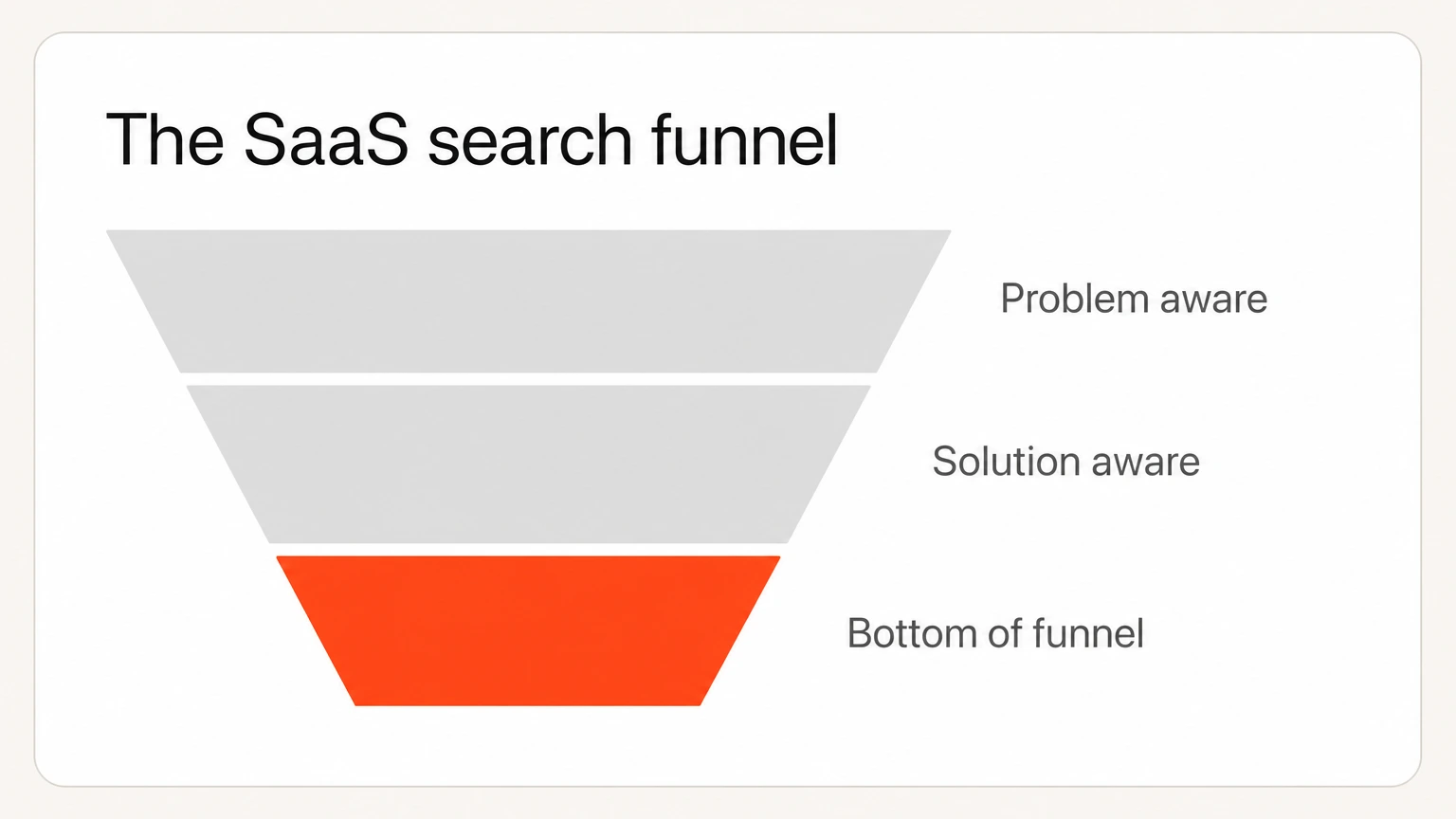
The SaaS search funnel
Most SaaS SEO fails because it starts at the top. Reverse the order and revenue arrives sooner.
Bottom of funnel
Start here. Weeks to impact- Alternative searches. "[Competitor] alternatives", run by buyers actively switching
- Comparison searches. "[Competitor] vs [competitor]", run during shortlisting
- Category searches. "Best [category] software for [segment]"
- Pricing and integration searches. The last checks before signup
Middle and top
Build underneath. Months to compound- Problem-aware searches. The pain your product solves, before the buyer knows tools exist
- Jobs-to-be-done guides. "How to run [process]", where your product is the natural answer
- Templates and free tools. Linkable assets that also capture emails
- Category education. The content that earns citations and links
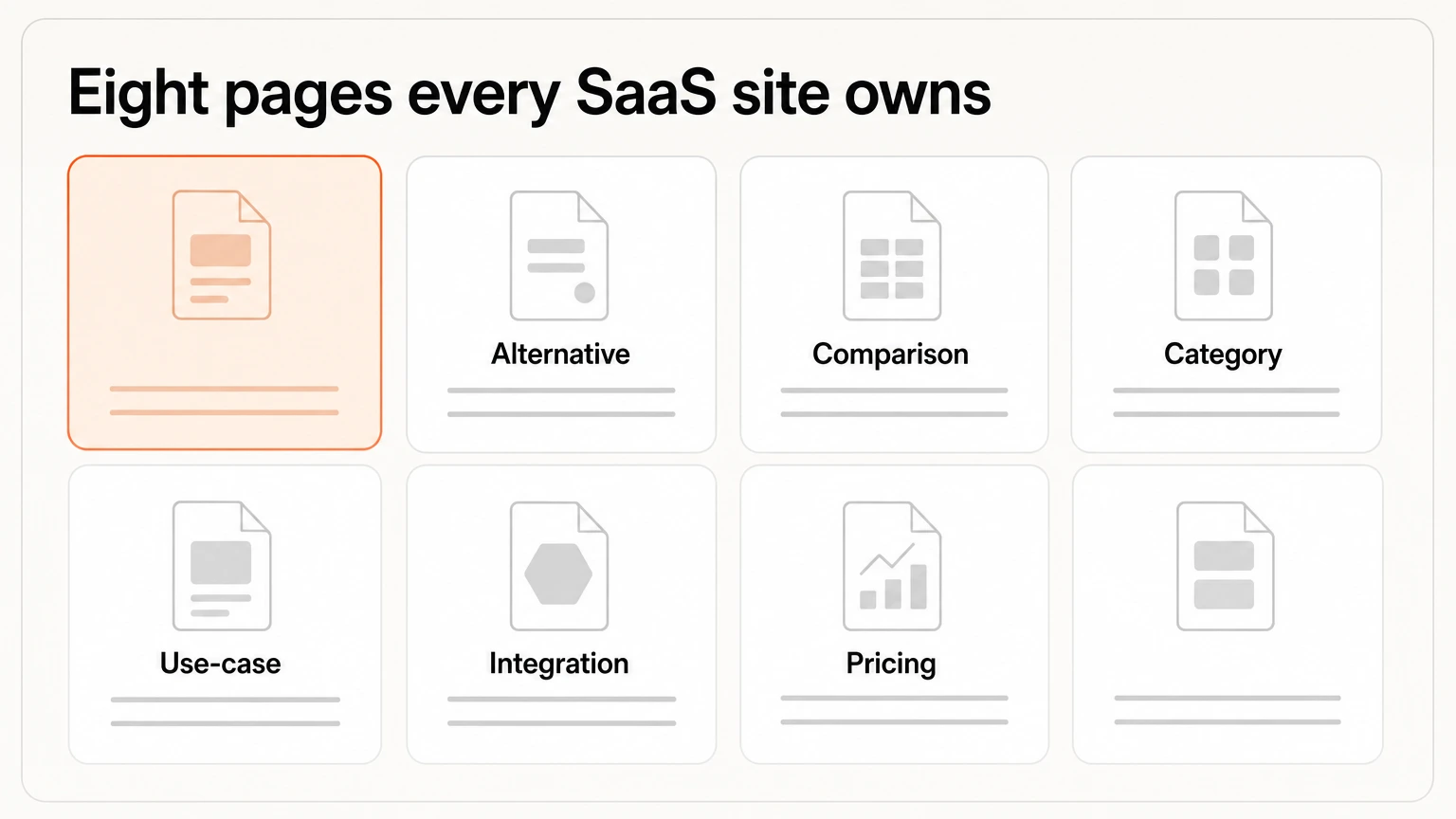
The eight pages every SaaS site should own
These are the templates that convert search intent into signups. Most SaaS sites are missing at least four.
Alternative pages
"[Competitor] alternatives." The buyer has already decided to leave someone. Be the page they land on.
Comparison pages
"You vs them", written honestly. Admitting where a rival is better earns the trust that closes the rest.
Category pages
"Best [category] software for [segment]." The highest-competition, highest-value terms in your market.
Use-case pages
One page per job your product does, in the language the buyer uses for that job rather than your feature names.
Integration pages
One page per tool you connect to. Programmatic, high-converting, and usually the fastest scalable win available.
Pricing page
Buyers search "[product] pricing" by name. Hiding the number sends them to a third-party page you do not control.
Free tools
A calculator or generator that solves one slice of the problem. Earns links passively and demonstrates competence.
Templates & libraries
Programmatic assets that rank for hundreds of long-tail terms and pull the user into the product to use them.
The technical layer SaaS gets wrong
Software companies build applications, and applications are constructed in ways that search crawlers find difficult. This is the single most common reason a well-funded SaaS content program produces nothing: the pages were never properly indexed in the first place.
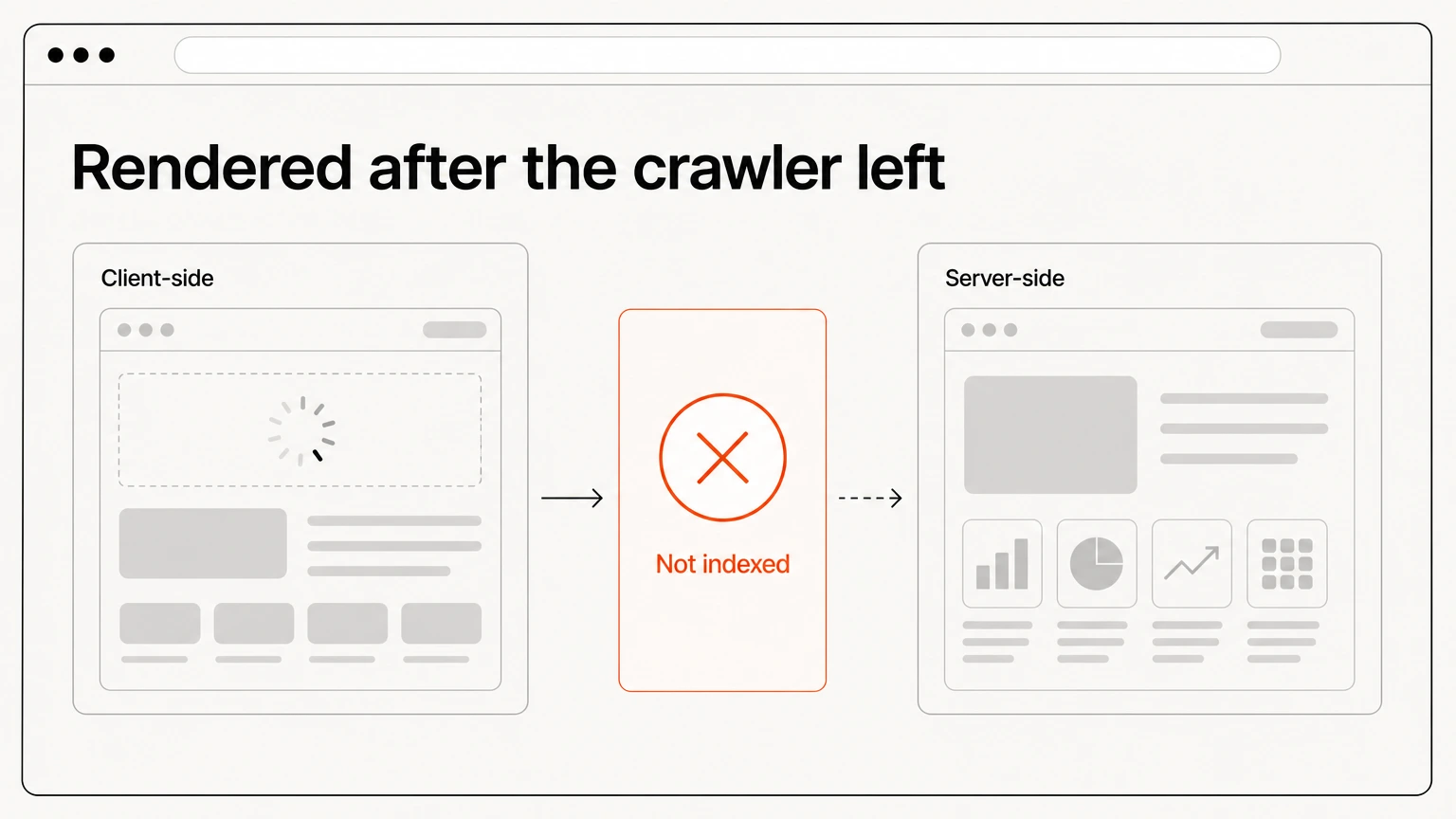
JavaScript rendering
If your marketing pages are client-side rendered, Google has to execute your JavaScript before it can see the content. It usually manages, eventually, but the delay is real and other engines are less patient. AI crawlers are notably worse at it. Server-side rendering or static generation for anything you want ranked removes the entire risk class.
App shell and gated content bleed
Logged-in application routes, staging subdomains and thin utility pages routinely leak into the index, diluting crawl budget and confusing the site's topical signals. A clean separation between application and marketing site, with correct robots directives, fixes it.
Programmatic pages without thin-content guards
Generating a page per integration is powerful. Generating four hundred near-identical pages with one word swapped triggers quality problems that can suppress the whole directory. Every programmatic template needs genuinely unique content per page and a threshold below which the page does not get published.
Canonical and parameter logic
Multi-region sites, filtered listing views and documentation versioning all create duplicate URL paths. Canonical tags handle it when they are deliberate, and create silent ranking loss when they are inherited from a template nobody has reviewed.
Run site:yourdomain.com and count what you find. If the number is dramatically higher or lower than your intended page count, your technical layer is your bottleneck and no amount of content will fix it.
AI search: the new shortlisting surface
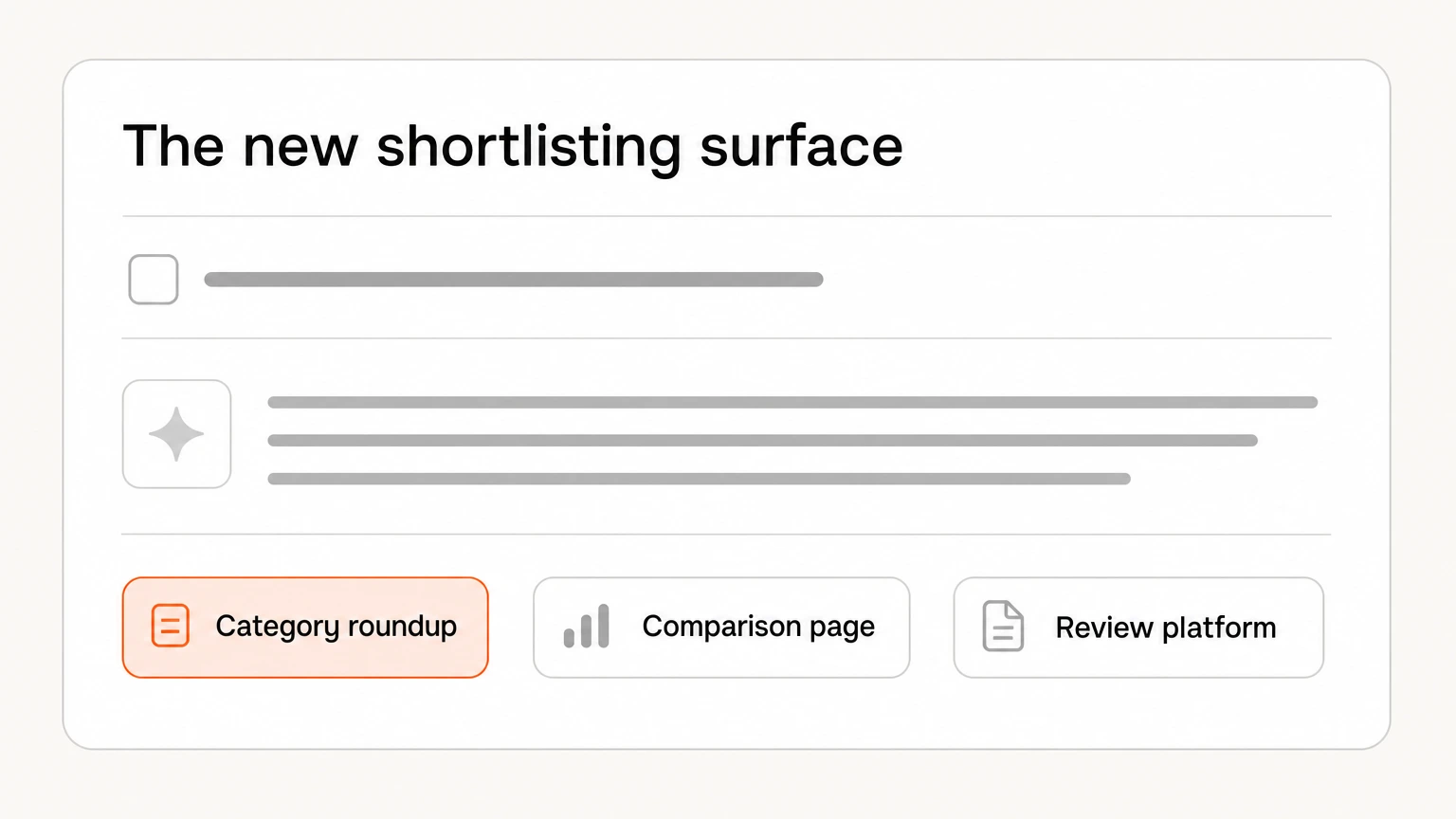
The material change to SaaS SEO since 2024 is that a large share of software buyers now begin with a question to an AI assistant rather than a search box. They ask which tool suits a team of twenty, or what the best alternative to a specific product is, and they treat the answer as a shortlist.
Those answers are assembled from sources the model trusts: category roundups, comparison articles, review platforms, community threads and well-structured vendor pages. Two consequences follow. First, getting mentioned in third-party roundups is now a direct acquisition activity rather than a branding nicety. Second, your own pages need to be structured so a model can lift a clean, self-contained claim out of them.
What makes a page quotable
- A direct answer in the first two sentences, before any preamble
- Explicit definitions written as "X is Y" rather than implied through narrative
- Tables and specific numbers, which models extract far more reliably than prose
- Self-contained sections that make sense without the paragraphs around them
- Named authors, dates and citations, which raise the trust signals models weigh
This is worth measuring rather than assuming. Citation share across ChatGPT, Claude, Perplexity, Google AI Overviews, Gemini, Grok and Bing can be tracked per buyer question, and it moves independently of your Google rankings.
What to measure
Leading indicators tell you whether the work is landing. Outcomes tell you whether it was worth doing. Report both, but never confuse them.
Leading indicators
- Top-3 commercial keyword count
- Pages indexed versus published
- Referring domains earned
- Core Web Vitals
- AI citation share of voice
Outcomes
- Free trials and demos from organic
- Product- and sales-qualified leads
- Pipeline influenced by organic pages
- CAC payback versus paid
- ARR influenced, and retention of those cohorts
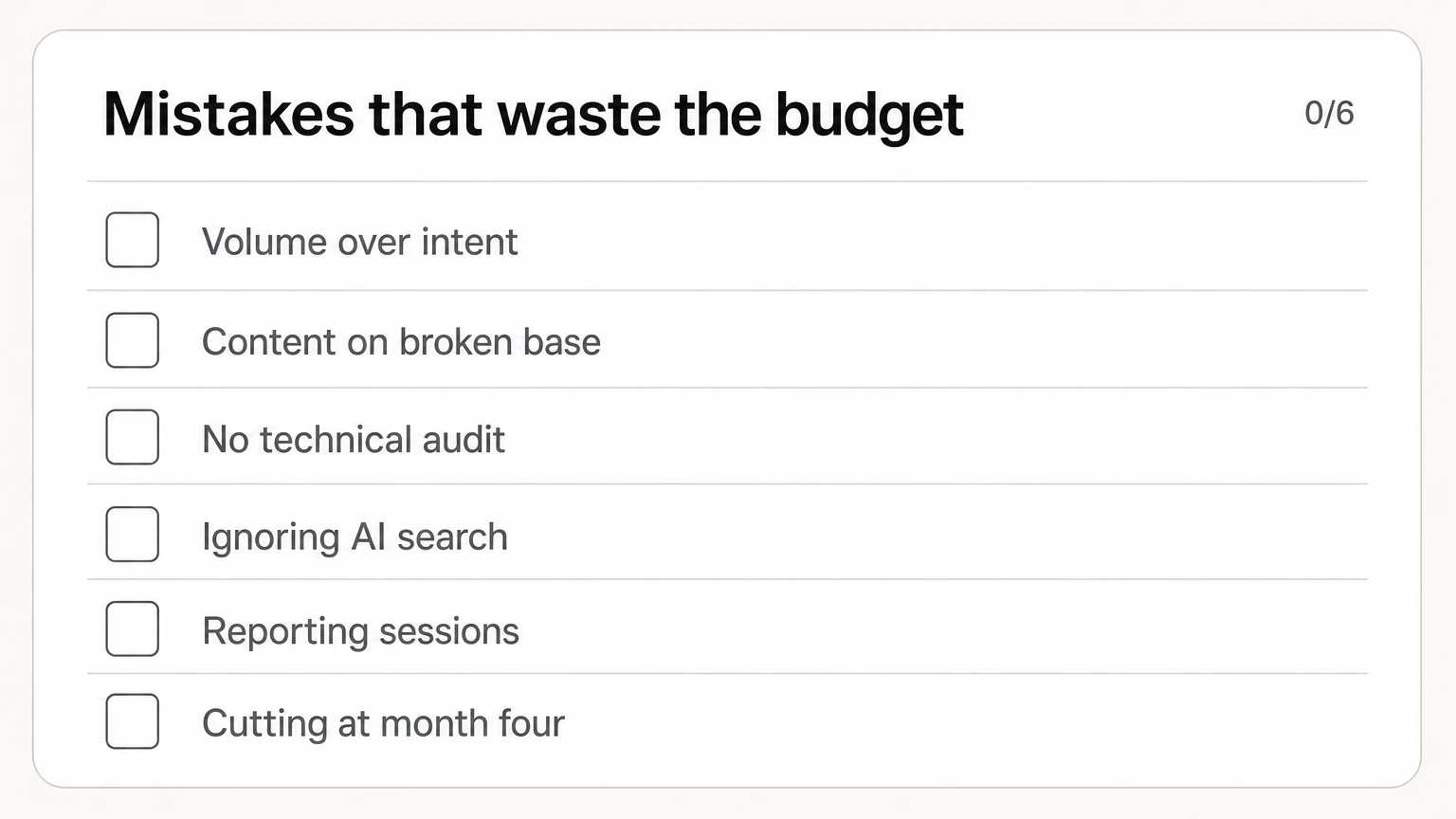
Seven mistakes that waste a SaaS SEO budget
Strategy mistakes
- Starting at the top of the funnel. Publishing awareness content for six months before touching a comparison page delays every signal of progress.
- Chasing volume over intent. A term with 20,000 searches and no buying intent is a worse investment than one with 200 and a credit card behind it.
- Treating content as a publishing quota. Four posts a month is an output, not a strategy. Nobody in the buying committee cares how many you shipped.
- Ignoring the sales team. The objections your reps answer daily are the exact queries your buyers type. Not mining them is free money left behind.
Execution mistakes
- Shipping content onto a broken technical base. Unindexed pages cannot rank, however good they are.
- Building comparison pages that only flatter you. Buyers detect it instantly, and so increasingly do the models summarizing you.
- No conversion path on the page. A ranking page with no clear next step is an expensive way to educate someone else's customer.
How to start a SaaS SEO program
If you are beginning from close to nothing, the order below produces signal fastest. It is the sequence we run on new engagements, and the same order works in-house.
- Audit indexation before anything else. Establish what Google can actually see, render and index. Fix that first; everything downstream depends on it.
- Interview sales and mine call recordings. Extract the words buyers use, the competitors they name, and the objections they raise. This becomes your keyword list, not a volume export.
- Map keywords to buying stage and ICP segment. Group by intent rather than topic, and mark which terms indicate an active evaluation.
- Ship the bottom-funnel set. Two or three alternative pages, one or two comparisons, and your highest-value category page. Build the conversion path into the brief.
- Baseline your AI citation share. Record how often each engine names you for your core buyer questions before you change anything, so you can prove movement later.
- Start earned authority work. Target the roundups and publications that both pass link equity and feed AI answers.
- Layer the authority content underneath. Now build the topical depth that makes the commercial pages defensible.
- Instrument reporting to pipeline. Connect organic sessions to trials, demos and CRM outcomes. If you cannot see which page produced revenue, you cannot allocate budget.
Where teams usually need help
- Steps 1 and 8 are where in-house teams most often stall. Both need engineering and analytics access rather than marketing effort.
- Step 6 is the hardest to do without existing relationships, and the easiest to do badly and get penalized for.
- Steps 2 to 5 are very doable in-house if someone owns them properly.
SaaS SEO questions
The questions software teams ask most often when they start looking into this.
Talk to us about your SaaSWhat is SaaS SEO in simple terms?
What is an example of SaaS SEO?
How is SaaS SEO different from normal SEO?
Is SaaS SEO still worth it in 2026?
How long does SaaS SEO take to work?
What are the most important SaaS SEO metrics?
Should a SaaS company do SEO in-house or hire an agency?
What is product-led SEO?
Want this run for you?
We take a limited number of SaaS clients and start bottom-of-funnel. Tell us the product, the category and who you are up against.
Operator-run since 2018 · From $5,000/mo · Reply within 24h