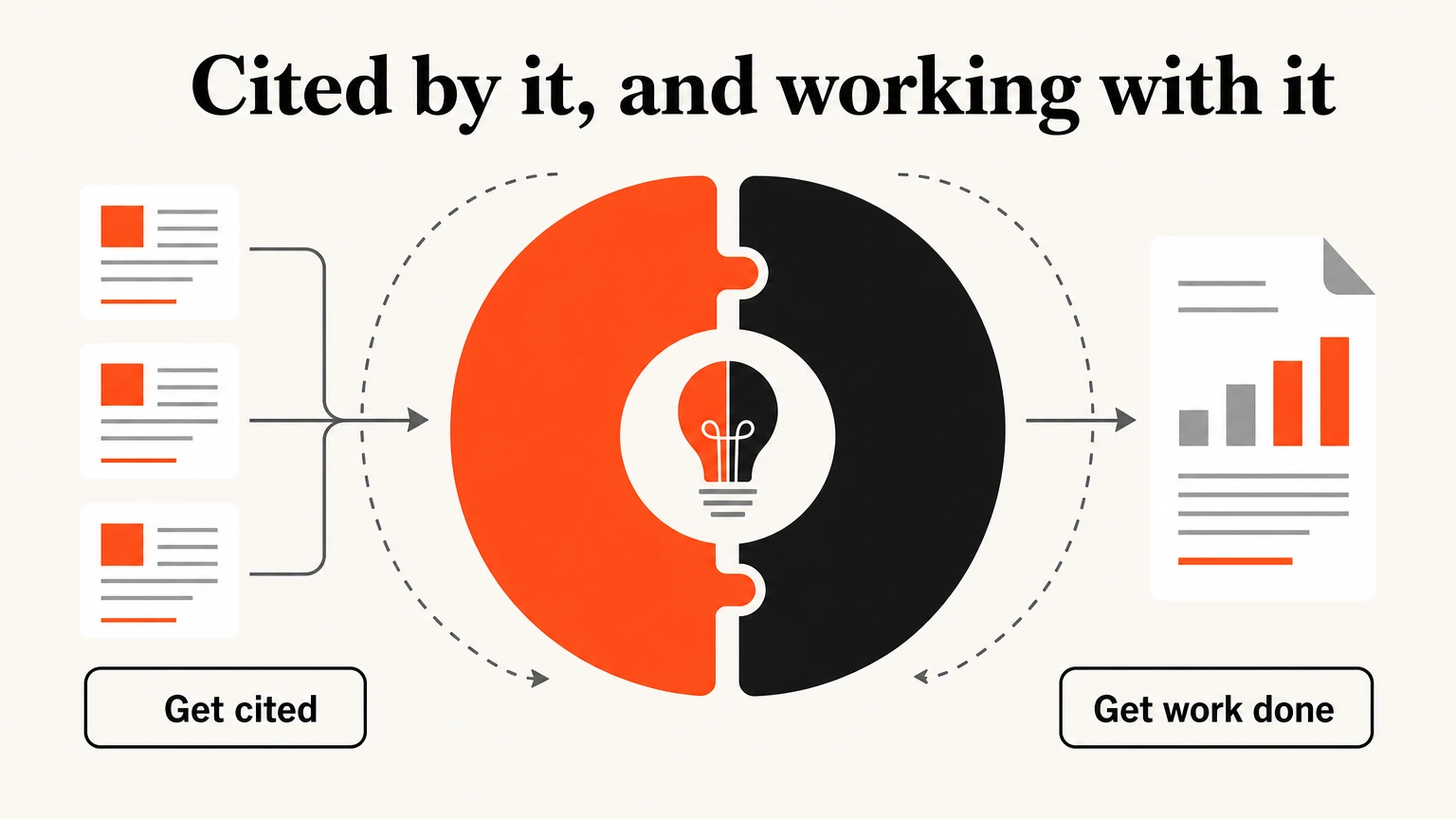
"ChatGPT SEO" means two completely different things, and search results for the phrase are split roughly down the middle between them. One group wants ChatGPT to mention their brand. The other wants to use ChatGPT to do SEO work faster. This covers both, starting with whichever you came for.
ChatGPT SEO means either getting ChatGPT to cite your brand in its answers, or using ChatGPT as a tool to do SEO work. For the first, the requirements are being indexed in Bing and Google, question-shaped content with direct answers, and brand authority across third-party sources. For the second, it is excellent at drafting and structuring, and unreliable at auditing.
Jump to getting cited by ChatGPT, or to using ChatGPT for SEO work.
Part one: getting ChatGPT to cite your brand
Start with the correction that saves the most wasted effort. There is no rank one in ChatGPT. The model does not order results; it writes an answer and decides which brands are credible enough to name inside it. You are in the answer or you are not, and there is no fourth place in a sentence.
That reframing matters because it changes what you optimize. You are not competing for a slot. You are trying to be one of the three or four names a model considers safe to recommend.
How ChatGPT finds anything at all
Two mechanisms, and only one is under your control.
The first is training data, frozen at a cutoff. This is why ChatGPT sometimes states confidently outdated facts about products, and why nothing you publish today fixes it directly.
The second is live browsing. When ChatGPT needs current information, it searches the web, and the underlying index it draws on is Bing's, alongside Google. This produces the single most actionable and most ignored implication in this whole discipline: if you are not indexed in Bing, ChatGPT cannot find you when it browses.
Most marketing teams have never opened Bing Webmaster Tools. Verify your site, submit your sitemap, and check the index coverage report. It takes about fifteen minutes, costs nothing, and it is a prerequisite for ChatGPT's browsing to reach you at all. Compared with the effort most teams pour into AI visibility tactics, the return here is absurd.
What actually earns a citation
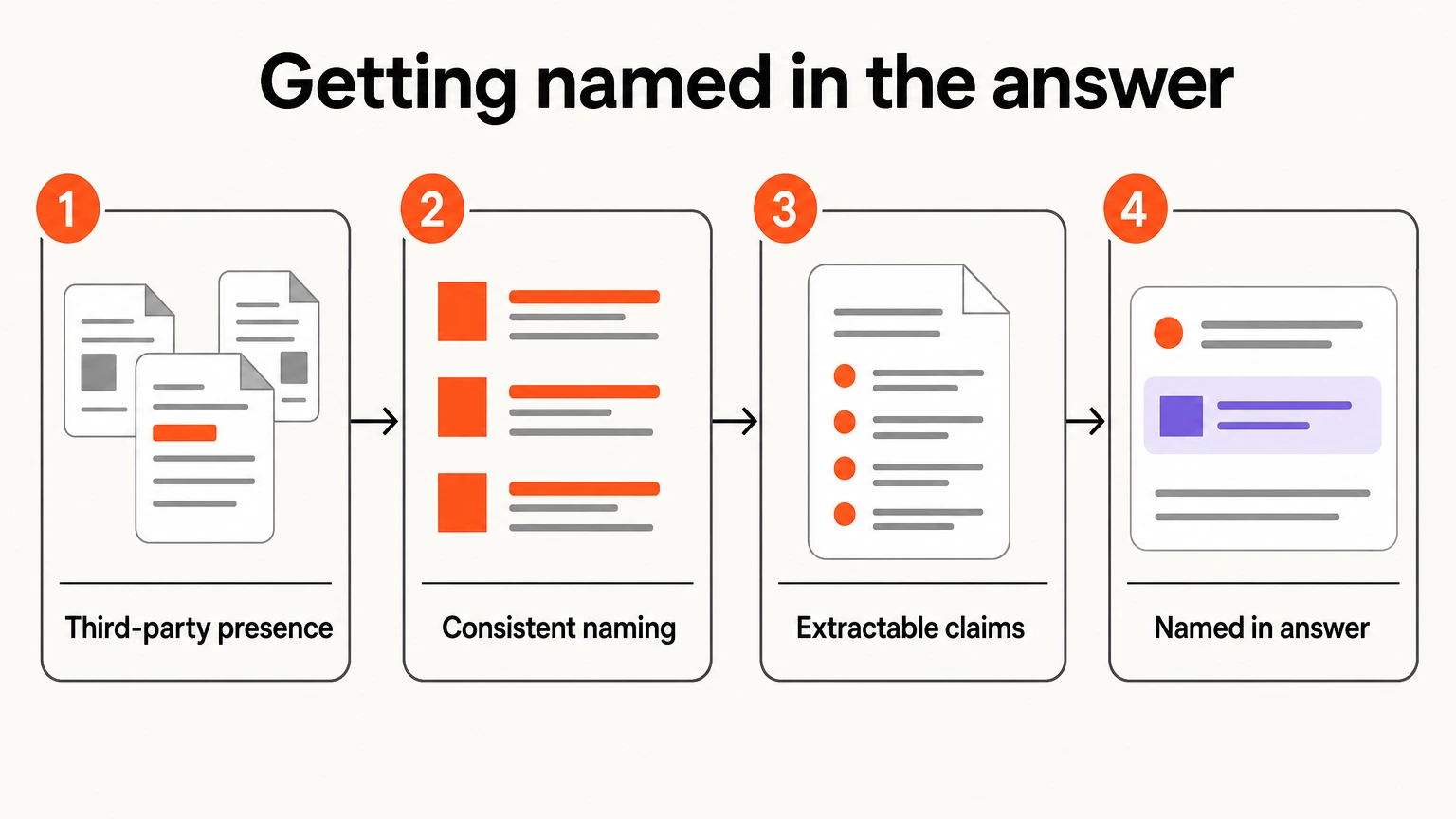
Once you are findable, five things decide whether you get named. They are unglamorous and they compound.
- Be indexed in Bing and Google. The prerequisite. Everything else is wasted without it.
- Write in question-and-answer shape. Headings phrased as questions your buyers actually ask, with the direct answer in the first sentence underneath rather than four paragraphs down.
- Add structure the model can parse. Lists, tables, and schema where the marked-up content genuinely appears on the page.
- Build authority off your own domain. Models weight mentions on review platforms, Reddit, Trustpilot and industry publications heavily, because independent corroboration is what makes a recommendation safe.
- Publish quotable specifics. Original figures, named methods, dated statistics and real case detail. A model choosing between two passages will take the one with a concrete number in it.
The uncomfortable pattern across all five is that most of your ChatGPT visibility is decided on pages you do not own. Your site needs to be findable and clean. The recommendation itself is built from third-party consensus.
The reputation problem, which matters more than absence
Teams worry about not appearing. The more expensive failure is appearing badly. ChatGPT will happily state that your product lacks a feature it shipped two years ago, or price you wrongly, or describe you as serving a segment you abandoned, because it learned that from an outdated roundup nobody has updated.
That buyer never visits your site to discover otherwise. They read the answer, form a shortlist, and you are not on it for a reason you will never see in analytics.
Check this deliberately. Ask ChatGPT what your product does, what it costs, who it suits, and what its drawbacks are. Then ask what it is basing the answer on. The citation usually points straight at the source that needs correcting, and getting that publisher to update is often the highest-value hour available in week one.
Part two: using ChatGPT to do SEO work
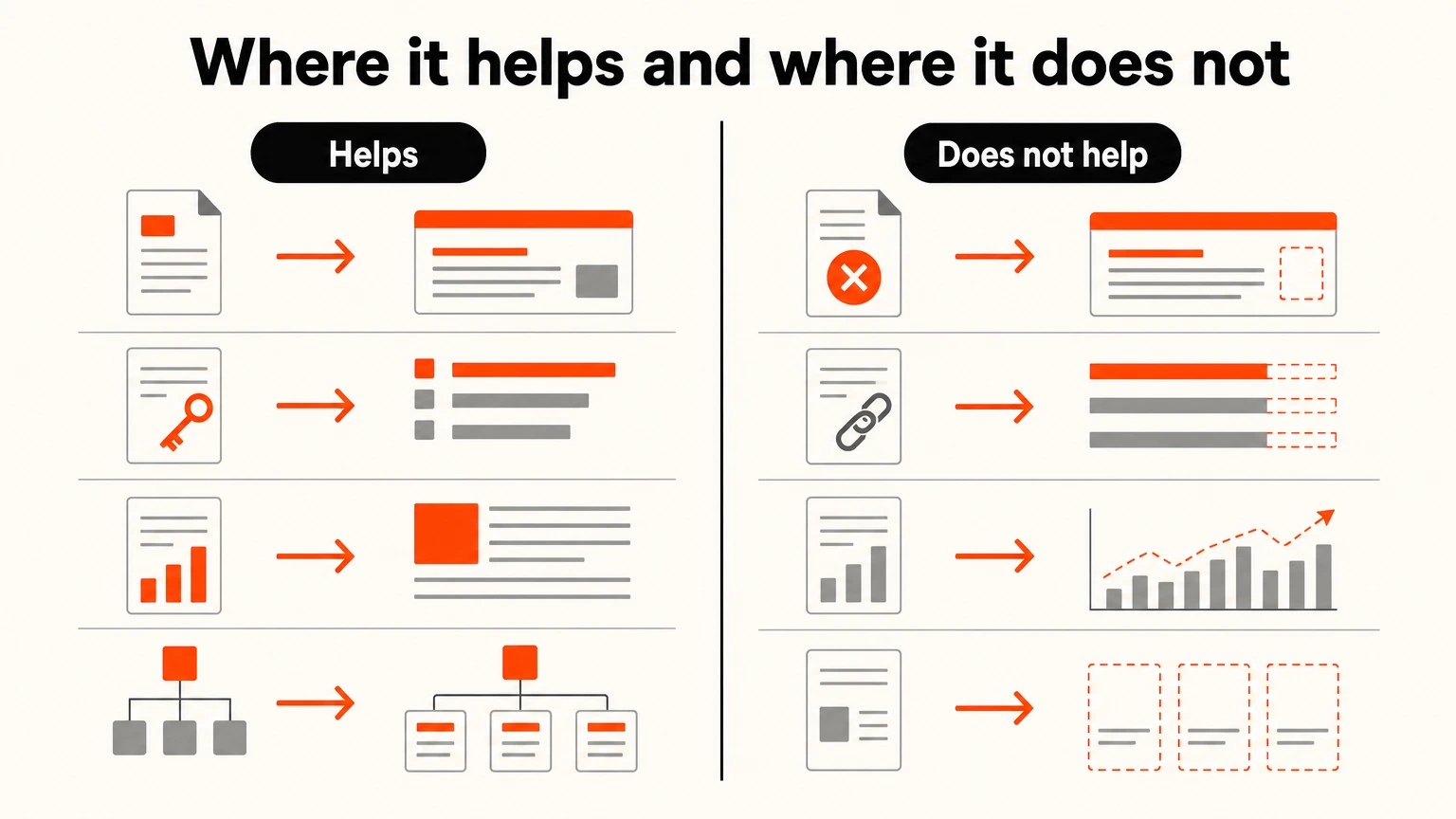
The other half of the search. Here the honest framing is that ChatGPT is genuinely excellent at some SEO tasks, mediocre at others, and actively dangerous at a few. Knowing which is which is the whole skill.
| Task | Verdict | Why |
|---|---|---|
| Clustering keywords by intent | Excellent | Genuine language understanding. Far faster than doing it by hand. |
| Drafting from a strong brief | Good | Structure and first drafts, provided a human wrote the brief. |
| Writing schema markup | Good | Well-documented syntax. Validate the output before shipping. |
| Summarizing competitor pages | Good | Fast structural analysis of what a ranking page covers. |
| Generating meta titles at scale | Good | With character limits stated and a human pass at the end. |
| Search volume and keyword data | Dangerous | It has no access to search data and will invent confident numbers. |
| Technical site audits | Unreliable | Misses a large share of obvious errors. Use a crawler. |
| Strategy and prioritization | Poor | Cannot weigh your roadmap, contract value or engineering capacity. |
| Final voice and product claims | Poor | Produces pages a competitor could publish by swapping the name. |
The keyword data trap
This one deserves its own warning because it looks so plausible. Ask ChatGPT for the monthly search volume of a keyword and it will give you a number. The number is invented. The model has no connection to search data and no way to know, but it is trained to sound confident.
People build content plans on these figures. Connect the model to real data through an API or a tool that provides it, or use it purely for clustering and let an actual keyword tool supply the volumes.
The audit trap
Pasting a URL and asking for an SEO audit produces a plausible-looking list that misses most of what matters. It cannot crawl your site properly, cannot compare rendered against raw HTML, cannot read your log files and cannot see your Search Console data.
Practitioners testing this consistently find it misses the large majority of critical, obvious errors. Use a crawler for the audit and use the model to help interpret and prioritize what the crawler found. That division of labor works well.
Where it genuinely earns its place
Clustering a few thousand keywords by intent used to take a competent analyst two days. It now takes about two hours, and the output is arguably better because the model is not fatigued by hour six. Same for summarizing what twenty ranking competitor pages have in common structurally.
That is real leverage, and it is why our own retainers cover more scope than the hours would otherwise buy. We are open about where we use it and where we do not, which is covered on the automations page.
We measure ChatGPT visibility rather than guessing at it
Every engagement starts with a fixed set of twenty to fifty buyer questions, drawn from your sales calls, run across ChatGPT and six other engines before we change anything. We record whether you appear, where in the answer, how you are described, and which sources the answer used. That last column tells us exactly where to work.
- Bing indexation checked in week one, because it is the prerequisite most teams have never verified
- Accuracy audit included. Being described wrongly costs more than being absent
- We work the third-party sources where the recommendation is actually decided
- We will tell you if AI visibility is not your problem, which is often. Usually it is rendering or authority.
A ChatGPT visibility checklist
In order. The first three cost almost nothing and are skipped by most teams.
- Verify your site in Bing Webmaster Tools and submit your sitemap. Fifteen minutes, and it is the prerequisite.
- Confirm your content exists in raw HTML. AI crawlers handle JavaScript worse than Googlebot. If your copy only appears after scripts run, assume it is invisible.
- Ask ChatGPT what your product is, then ask what it is basing that on. Correct the cited source before anything else.
- Rewrite your key pages in question-and-answer shape, with the direct answer immediately under each heading.
- Add one quotable specific per page. A real number, a dated figure, a named method.
- Complete your review-platform profiles. G2, Capterra, Trustpilot as relevant to your category.
- Pursue inclusion in category roundups, which is where most commercial recommendations originate.
- Re-run your question set monthly and record the trend rather than reacting to any single answer.
For the deeper mechanics of why structure affects citation, the LLM SEO guide covers retrieval and chunking. For the strategic frame across all engines, see answer engine optimization.
Frequently asked questions
What is ChatGPT SEO?
How do I rank number one in ChatGPT?
Does ChatGPT use Bing for search?
How do I get ChatGPT to mention my brand?
Can ChatGPT do SEO for me?
Is ChatGPT accurate for keyword research?
Why does ChatGPT say something wrong about my company?
Can ChatGPT run an SEO audit?

Mohammad Qaiser
Working in SEO since 2010, founder of Authority Magnet since 2018, and campaign lead on every case study the agency publishes. Also built PRWiz, where this work gets tested on our own software before it reaches a client.
Work with us