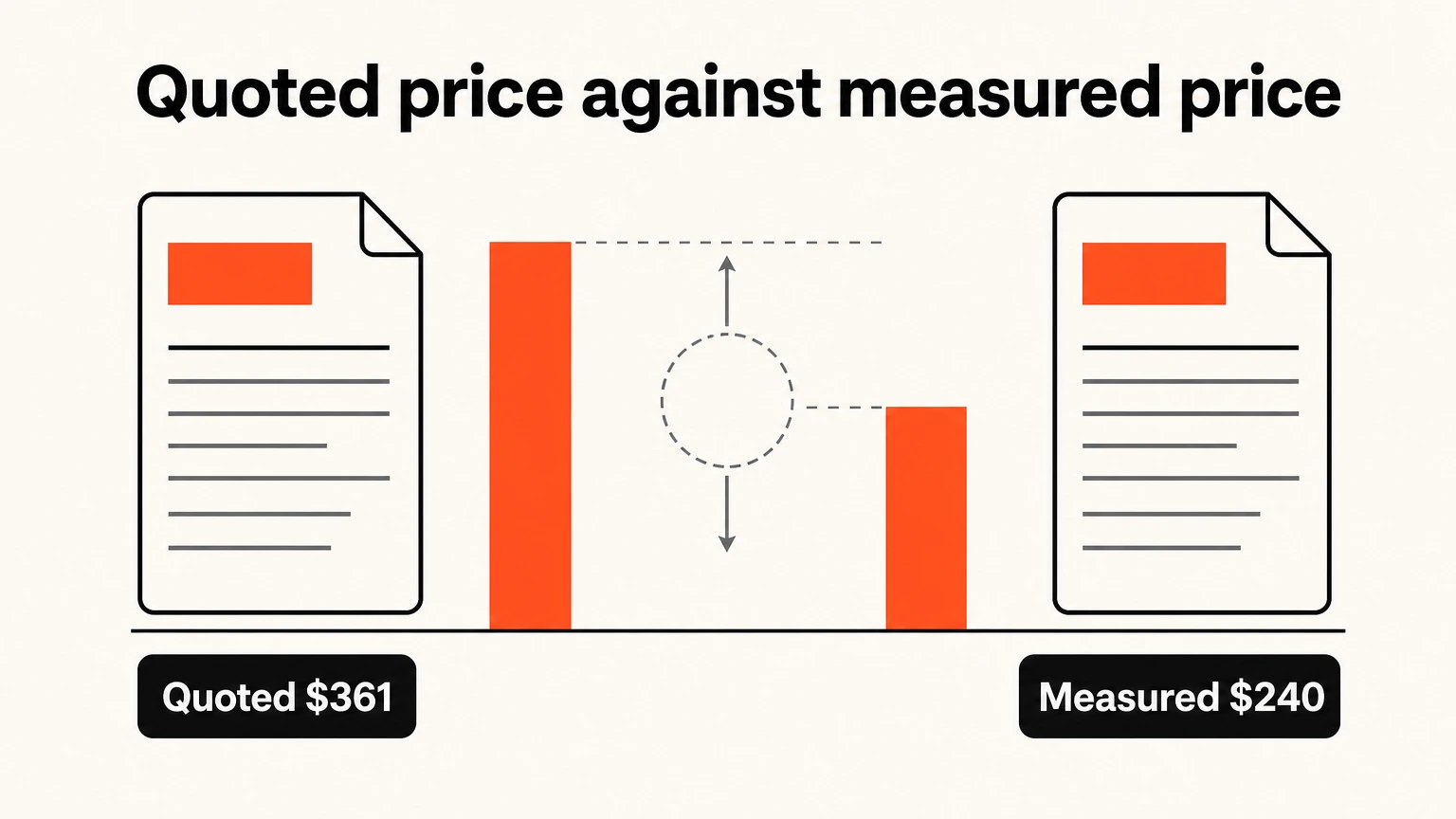
Every number you have read about link building pricing traces back to either a survey or a guess. Then PRWiz went and measured the market properly: 251,831 live offers across 91,518 domains and 15 marketplaces. I read the whole report, and these are the findings that matter if you run a SaaS company, plus the calculation it does not do, which is what a link is actually worth at your contract value.
The median price of a guest post backlink is $240, with the middle half of offers between $103 and $560. Link insertions run a median $263. Managed agency retainers run $1,000 to $10,000 a month. The $361 figure quoted across most pricing guides sits above 63.1% of the offers actually on sale.
A word on where these come from. The study is PRWiz's Backlink Price Index, not ours. PRWiz is a link building marketplace under the same parent company as this agency, run by a separate team on a separate product, which is worth stating plainly because they had a commercial interest in the answer. Two things make me trust it anyway: the methodology is published, and their own listings sit inside the index rather than beside it, which puts them twelfth of fourteen marketplaces on price rather than first. A study built to flatter its author does not usually rank the author near the bottom. Everything below is their data and my reading of what it means for software companies.
Why every published price is wrong in the same direction
Look at what the pages currently ranking for this question say a link costs. One says $461. Another says $300 to $750. Another says $50 to $2,000. Another gives $300 to $1,000. None of them states a sample size, and none distinguishes a mean from a median.
That last omission is the whole problem. Backlink prices are violently right-skewed:
| Statistic | Value | What it tells you |
|---|---|---|
| Median | $240 | What the market actually charges for a typical placement |
| Mean | $640 | What a handful of four-figure placements do to an average |
| Ratio | 2.7 to 1 | How badly a mean overstates this particular market |
| 95th percentile | $2,065 | The tail doing the damage |
| Offers above $1,500 | 7.6% | Small in count, enormous in effect on the average |
There is a second distortion worth naming. Most quoted figures are agency retail. When an agency reports paying $461 a link, that usually includes prospecting, outreach labor, content, account management and margin. It is a real number for a real service. It is not the price of a placement, and comparing the two is comparing a restaurant bill to a grocery receipt.
The distribution has no tidy cluster either. Roughly a fifth of the market sits in each of the $100 to $199, $200 to $349 and $350 to $749 bands, which is precisely why any single average is meaningless.
What Domain Rating actually does to a price
| DR band | Offers | Median | Middle half |
|---|---|---|---|
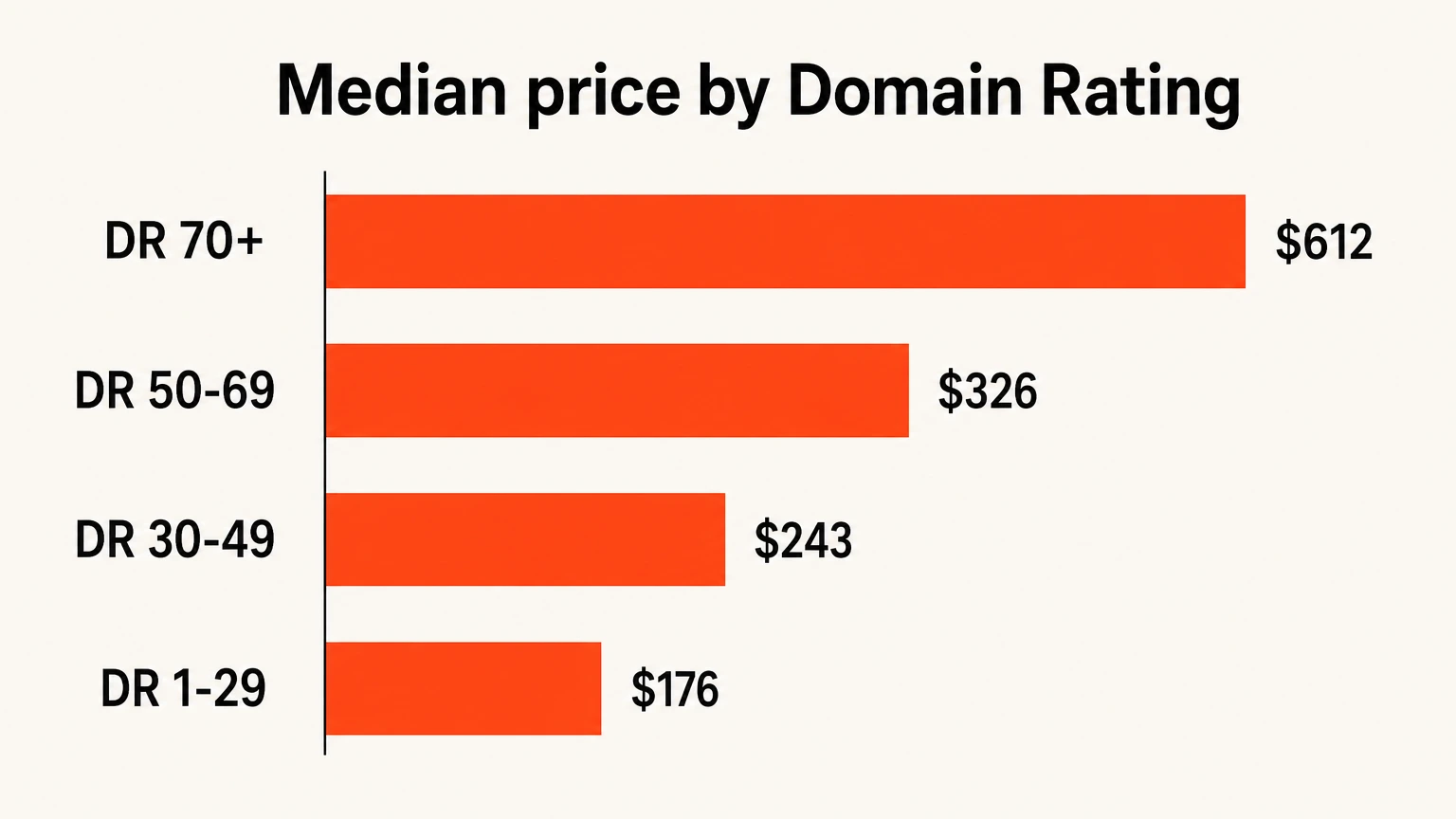
| DR 1 to 29 | 63,305 | $176 | $80 to $357 |
| DR 30 to 49 | 59,726 | $243 | $111 to $518 |
| DR 50 to 69 | 34,521 | $326 | $130 to $798 |
| DR 70+ | 18,004 | $612 | $210 to $1,526 |
Bottom to top multiplies the median by 3.5. That is a real premium and a long way from the tenfold jump implied when a vendor quotes $2,000 for a DR 70 placement. Note the ranges: at DR 70+ the middle half runs $210 to $1,526, a sevenfold spread inside a single authority band. Authority alone cannot explain a price.
Readership prices links better than authority does
This is the most useful finding in their dataset, and it changes how you should filter any marketplace.
| Monthly organic traffic | Offers | Median price |
|---|---|---|
| 500 to 5K | 81,203 | $183 |
| 5K to 25K | 49,274 | $282 |
| 25K to 100K | 17,385 | $380 |
| 100K+ | 18,375 | $580 |
Traffic spreads price 4.5 times against 3.5 times for Domain Rating. Cross the two signals and the result is the single clearest number in their study:
A site with DR under 40 and more than 25,000 monthly visitors costs a median $283. A site with DR 50 or better and under 1,000 visitors costs $138. Measured across 11,125 offers in the index. The market charges double for readers and discounts authority without them, which is the opposite of how most buyers filter.
The practical instruction: sort on traffic first and use authority as the tiebreaker. If you sort a marketplace by DR and buy from the top, you will routinely pay a premium for pages nobody reads.
The same link costs 30% more depending where you buy it
Of the 91,518 domains PRWiz analyzed, 65,340 are sold by two or more marketplaces. That is 71% of the market: the same publisher, the same slot, listed in several storefronts at different prices.
- The median gap is 30%, or $55 on top of the cheaper listing
- On 17.2% of shared domains the price at least doubles
- On 7.2% it triples, and on 2.5% it is five times or more
None of that is fraud. Marketplaces negotiate their own publisher rates, carry different margins and resell each other's inventory. It is what a market with no published prices does to the people buying in it. The practical response is simple: open a second marketplace before you buy. On one placement in six that habit is worth half the price.
What software companies actually pay
Here is the part of their data that should cheer up anyone selling software. Technology is one of the cheapest major categories in the entire index.
| Category | Offers | Median | Like-for-like |
|---|---|---|---|
| Finance | 3,356 | $404 | $424 |
| Automotive | 3,267 | $352 | $418 |
| Travel | 11,069 | $332 | $409 |
| SaaS and software | 2,228 | $297 | not measured |
| News and media | 37,751 | $240 | $216 |
| Business | 6,133 | $240 | $228 |
| Technology | 8,184 | $210 | $199 |
Finance costs nearly double technology. The driver is commercial value rather than risk: a finance publisher knows what a mortgage lead is worth and prices for it. Technology sits at the bottom because supply is enormous, and on a like-for-like slice it is the cheapest major category in the index at $199.
Two consequences for a SaaS founder. Your placements are cheaper than almost anyone else's, so the budget goes further than the published guides suggest. And because supply is enormous, relevance filtering matters more for you than for anyone else: there is a vast amount of cheap technology inventory that your buyers have never read.
What a link is worth at your contract value
This is the calculation the pricing guides never do, and it is the only one that matters for a founder. Stop asking what a link costs and work out what one is worth to you.
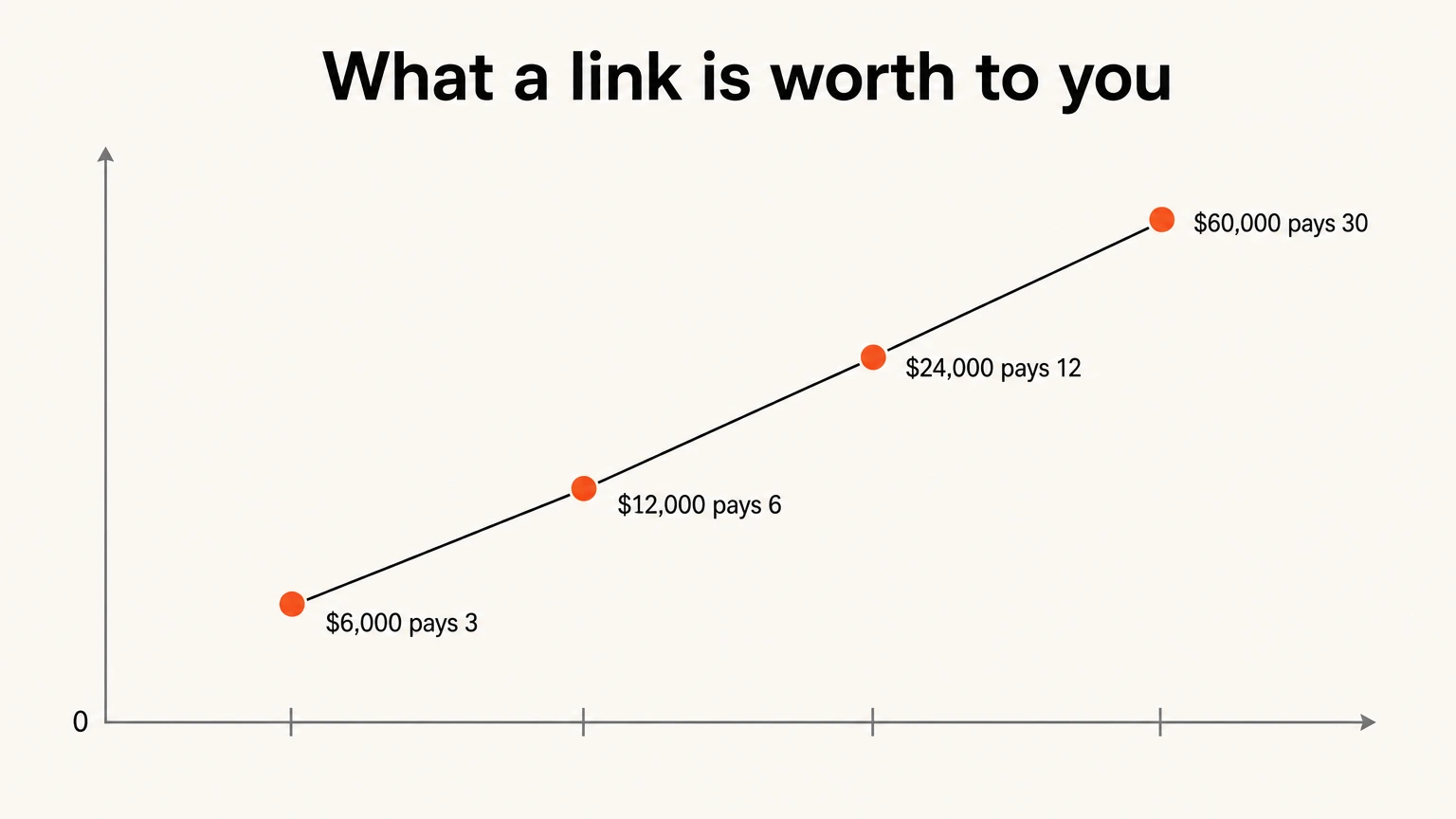
The chain runs: keyword volume, to click-through, to trial, to customer, to contract value. Here it is with real arithmetic at three contract values, assuming a page that reaches position three for a keyword doing 200 searches a month, a 12% click-through, and a 3% visit-to-trial rate.
| Your ACV | Trials per month | New customers at 10% | Monthly contract value | Placements it pays for |
|---|---|---|---|---|
| $6,000 | 0.7 | 0.07 | $420 | 3 at the $138 median |
| $12,000 | 0.7 | 0.07 | $840 | 6 |
| $24,000 | 0.7 | 0.07 | $1,680 | 12 |
| $60,000 | 0.7 | 0.07 | $4,200 | 30 |
Read the last column as: how many placements could you buy to rank that one page and still be ahead inside the first month of the customer it produces. At a $60,000 contract value the answer is thirty, which is more than most pages need. At $6,000 it is three, which is probably not enough to move a competitive term.
Below roughly $6,000 in average contract value, paid link building rarely clears its own cost on a single page, and the money is usually better spent on content that earns links without being bought. Above about $20,000 the arithmetic is so comfortable that the constraint stops being budget and becomes finding placements worth having. Most published pricing advice ignores contract value entirely, which is why it is useless for deciding anything.
One more variable that is now real and rarely priced in. The category roundups and comparison pages that pass link equity are also the sources AI engines retrieve when someone asks which tool to buy. A placement that used to return ranking value now often returns citation value too, which shifts the arithmetic above in your favour without changing the price. We cover the measurement side of that in AI search for SaaS.
What a monthly budget actually buys
| Monthly budget | At index median $240 | At marketplace median $138 | What that pace looks like |
|---|---|---|---|
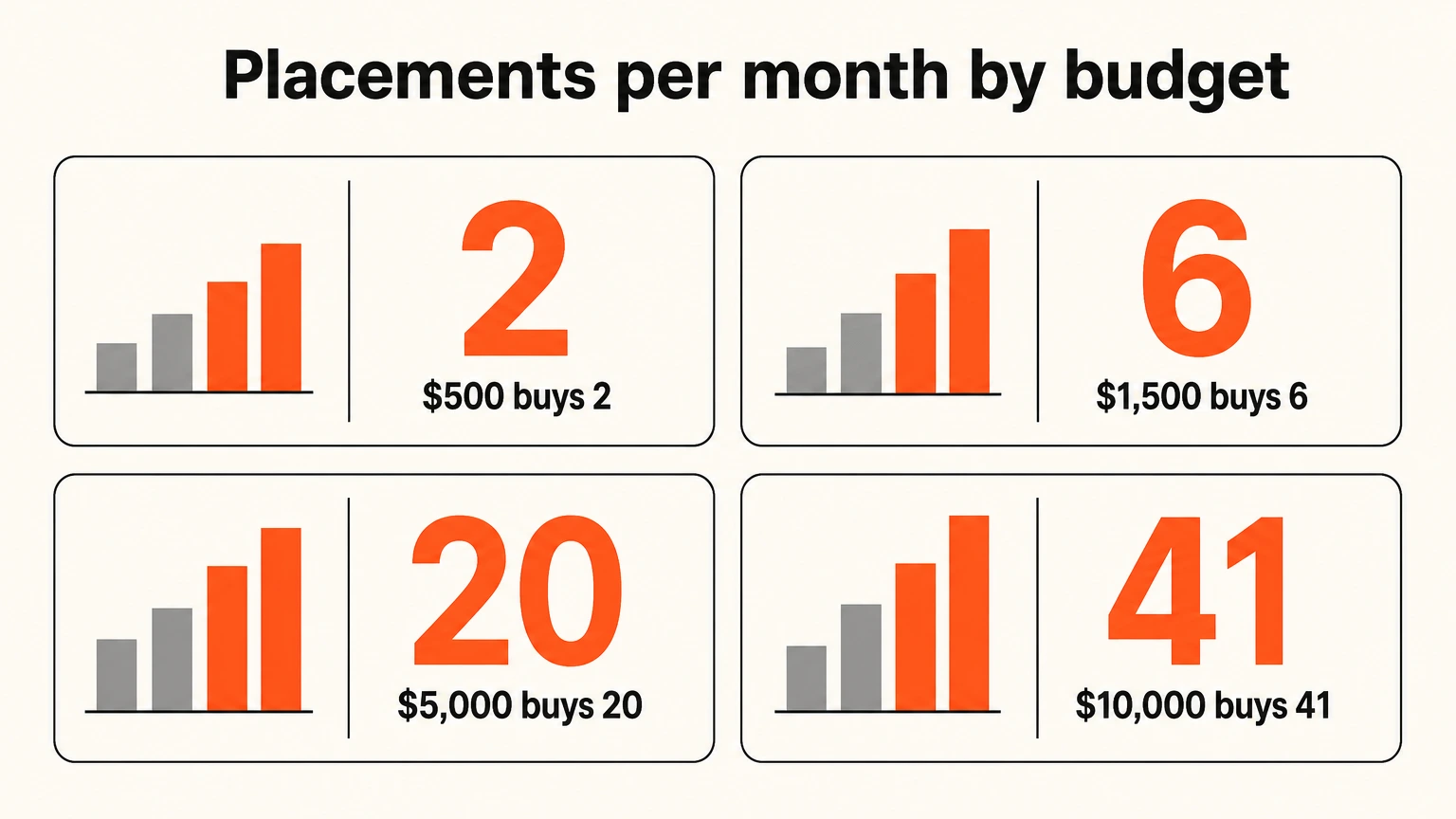
| $500 | 2 links | 3 to 4 links | One service page, built slowly. Viable for a single high-value term. |
| $1,500 | 6 links | 11 links | A serious campaign with room to test two or three page types. |
| $5,000 | 20 links | 37 links | A competitive commercial vertical, or an agency covering several clients. |
| $10,000 | 41 links | 75 links | Enterprise pace, usually mixed with digital PR rather than spent purely on placements. |
Two things worth saying about that table, both of which argue against spending more.
More links is rarely the right answer. Four well-chosen placements a month on publications your buyers read will outperform twenty cheap ones almost every time, and the twenty leave you with a profile to explain later.
Consistency beats size. A site adding four links a month for six months compounds and looks natural. A site adding twenty-four in one month and nothing after looks like exactly what it is.
When not to buy links at all
- Your pages are not indexed. Links to a page Google cannot see do nothing. Check coverage first; this is free and takes an afternoon.
- Nothing on the site is worth citing. Outreach on a page nobody would reference fails regardless of who sends the email, and a bought placement on a thin page is a bought placement on a thin page.
- You have not claimed the free links. Integration partner directories, unlinked brand mentions and review platform profiles cost nothing and most SaaS companies have claimed none of them.
- Your budget is under $300 a month. That buys two placements. Two placements will not move a competitive term. Spend it on the page instead and come back.
- Your average contract value is under $6,000 and you have not tested whether organic converts at all. Prove the channel with content before adding a paid input.
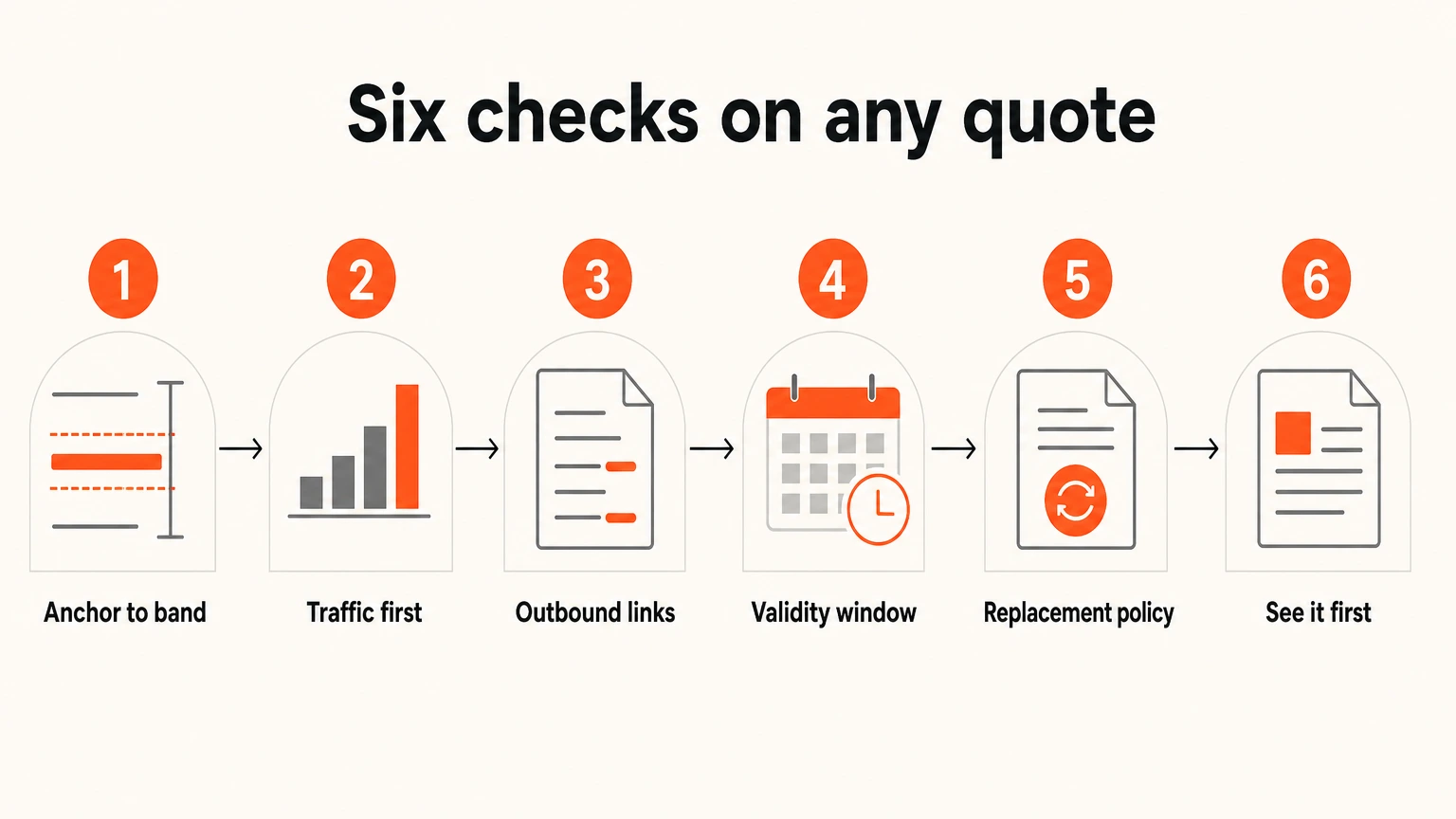
Six checks on any quote
- Anchor to the band, not the quote. Find the DR band and traffic band, compare against the medians above. Past the 75th percentile needs a reason you can say out loud.
- Check traffic before authority. A DR 60 site with 200 monthly visitors is priced on a vanity metric, and the market data above agrees.
- Read the outbound links on a recent post. If it already points at a dozen unrelated commercial sites, you are buying a slot in a scheme.
- Confirm the validity window. Permanent versus one year is not the same product, and rented placements run a median $162 against $133 permanent. You pay 22% more for the link that expires.
- Ask what happens if it disappears. Monitoring, a replacement policy and a named window are the answers you want.
- Refuse to buy anything you cannot see. If the domain stays hidden until payment clears, the price is irrelevant.
If you would rather compare providers than placements, the link building services comparison covers ten of them with pricing, and the tools we use covers the software side.
Frequently asked questions
How much does link building cost?
Why do published link building prices vary so much?
How much should a SaaS company budget for link building?
Is it worth paying for backlinks?
How much does a backlink cost by Domain Rating?
Do link building costs differ by industry?
How many backlinks does a SaaS company need per month?
What is the cheapest way to build links for a SaaS product?
Are cheap backlinks worth it?
How much does link building cost per month for an agency retainer?

Mohammad Qaiser
Working in SEO since 2010, founder of Authority Magnet since 2018, and campaign lead on every case study the agency publishes. Also built PRWiz, where this work gets tested on our own software before it reaches a client.
Work with us