Applications open, taking on a few SaaS clients for Q3 2026. Engagements from $5,000/mo. See how it works

Portfolio owner grows to 1.2M monthly visitors with one team

Twenty niche sites, five separate suppliers, and a coordination cost that grew faster than the portfolio did. Consolidating every function into one team is what made the next ten sites possible.

By Mohammad Qaiser, Founder & Campaign Lead · Last updated 3 August 2026 · Figures as reported by the client

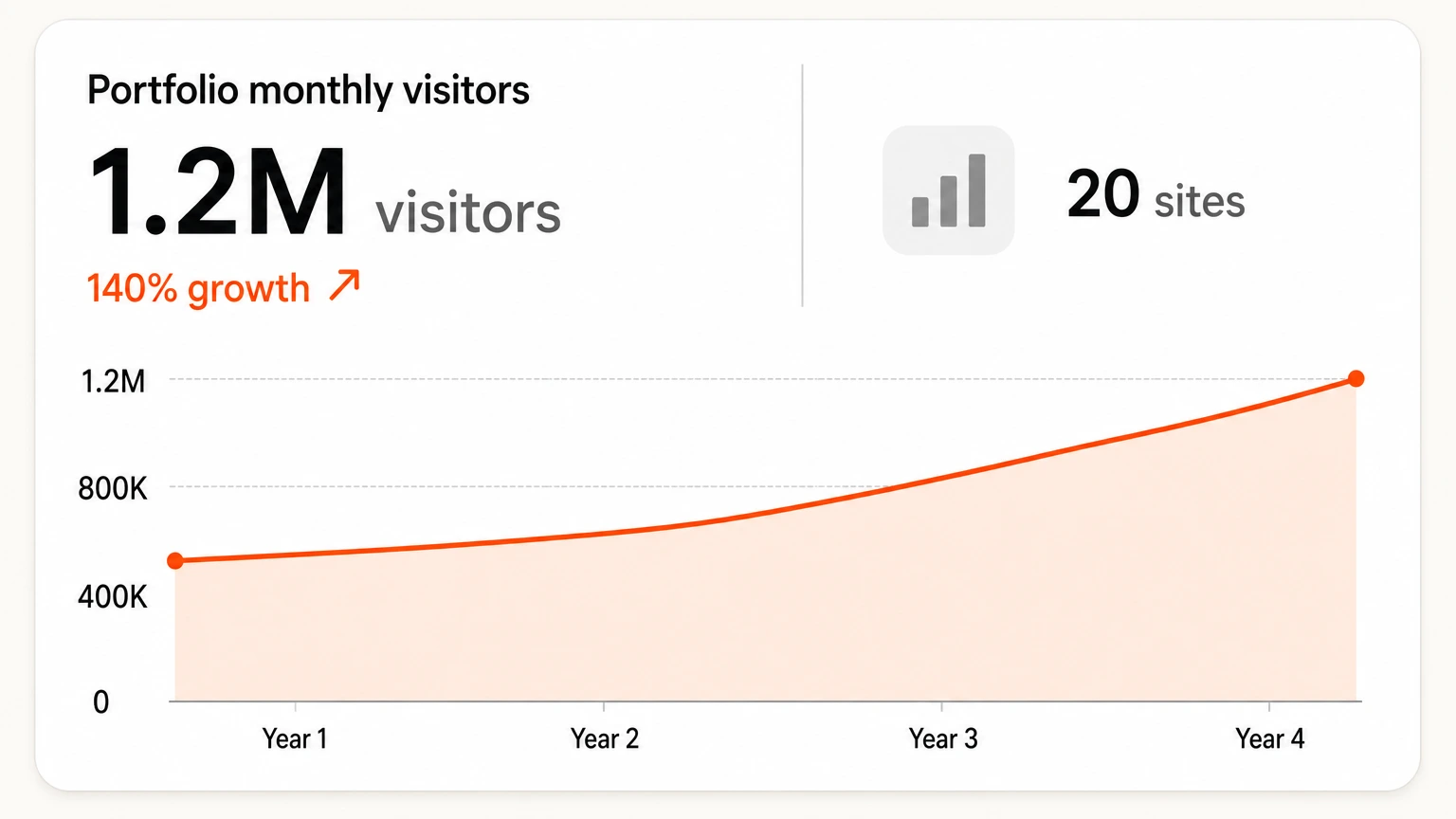
A chart illustrating portfolio monthly visitors rising from 500,000 to 1.2 million across 20 sites
Illustration, not a screenshot. No client analytics capture exists for this engagement. This chart is drawn from the reported figures below, 500K to 1.2M monthly visitors across 20 sites with 140% revenue growth, and is here to show the shape of the change rather than to stand as evidence of it. The two campaigns with real dashboards publish those captures instead.
The short answer

What happened, in one paragraph

Forrest Webber ran a portfolio of content sites on a bench of freelancers with different schedules and different quality bars. We absorbed five workstreams into one team. The portfolio went from a handful of sites to 20, from 500K to 1.2M monthly visitors, and revenue grew 140% to a peak of $40K a month. Five or more separate vendors were replaced.

20 sites run by one team5 workstreams absorbedNamed client, quoted in full below

The challenge: twenty sites, five vendors, no shared standard

Forrest Webber owns Wander Media LLC, a portfolio of niche content sites. Unlike the other two campaigns on this site he is named, because he is a public reviewer who has spoken about the work himself.

The portfolio's problem was not strategy. It was that every function ran through a different supplier: writers on one arrangement, link builders on another, WordPress maintenance on a third, plus separate people for technical work and reporting. Each vendor had its own turnaround, its own definition of finished, and no view of what the others were doing.

At a handful of sites that is survivable. Scaling it is where it fails, because the coordination cost grows faster than the portfolio does. Adding a site meant adding a slice of work to five separate queues and then chasing all five.

This is a production-systems problem rather than an SEO problem, and it is the same one a software company hits running programmatic pages across hundreds of integrations. The constraint is never ideas. It is a repeatable process that does not degrade at volume, which is what our process is built around.
The goal: one team, one standard, more sites

The brief was to make growth an operational question rather than a coordination one. Concretely: consolidate the vendors, hold a single quality bar across every site, and make adding a site cheap enough that the portfolio could keep expanding.

Traffic and revenue were the outcome measures. The working measure was simpler: how much of Forrest's week went to managing suppliers instead of to buying and building sites.

Before and after

What changed

The operational picture, side by side.

The portfolio before and after consolidating five vendors into one team
 BeforeAfter
Sites in the portfolioA handful20
Monthly visitors500K1.2M
Monthly revenue$10K$40K at peak
Revenue growthNot recorded140%
Suppliers to manage5 or more1
Quality standardPer vendorOne, across every site
Adding a siteWork queued with five suppliersOne brief, one team

The five workstreams we absorbed

1. Content strategy, per site

Each site got its own plan rather than a shared calendar. Twenty niches means twenty different competitive positions, and treating them as one content operation is how portfolios end up with twenty mediocre blogs.

2. Link building

Consolidated onto one process with one standard for what counts as a placement worth having, run through the same service stack as our agency campaigns.

3. Technical audits

A recurring audit pass across every site on a rotation, so problems were found on a schedule rather than when traffic dropped.

4. WordPress management

Updates, plugin hygiene, backups and the unglamorous maintenance that a portfolio of twenty sites generates continuously and that nobody wants to own.

5. Reporting

One report covering the whole portfolio instead of five partial views that had to be reconciled by hand. Much of this is now handled by the tooling described in our SEO automations work.

Why consolidation was the lever

None of these five workstreams is difficult on its own. The difficulty was that they were five separate relationships, and every new site multiplied the coordination rather than adding to it. Removing the seams is what let the portfolio grow.

Where it got to

Monthly visitors went from 500K to 1.2M. The portfolio went from a handful of sites to 20. Revenue grew 140%, peaking at $40K a month against $10K at the start.

The $40K figure is the one worth checking rather than taking from us, and you can: Forrest told the story himself on Niche Pursuits, whose headline states the same number. How Forrest Webber Grew to $40k Per Month After Replacing Rental Properties With Websites, published February 2023. It is his account on a site that is not ours.

The number that is harder to put in a table is that adding a site stopped being a project. That is the change that made the traffic figure possible rather than the other way round.

In his words

The client, unedited

Reproduced exactly as written, from the same record that feeds every other page on this site.

Forrest Webber in dramatic side lighting against a black studio backdrop
Forrest Webber
Owner, Wander Media LLC

I am so glad we found Authority Magnet for our portfolio. No more going through countless content writers, paying an arm and a leg for link building or the frustration of finding good WordPress VAs. They do it all!

While Mohammad and his team focus on providing world-class link building services, I can focus on what I do best! Win-Win.

Verified review

All 20 client reviews, including five on camera with transcripts.

Campaign data

Every figure in one table

Source stated per row. This engagement has no client analytics export, so the figures are as reported by the client.

Portfolio campaign metrics with start value, end value and source for each
MetricAt startAfterSource
Monthly visitors500K1.2MClient reported
Sites in the portfolioA handful20Client reported
Monthly revenue$10K$40K at peakClient reported; $40K corroborated by Niche Pursuits
Revenue growthNot recorded140%Client reported
Workstreams absorbed05Campaign records
Separate vendors replacedNot recorded5+Campaign records

Unlike the two campaigns on the case studies hub, this one has no Ahrefs or Search Console capture behind it, and we would rather label that plainly than illustrate it with something that looks like a dashboard.

FAQ

Questions about this engagement

Including the one about the missing screenshots.

Ask about your portfolio
Why are there no analytics screenshots for this one?
Because we do not have them. This was a long-running operational engagement rather than a campaign with a defined before-and-after window, and no dashboard export was captured at either end. The figures are as reported by the client, who is named and has spoken about the work publicly, and the chart at the top of this page is labeled as an illustration rather than dressed up as a capture.
How is this different from hiring an agency per function?
Per-function suppliers each optimize their own piece, which is rational for them and expensive for you. The link builder does not know what the content team published last week, the WordPress person finds out about a migration afterward, and reconciling five reports is your job. One team means the seams disappear, and the seams are where the cost actually sits at portfolio scale.
Does 140% revenue growth come from traffic alone?
No, and it would be misleading to imply it. Traffic roughly doubled while revenue grew 140%, so monetization improved as well as volume, and part of that is the client's own work on ad partners and placements. Growing a portfolio from a handful of sites to twenty also changes the revenue base independently of any per-site improvement.
Is this relevant if I run one SaaS product rather than twenty sites?
It is relevant if you are running programmatic pages at scale, which is the same problem wearing different clothes: hundreds of integration, comparison or use-case pages that have to hold a quality bar without a person checking each one. If you have one product and forty pages, this engagement is the least relevant of the three case studies here.
Would you take a portfolio engagement now?
Sometimes, and not by default. The roster is capped and most of it goes to SaaS and high-ticket B2B, which is where the rest of this site is aimed. A portfolio of a size where consolidation is genuinely the lever is worth a conversation. A portfolio of three sites usually is not, and we would say so rather than take it.

Running more sites than you can supervise?

Tell us how many, and which functions are currently on separate suppliers. We will tell you whether consolidation is the lever or whether you have a different problem.

From $5,000/mo · Realistic targets, stated before you sign