Immigration firm grows organic traffic by 6,600%
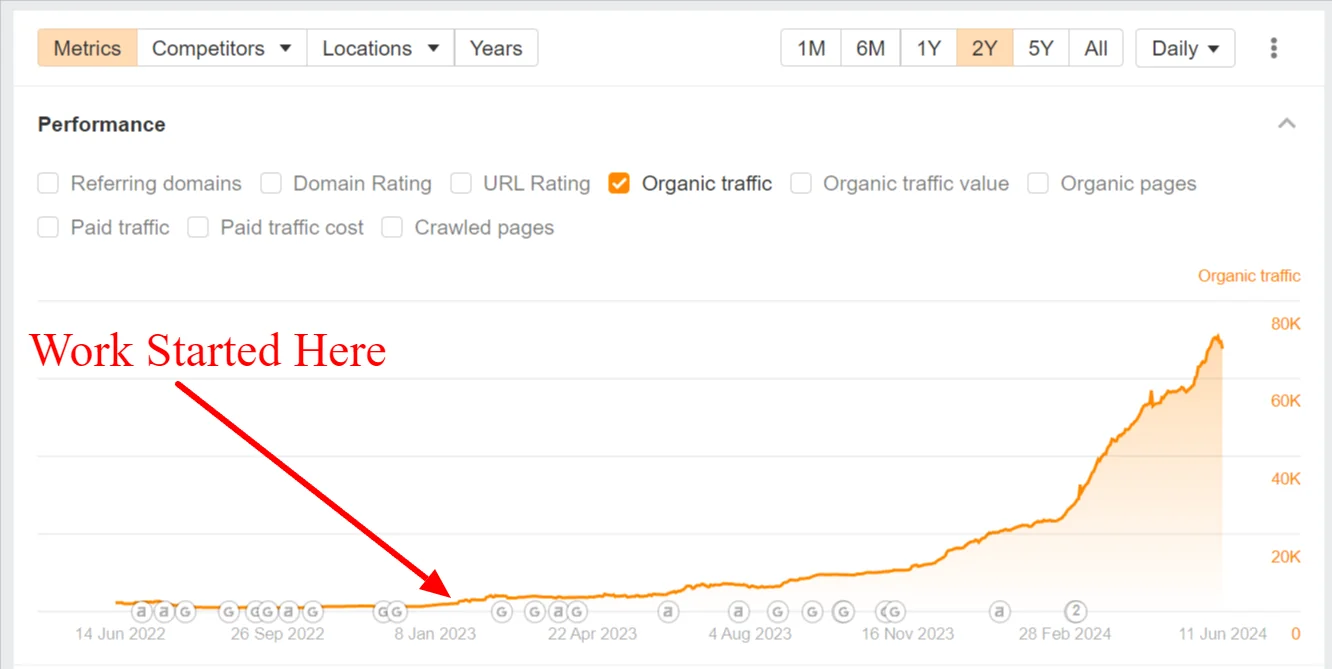
A high-ticket immigration services firm ran its entire pipeline through paid ads in one of the most expensive niches in search. Sixteen months later it held #2 on the term buyers use right before they choose a firm, on 67.7K monthly organic visits.
What happened, in one paragraph
A high-ticket immigration services firm grew organic traffic 6,600% over 16 months, from roughly 1,000 monthly visits to 67.7K. Daily organic clicks went from about 30 to over 2,000. The campaign built 294 links, took 1,114 keywords into the top three, and finished at #2 for the term buyers search immediately before choosing a firm.
The challenge: every lead came from paid ads
The client is a high-ticket immigration services firm. We are not naming them; they are under NDA and asked not to be identified. What matters for judging the work is the shape of the business, and that we can describe.
Each case is worth between $10,000 and $100,000. That economics is why immigration is one of the most expensive niches in paid search, and it is why the firm's entire acquisition pipeline ran through Google Ads. Every case had a cost attached to it before the first conversation, the cost went up every quarter as more firms bid on the same terms, and the moment the card stopped being charged the pipeline stopped.
Organic was not a channel. The site ranked for roughly 1,000 visits a month, almost none of it commercial, against legal domains that had been publishing since the early 2000s. Domain Rating sat well below the firms holding the first page.
This is the same position a Series A SaaS company is in when its whole funnel is paid: the unit economics work until they do not, and there is no owned asset underneath. The plays that fix it are the ones described in our B2B SaaS SEO work, run against a different vertical.
The goal: rank where the decision happens
The brief was not traffic. It was to own the searches that happen at the end of the decision, when someone has already decided they need help and is choosing who to hire. In immigration those are a small set of very high value terms with entrenched incumbents on them.
We set three targets before starting, so the campaign could be judged rather than narrated:
- Top three for the highest-commercial-intent terms in the category, not top ten and not featured-snippet consolation prizes.
- Enough authority to hold those positions, which in a legal-adjacent niche means earned links from real publications rather than volume.
- A traffic base large enough that paid spend becomes a choice rather than the only option.
The five-stage sequence over 16 months
The order matters more than any single tactic. Doing these in a different sequence produces a fraction of the result, because each stage only works once the one before it has landed.
Stage one, months 1 to 3: linkable assets before any outreach
We built resources worth citing before asking anyone to cite anything: process explainers, eligibility breakdowns, cost and timeline references. Outreach with nothing to point at is a favor request. Outreach pointing at a genuinely useful reference is an editorial pitch, and the reply rate difference is not marginal.
Stage two, months 3 to 7: guest placements and niche edits
With assets in place we ran placement work through immigration-adjacent and general publications, then niche edits into existing pages that already ranked for related terms. This is the phase that moved Domain Rating, and it is the same process we run as our link building service.
Stage three, months 6 to 11: displacing competitor citations
We took the pages competitors were earning links to, found where those citations came from, and built better versions of the referenced resource. Then we went back to the same publications. Roughly a third of the 294 links came from this stage.
Stage four, months 9 to 14: entity and NLP refinement
Once authority existed to support it, we rewrote the commercial pages around how the topic is actually modeled: entity coverage, the relationships between visa types and eligibility conditions, and the specific questions that sit between a search and a phone call. This is the stage that produced the top-three surge rather than more top-ten rankings.
Stage five, months 12 to 16: consolidation
Internal linking rebuilt around the pages that were now winning, cannibalization resolved, and the remaining link budget aimed at the four terms with the highest value per click.
Entity work in month two would have improved pages nobody trusted. Outreach in month one would have pitched pages with nothing worth citing. The sequence is the method, and it is the part that transfers to a software category with entrenched incumbents.
Where it finished after 16 months
Two more captures from the same account, each captioned with the tool, the exact window and the metric.
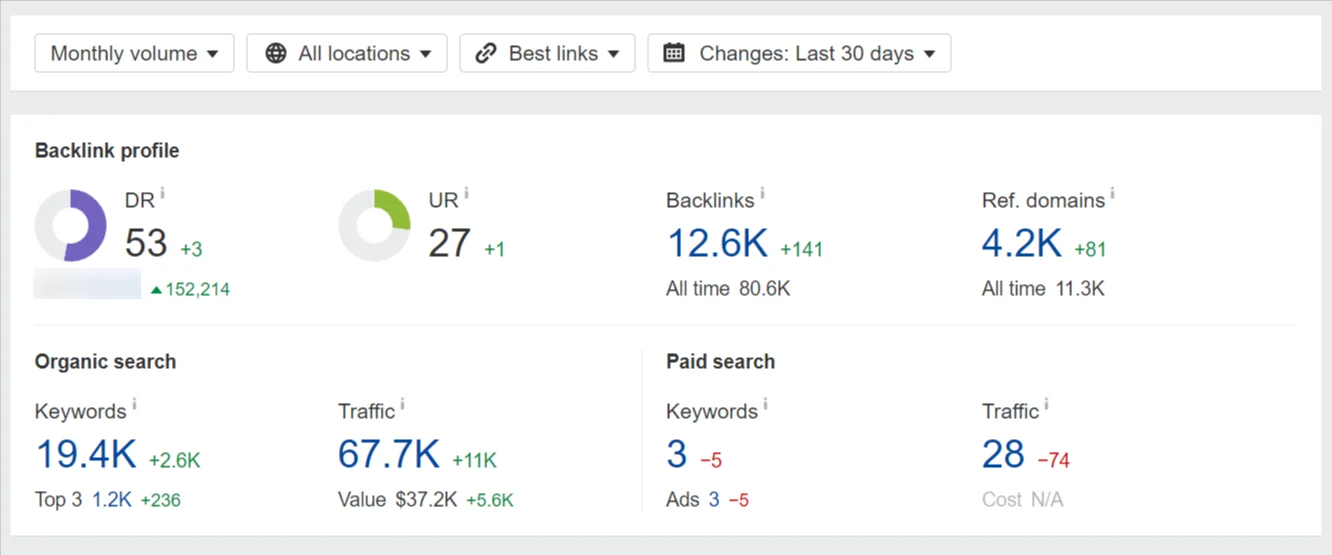
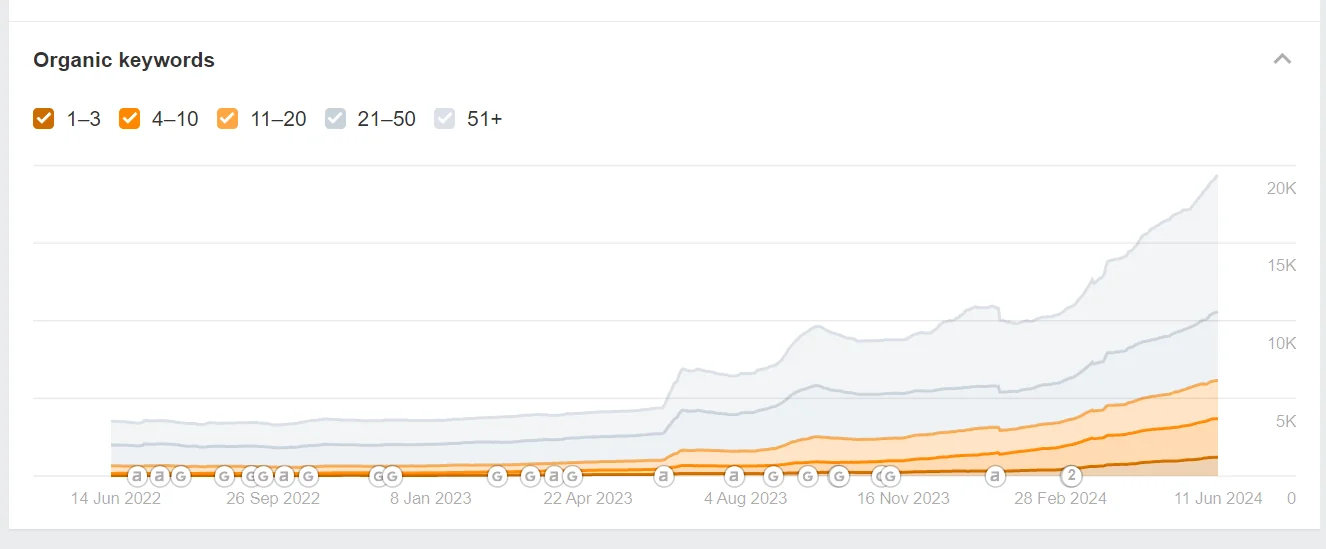
The headline number is the 6,600% traffic gain, but the number that changed the business is the top-three count. Of 2,359 keywords ranking in the top ten, 1,114 sit in positions one to three and the remaining 1,245 in positions four to ten. Position three to position one is roughly a tripling of clicks on a commercial term, so where inside the top ten a page sits is the whole game.
The single most valuable term in the category finished at #2. That is the search someone runs after they have decided they need to hire, which is why it was the target rather than the highest-volume phrase.
What the same traffic would have cost to buy
Immigration is one of the most expensive categories in paid search, which is what makes the comparison worth stating rather than hand-waving.
Ahrefs puts the estimated monthly traffic value at $37.2K. Annualized that is roughly $446K a year, and across the 16 months of the campaign roughly $595K cumulative.
The 294 links cost an average of $250 each in placement fees, which sits at the low end of the range published on our link building page. We are stating it because withholding it invites a worse guess, and because it is the number that lets you check the work rather than take it on trust.
294 links at $250 is about $73,500 across sixteen months, or roughly $4,600 a month, and our published floor for a SaaS engagement is $5,000 a month. Those two numbers do not sit inside one another. $250 is the placement cost of a link, meaning what it costs to earn and place it, not a share of an agency fee. Placement budget and retainer are separate lines, and this campaign ran before the SaaS tiers now published on this site existed, so the $5,000 floor was never the figure it was billed against. We would rather set out the arithmetic and tell you what it does not show than publish a per-link cost and let it be read as the whole engagement.
$37.2K/mo is Ahrefs' own estimate of what the site's organic traffic would cost to buy through Google Ads at current bid prices. It is a proxy for channel value, not revenue, and not a bank statement. The $446K annual and $595K cumulative figures are our own arithmetic on that estimate, 12 and 16 months of $37.2K respectively, and they inherit every limitation of the underlying estimate. They are stated because the comparison to a paid budget is the point of the campaign, not because they are audited numbers.
The part the numbers do not capture is that the paid pipeline had a floor under it that rose every quarter, and the organic pipeline does not.
Every figure in one table
Start, finish and source for each metric, so nothing here depends on reading the prose.
| Metric | At start | After 16 months | Source |
|---|---|---|---|
| Monthly organic traffic | ~1K | 67.7K | Ahrefs, estimated |
| Daily organic clicks | ~30 | 2,000+ | Ahrefs, estimated |
| Keywords in positions 1 to 3 | 10 | 1,114 | Ahrefs |
| Keywords in positions 1 to 10 | Not recorded | 2,359 | Ahrefs |
| Links earned | 0 | 294 | Campaign records |
| Average placement cost per link | Not recorded | $250 | Campaign records |
| Domain Rating | Below page-one set | 53 | Ahrefs |
| Estimated monthly traffic value | Not recorded | $37.2K | Ahrefs, equivalent paid spend |
| Position on the highest-value term | Not ranking | #2 | Ahrefs |
| Value per case | $10K to $100K | Client | |
Starting from roughly 1,000 visits a month is what makes a 6,600% gain arithmetically possible. The absolute figures sit beside the percentage for that reason. The other two campaigns on the case studies hub started from different bases and are worth comparing on the absolutes.
Questions about this campaign
The ones we get asked when we walk through it on a call.
Ask about your categoryHow long before the campaign showed anything?
Why 294 links, and were any of them bought?
Does a 6,600% gain mean the site started from nothing?
Is the $37.2K monthly traffic value actual revenue?
Does any of this transfer to a SaaS company?
Want this run against your category?
Tell us the terms and the competitors. We will tell you what we think is realistic, including when the honest answer is that the sequence would take two years.
From $5,000/mo · Realistic targets, stated before you sign