Wellness brand grows monthly organic clicks by 168%
A premium at-home waxing brand in a niche held by legacy players with ten-year content libraries. The crawl was quietly broken, the blog was written to a keyword list, and the product pages had no structured data. Six months later, 757 keywords in the top three.
What happened, in one paragraph
A premium at-home waxing brand grew monthly organic clicks 168% in six months, from 6,000 to 16,100, and took keywords in the top three from 58 to 757. It took 100+ technical fixes, 99 existing blog posts rewritten for intent, nine product pages restructured, and 54 earned links. Product pages became the category authority, which is where the revenue sat.
The challenge: a good product, invisible below the fold
The client is a premium at-home waxing brand. They are under NDA and are not named here. The product was good and the reviews were good, and neither fact was reaching anyone who had not already heard of them.
The niche was held by legacy players with content libraries eight and ten years deep. The brand had a blog with roughly a hundred posts written to a keyword list rather than to a buyer, product pages with no structured data, and a site whose crawl was quietly broken in a way nobody had looked for.
The specific problem underneath everything else: a URL structure emitting double-slash paths. Google was spending its crawl budget on duplicates of pages it had already seen. Rewriting a hundred posts on a site in that state would have produced nothing, which is why the technical work went first and the content work waited.
The same class of problem shows up on software sites in a heavier form, through JavaScript rendering and faceted routes. That is the ground our technical SEO work covers.
The goal: make the product pages the authority
Most e-commerce SEO programs aim the content at the blog and hope some of it reaches a product page. We inverted that. The blog existed to build topical coverage and internal link equity; the pages that had to rank were the ones that took money.
- Fix the crawl before writing anything. No content work until the technical base could support it.
- Rewrite what already existed rather than publish more. Ninety-nine posts were already indexed and already had history. New posts start from zero.
- Restructure the nine product pages with proper schema, real specification detail and the comparison content buyers were searching for elsewhere.
- Earn links to the category pages, not the homepage, so the authority landed where the rankings were needed.
What was actually done
100+ technical errors, first
The double-slash URL structure was the headline fix. Alongside it: duplicate title and description resolution, an internal link graph that left several product pages four clicks from the homepage, missing and malformed structured data, and a set of redirect chains inherited from a platform migration nobody had cleaned up.
99 posts rewritten for intent
Not refreshed and not expanded. Each post was reread against what someone searching that phrase actually wants, then rewritten to answer it and linked to the product page that follows from the answer. Roughly a fifth were consolidated into other posts rather than kept, because two thin pages competing for one query is worse than one good page. This is the content approach we run on software categories too.
Nine product pages restructured
Specification tables, honest comparison against the alternatives including the ones we do not sell, review markup, and answers to the questions that were sending buyers to third-party sites to resolve.
54 earned links
Aimed at category and resource pages rather than the homepage, through digital PR and placement work. Fifty-four is a small number for six months and it was deliberate: in a niche this size, relevance beat volume.
Six months in
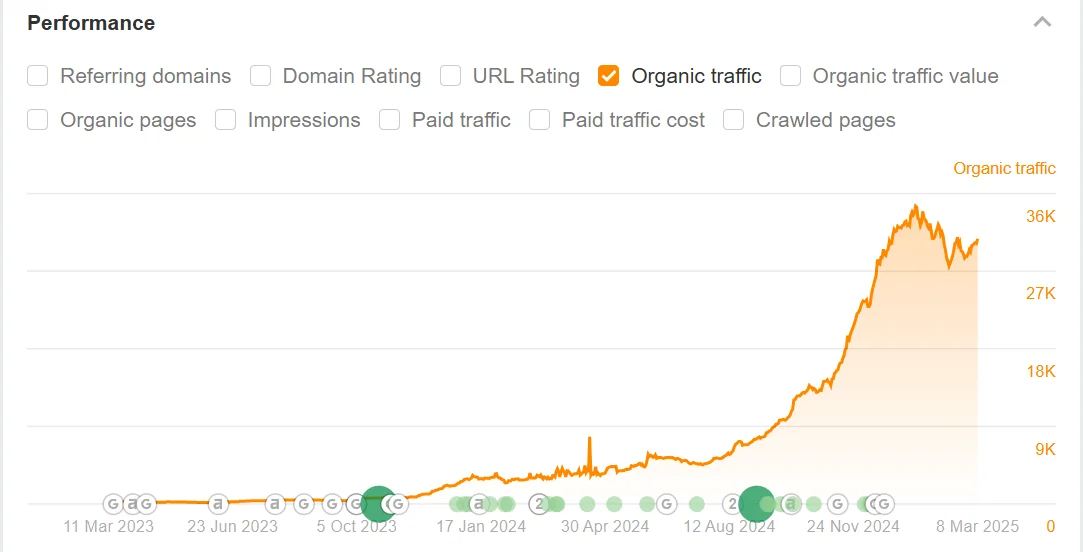
Clicks and impressions are Search Console actuals. Keyword counts and the traffic chart are Ahrefs.
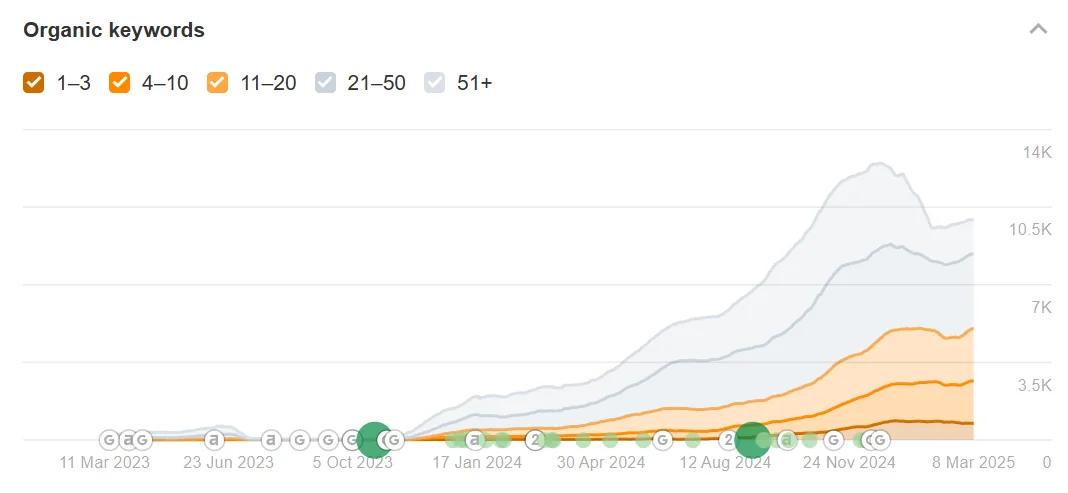
Monthly organic clicks went from 6,000 to 16,100. Impressions went from 310K to 1.18M. Keywords in the top three went from 58 to 757, and the top-twenty count went from 950 to 2,100.
The top-three figure is the one that changed revenue. Fifty-eight to 757 across six months, concentrated on product and category terms rather than blog queries, is what moved the site from a brand people found after hearing the name to one they found while deciding.
What Search Console showed afterward
This capture covers a different and later period than the six-month campaign above. It is here because it shows what happened to the position after the engagement, not because it restates the same claim.
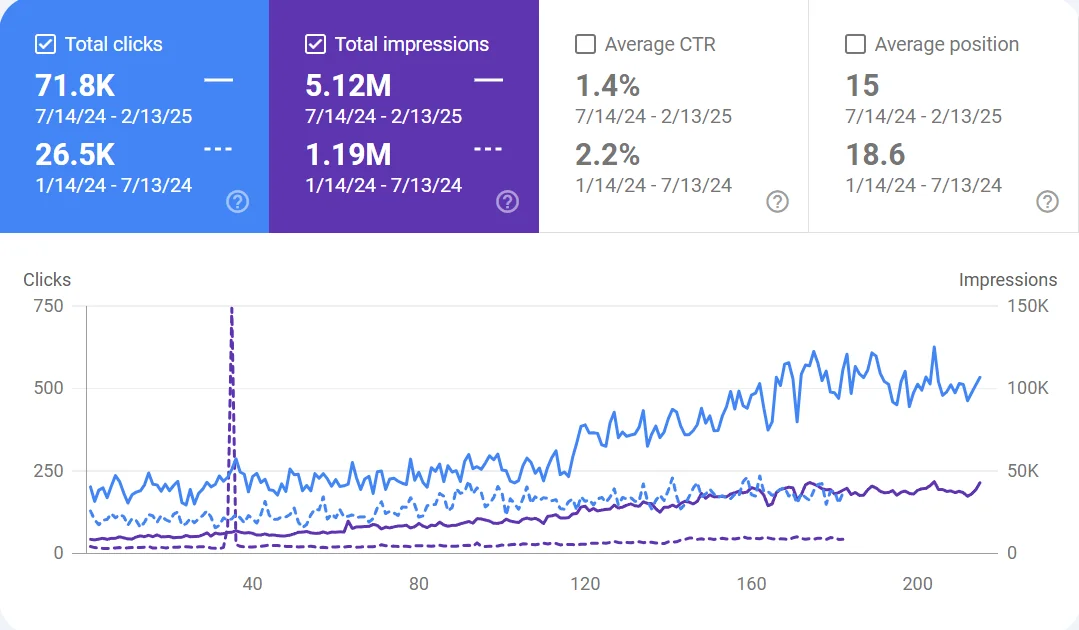
This window sits after the six-month campaign described above and shows the position being held and extended: clicks grew roughly 2.7 times, from 26.5K to 71.8K, while impressions grew roughly 4.3 times, from 1.19M to 5.12M, which is why average CTR fell from 2.2% to 1.4% over the same comparison. That is not a decline in performance. It is what happens when a site starts surfacing for a much wider set of head terms it previously did not appear for at all: the denominator grows faster than the numerator, and average position improved from 18.6 to 15 across the same period.
The two sets of numbers are consecutive phases rather than the same one. The campaign copy above ends at 1.18M monthly impressions; this capture starts at 1.19M. We are stating that relationship rather than merging the two into a single larger figure, because they measure different windows and merging them would not be supportable.
Every figure in one table
The six-month campaign only. The later Search Console window above is deliberately not folded into these rows.
| Metric | At start | After 6 months | Source |
|---|---|---|---|
| Monthly organic clicks | 6K | 16.1K | Search Console |
| Monthly impressions | 310K | 1.18M | Search Console |
| Keywords in positions 1 to 3 | 58 | 757 | Ahrefs |
| Keywords in positions 1 to 20 | 950 | 2,100 | Ahrefs |
| Links earned | 0 | 54 | Campaign records |
| Blog posts rewritten | Not recorded | 99 | Campaign records |
| Product pages restructured | Not recorded | 9 | Campaign records |
| Technical errors fixed | Not recorded | 100+ | Campaign records |
Six thousand monthly clicks is a real starting base rather than a standing start, which makes 168% a harder gain than the same percentage from near zero. The immigration campaign on the case studies hub started far lower and is worth comparing on absolutes rather than percentages.
Questions about this campaign
Including the one about the CTR line in the screenshot.
Ask about your categoryWhy did click-through rate fall from 2.2% to 1.4%?
Why rewrite 99 posts instead of publishing new ones?
What was the double-slash URL problem?
Why do the Ahrefs charts show higher numbers than the copy?
Does an e-commerce campaign tell me anything about SaaS?
Want the technical base checked first?
Most sites we look at have something like the double-slash problem sitting under them. Tell us the domain and we will say what we find, including when the answer is that it is already fine.
From $5,000/mo · Realistic targets, stated before you sign